Posts

Showing posts with the label Cover 1

Football Fundamentals: The Tite Front Defense
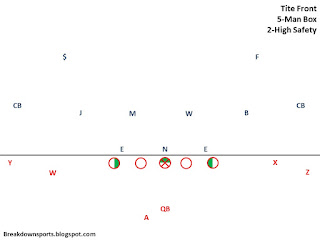
Image
The defense du jour against modern spread attacks is what is commonly known as the “Tite” front. Over the past couple years, you’ve seen Big 12 teams run it increasingly often, and SEC and other teams start to incorporate variants of the look more often as well as they begin to deal with an increasing number of spread formations. But what exactly is the “Tite” front? Like any front, say, a 4-3 Under, it isn’t necessarily any one thing. You can have single-high, two-high, or even three-high safeties. You can attach your overhangs differently. And with Tite, it may even mean different box numbers. And of course, there are multiple techniques that can be employed along the way. This post is a primer to the Tite front. At the end, I’ll link some of the better articles that get into greater depth for those interested, but for now, we need to understand the basics, so that we can understand how to attack it.

Film Review: 2017 OSU vs Indiana - Fade, Back Shoulder, and a Coverage Adjustment

Image
AP Photo/ Darron Cummings For nearly a half of play, the Indiana Hoosiers looked poised to make the Buckeyes sweat out a potential early season massive upset. It wouldn't be the first time a team came out with a great gameplan earlier in the year and caught an opponent looking ahead to the supposed bigger challenge. With the Ohio State on defense, the Buckeyes wanted to come out in a lot of single-high defensive looks, predominately Cover 1 , put bodies near the LOS, and out athlete Indiana. In the battle of the DL vs OL, OSU dominated. But on the outside, despite relatively good position from defensive backs, Indiana executed nearly perfectly. One could argue that the execution was bound to wane, but repeatedly throwing one of two throws - a fade or a back shoulder fade to the boundary - allowed IU QB Richard Lagow to find an easily repeatable rhythm, particularly with big bodied and sure-handed WR Simmie Cobbs. In this article (and the next) we will look at the basic gam...

Inside the Playbook: More depth into Don Brown's Defense

Image
Going a bit more in depth with Don Brown's scheme

Let's Speak Technique: OSU's Chris Ash on Press Coverage

Image
Upon hiring Chris Ash away from Iowa State, OSU switched from primarily a Cover 6 look to a press Cover 4 base. The change was part of a plan to put more pressure on the offense, from the front 7 to the back 4. And there is no bigger push in college football than the implementation of press coverage. All coaches have their tweaks to the technique based on leverage, offensive formation, play call, and player abilities. After the jump, Chris Ash goes into detail from his ISU days about Man Press technique.

Film Review: Northwestern and Switch 86, Drag and Follow, and Bunch Concepts

Image
Even with an offense that has sputtered lately in Northwestern, there are still some really cool intricacies and chess matches that can be found from game-to-game. In my opinion, most casual fans get caught up with “is it working or not?” Obviously, in the end, that’s ultimately what’s important. But the issue that I believe catches fans is when they try to figure out “Why?” Often, they converge to mostly meaningless catch-phrases such as “predictable”, “not innovative”, “stupid” and the like. The idea being that they see, they actually see with their own two eyes, a team execute a certain thing with ease and they assume “it must be the play design.” That’s because you can see the play design, you can see it develop in front of you and you can kind of understand it and when it works, obviously it works. Compounding matters may be video games, where many casual fans can call their own plays and feel some sort of ability to do what this guy getting paid a bunch of money can do. But ...

Football Fundamentals: Cover 1 Defense Adjustments

Image
Like all coverages, coaches have developed adjustments and checks to mitigate some of the weaknesses of a coverage, or to hinder some of the methods offenses use to attack the defense without switching up the coverage entirely. This is done for teams with certain strengths, against certain formations that look to exploit some aspect of coverage, or to take advantage of offensive tendencies in certain situations. These adjustments can be called in the huddle based or they can be checked based on the offensive look or motion pre-snap. In this piece, we’ll go over some of the things Cover 1 defenses do to adjust to offenses. As a primer, here's your standard Cover 1

Football Fundamentals: Cover 1 Defense

Image
The Cover 1 defense: probably the first defense you learned, whether you knew you learned it or not, whether it was in youth football or in your backyard. Man vs man. Mono y mono. You vs me. Let’s see who can out athlete who. And of course, then there’s the one person playing center field, looking to pick off any pass with a little too much air or smash anyone who dares come over the middle without fear. Yup, good ol’ fashioned Cover 1. It’s as simple as that, right? Well, actually, yeah, pretty much. Relative to other coverages employed in modern football, Cover 1 is about as intuitive and instinctive as it gets. But, that’s relative to other defenses. That doesn't mean that there isn't technique that is required to be successful to run this defense, there is always more to a coverage than that. The Basics [Green = Man-to-Man Match-up, Yellow = Deep zone, Purple = Short zone, Red = Defensive movement, Blue = Offensive movement] Strengths Weaknesses ...

Inside the Playbook: Nebraska's Single High Defense vs Run Heavy Offenses

Image
Originally Posted at Maize n Brew on July 26, 2013 Background In the summer of 2013, Nebraska was coming off of one of their worst seasons in terms of run defense. Their DTs struggled mightily, their DEs weren't enough to counter the problems on the interior. This post discusses some of the basic Pelini defenses, and the adjustments he made when he realized his team struggled to stop the run. While Nebraska's run defense improved over the course of '13, these are still tactics that Pelini will go to in times of need. For what it's worth, an added bit of information is that Pelini prefers to 2-gap his two DTs on the interior. By the time much of the film seen below was taken, it had appeared the Nebraska defensive staff had stopped asking the Nebraska DTs to 2-gap, and instead focus on maintaining a single gap. This simplification of the defense makes it easier for the DTs to do their job, but tends to make the defense as a whole a bit less effective. Introductio...

Inside the Playbook: Defending the Speed Option in Cover 1 (Preview)

Image
Leaving the offense for a minute, perhaps the most aggravating thing from the Nebraska game was Michigan's inability to defend the speed option. Unfortunately, this has seemed to be a common trend for the Mattison defenses since his arrival back in Ann Arbor. But why? Is Michigan doing something inherently too difficult to accomplish? What are they really asking their defense to do? In this post, we will look at how Michigan has tried to defend the speed option in the past, what went wrong against Nebraska, and how Michigan will look to fix this issue this year. How the Speed Option is Run Be it under center or from the shotgun, the speed option is essentially the same. The offensive line, in the case of most modern day offenses, will run their standard outside zone blocking scheme. The one difference is that the offense will bypass the defense's EMOL toward the play and instead work to the 2nd level. The defender left free with be the option defender, the player that the QB ...

Film Review - Cleaning up Coverage

For the most part Michigan played pretty solid in coverage against MSU, but also had some significant busts that lead to big gains for the Spartans. There have been some questions about a few of the ways that Michigan has worked in coverage, and I'll briefly discuss how Michigan plays man coverage to help clear that up as well. At the end of the day, what you see from this exercise though, is that you can be very good most of the day, but if just a few mistakes get exploited, the opposing team can put up points. Man Coverage People have been wondering about if Michigan is doing this right. Namely, the common complaint is not turning back and looking for the ball. In man coverage, once you flip your hips, you have two basic techniques you will play: in-phase (in-sync, in-step, in-line, even) and trail. In-phase means that you have your hip on the front side of their hip and your shoulder on the front side of their shoulder, and you're using your body to gradually defl...