Posts

Showing posts with the label screen action

Inside the Playbook: Bluff and Go RPO

Image
Introduction At the college (and high school) level, RPOs continue to grow more and more challenging to defend. With relaxed rules against linemen downfield, defenses have been forced to maintain coverage longer and longer following the mesh point. No play demonstrates this more than the “Bluff and Go” RPO.

Inside the Playbook: OSU's Tunnel Screen and Slip Screen Action

Image
I wanted to quickly go over a play design I really liked but didn’t work out due to poor execution in the Ohio State spring game. One thing I think that happens quite often in football is fans complaining about play calling. If the play call works, it was a great play call; if it doesn’t work, it was a bad play call. There is some truth to that in retrospect, but it’s rarely because of the play design or the conceptual idea behind the play. What I want to look at today is the tunnel screen and then the slip screen off the tunnel screen action. Hit them with: And once they cheat:

Football Fundamentals: Flare Control

Image
A great addition to any playbook is a concept known as flare control. Flare control is a RB route intended for the primary purpose of hold and/or manipulating the underneath coverage. It can act as a block on a LB, it can force defensive flow, and it can prevent the underneath coverage from sinking into downfield developing routes. Likewise, “bubble control” can be used in much the same way. Indiana, along with many other teams, use flare control and bubble control as a part of their screen action and double screenpackage . Flare Control The most common application of flare control is to hold underneath coverage to prevent them from sinking underneath deeper routes. It helps prevent that defender from bringing pressure, it forces them to respect the underneath threat, and it doesn't allow them to gain depth. On this play , the RB is no more than third or fourth in the QB’s progression, depending on the QB’s read of the safeties. He is not intended to be a primary receive...

Inside the Playbook: Indiana's Screen Package

Image
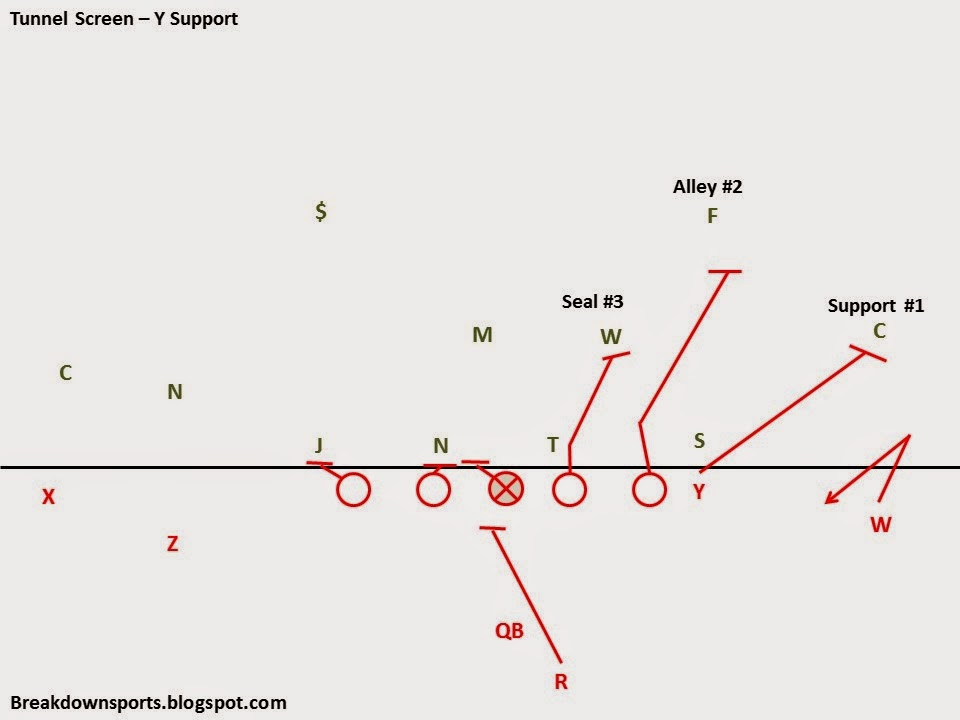
Indiana heavily utilizes the screen game to act like a rushing attack. In fact, a lot of their success comes off of screen misdirection and screen action, both things that are commonly associated with the run game. By doing this, they create conditions exactly what the spread offenses was designed for: to stretch offenses laterally as well as vertically. For defenses, this means a couple things, they must be extremely disciplined with their eyes and they must tackle in space. Brief Screen Primer A brief background on screen blocking first. The lineman that release depend on who isn’t covered and which defenders present a risk to the ball in the air or the receiver. This means any defender that will try to get in an alley between the passer and receiver must be cut down or washed away. Preferably on any outside screen you’ll have at least one blocker sealing off the inside to outside pursuit, another acting as a lead blocker in the alley, and another acting as a support blocker, whic...