Posts

Showing posts with the label Counter Trey

Football Fundamentals - RPO Run Concepts
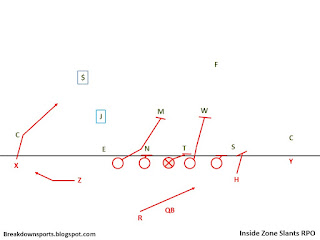
Image
If you've been following along, we've offered up a lot of pass concepts that can be paired with a run play to make an "RPO". We looked at passes behind the LOS , quick passes , and even downfield reads . We've also looked at pass first RPOs, known here as PRO . And if you've been really paying attention, you'll have noticed that those RPOs were attached to pretty much every kind of run scheme. Here we are going to summarize those run schemes and discuss briefly the types of routes to look for given the type of run.

Film Review: Nebraska Schemed By Northwestern's Cover 4; Then Schemed Them Back

Image
Northwestern threw a lot of cover 4 at Nebraska in an effort to get bodies down into the run game. One thing that Cover 4 allows is for the LBs to flow a bit more freely and quickly to the initial look, because the safety takes care of backside cutbacks . What we saw in the Nebraska vs Northwestern game was Northwestern initially having success bottling up Nebraska because of this. The safety crashing down from depth allows him to defend either the QB keep or the RB cutting back across the grain. Later on, however, we saw Nebraska adjust some of their play calls to take advantage of this scheme. In this post, we’ll look at just that.

Inside the Playbook - MSU Jet Sweep Package

Image
Originally posted at The Only Colors on 12/6/13 The jet sweep has become increasingly popular over the past decade or so, really coming into form when Houston Nutt first introduced his wildcat formation at Arkansas. It's important to distinguish this from an end around and a reverse. Reverses, End Arounds, and Jet Sweeps are 3 different plays designed to take advantage of different things from a defense. Reverse initially attacks 1 side before reversing fields and takes advantage of horizontal over-pursuit. End-Around has middle action attached & takes advantage of vertical over pursuit (by getting depth and around squeezing EMOL). A jet sweep has no misdirection in and of itself (though it will often be paired with a run call and used in its own right as misdirection) and is simply a sweep with jet motion attached. It is designed to get to the edge before the defense and is often utilized by teams with receivers that have more speed than their power backs. So Michigan S...

Inside the Playbook - Michigan's Rushing Attack, 2014

Image
Daniel Mears / Detroit News Under Doug Nussmeier, Michigan has switched to a predominately zone scheme. There are two typical types of zone runs: Inside Zone and Outside Zone. But that’s not all Michigan runs. They also utilize several gap and man blocking schemes to counter the standard zone schemes. Furthermore, they utilize several pin and pull adjustments to their zone stretch scheme to attack the edge. One thing I'd like you to do when looking at the diagrams is to split them in half through the center. Notice the playside and the backside throughout this post. What that will show you is what the defenders to that side of the field are seeing, and why it is difficult to defend all these concepts. The diagrams below are all from an I-formation with a FB. But it's important to note that these plays can all be run from a pistol set or a shotgun set, with a FB, or H-back, or even at times simply a TE, making them diverse throughout multiple formations.

Inside the Playbook: Ohio State's Two-Back Offense (PREVIEW)

Image
LINK to full article. In 2013, Ohio State had one of the best run offenses in the nation. Part of their success came from two-back sets, or more accurately, by motioning a slot receiver - their Percy Harvin role - into the backfield. Losing, in my opinion, the best college RB in football last year, but returning the dynamic Braxton Miller and all their Harvinites, two back sets will likely become more prominent in this year's offensive iteration. In this piece, we will look at why these sets are so difficult for defenses to defend, both from a pre-snap standpoint, and after the snap. Pre-snap Dilemma The Buckeyes base set will present four vertical threats. Often times, this will be with 11 personnel, with two split ends, a slot, an H-back, and a RB. At times Meyer will deploy more of a true TE look, and involve a flanker and slot or show a trips type set. Motioning 11 personnel or 10 personnel to 21 or 20 personnel presents a very different look for defenses. Let me explai...

Inside the Playbook: MSU's Jet Sweep Package

Image
Preview Michigan State faces a very athletic defense on Saturday, when they meet Ohio State in Indianapolis for the Big Ten Title. For the past couple weeks, the Spartans have added several deviations of their base play calls, seemingly to set up and prepare them for the show down against the Buckeyes. In this post we are going to look at MSU's jet sweep package. *     *     *     *     *     *     * Jet Sweep Fake - Counter Trey So now you've forced the defense to flow both outside and upfield to protect against the jet sweep and the inside zone. Particularly when the inside zone looks to be going in the same direction as the jet sweep motion, it really pulls the defense in that direction and upfield. This really allows a defense to fairly easily get outside leverage and seal them inside as they get caught in the wash. This almost works similar to a reverse, in that you are heavily selling one direction and then ge...

Inside the Playbook: OSU's Inverted Veer Package

Image
Ohio State does some interesting things within their offense that make it difficult for defenses to key them correctly. For one, they effectively mix up zone blocking and man blocking schemes, especially power blocking as of lately. In this post we are going to look at 4+ different plays which all utilize and inverted veer look, and explain why it is so difficult to stop them on offense. *     *     *     *     *     *     * Counter Inverted Veer As I described the inverted veer as power blocking from an option look, let's first look at how "counter trey" is blocked. "Trey" is a bit of a misnomer, as there often isn't a trey block, but it is the most common type of double team that comes from this blocking scheme and thus it is called trey. To note: Trey is a combo block from the playside PSE (playside TE) and the PST (playside OT) to the MIKE or backside LB. Deuce is a combo block from the PST and the PSG (pla...