Posts

Showing posts with the label offense

History and Evolution: Power O - Part III - The Modern Era of Power Diversity

Image
Previously Part I  - The Power Series Origins Part II  - Off Tackle Power Earns the Name Power Retaining the Power Series While "Power" began to be defined as the Off-Tackle Power O variant in the 1980s, most offenses, including the split back dominated West Coast Offenses, retained much of the Power Series plays within their playbook, albeit under different names. This made use of multiple backs to alter the backfield flow, changing the kick blocker, lead blockers, or sending someone elsewhere altogether. The Way Forward for Power Sweep 18/19 BOB (Big-on-Big, Back-on-Backer) is the classic Power Sweep 1982 San Francisco 49ers Playbook

History and Evolution: Power O - Part II - Off Tackle Power Earns the Name "Power"

Image
  Previously Part I  - The Power Series Origins Off-Tackle Power O becomes “Power” While the I-Formation had a scattering of purveyors dating as far back as the turn of the century, it wasn’t really until the early 1960s when a man known as Don Coryell would begin to popularize it within the Air Coryell offense. While at the upper levels of football it remained mostly unknown, by the late 1960s and into the 70s, coaches such as John Madden and Hank Stram started incorporating it within their offenses. By this time, most teams had now gone to 21 personnel, though split backs and near/far formations still held dominance. But, for instance, in the 1968 Chiefs Playbook, we immediately see what we know of today as traditional Power O (though, it should be noted, Power Sweep remained a vital part of the offense). 1968 Chiefs Playbook

Inside the Playbook: Wisconsin Play Action Power O Wheel

Image
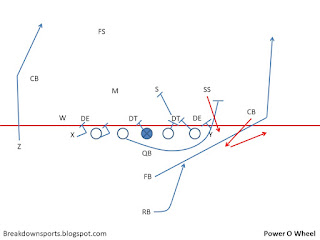
Against Iowa, Wisconsin was finally able to get things going offensively when they returned to an old friend in the offense: the wheel route off of Power O. I knew I had seen it previously, and mistakenly noted it was a few years ago in a bowl game, but actually it was against Indiana last year. The basics of the play are a hard Power O play action out of a heavy formation. Rather than kicking out, the FB plants and runs upfield on the wheel route. What ensues is beautiful, beautiful FBs rumbling in wide open spaces. Let's take a look.

Football Fundamentals - RPO Run Concepts

Image
If you've been following along, we've offered up a lot of pass concepts that can be paired with a run play to make an "RPO". We looked at passes behind the LOS , quick passes , and even downfield reads . We've also looked at pass first RPOs, known here as PRO . And if you've been really paying attention, you'll have noticed that those RPOs were attached to pretty much every kind of run scheme. Here we are going to summarize those run schemes and discuss briefly the types of routes to look for given the type of run.

Written in Chalk: Attacking the Tite Formation - Pre-snap

Image
Now that I’ve touched on how the Tite formation works , I want to take a look from the other side of the ball and how it can be attacked. While the focus of this post is primarily on the run game (because the backend coverage can be largely modified), it is important to keep in mind the common pass responsibilities, as we will draw from that conflict. Before getting into specific plays, I first want to look holistically at the formation and how to put an offense in position to exploit it. Then we can get a bit deeper into some actual play calling.

Football Fundamentals - RPO Pass Concepts - 3rd Level Read

Image
We've now touched on the basics of a "read offense", route concepts behind the LOS, and then the quick routes that are often attached to the RPO schemes. Now let's take it a little bit deeper and look at third level RPOs. We already looked at a few of these that are attached to quick pass concepts like the pop pass. In this post, we will look at a handful of concepts that attack third level reads.

Football Fundamentals: RPO Pass Concepts - Quick Hitters

Image
Now that we've covered the "read" offense and concepts that occur behind the LOS , let's now turn our focus down field a bit. This is where the RPO scheme is currently most dangerous, both at the lower levels, as well as at the college and NFL level. This is the quick passing concepts that are tied to the run threat. Let's take a look.

Football Fundamentals: RPO Pass Concepts Behind the LOS

Image
I previously set the foundation for "read" offenses . In this post, I want to build on that foundation to give a feel for the pass concepts that can be tagged onto various run schemes. There are a few different ways to break up this post to make it manageable, and the way I decided was to first look at the pass options that result in throws behind the LOS. In this case, illegal man down field doesn't come into play at the college level, so getting more than 3 yards down field isn't a concern.

Inside the Playbook: Ohio State's Book and Run Scheme and Arrow/Slide RPO

Image
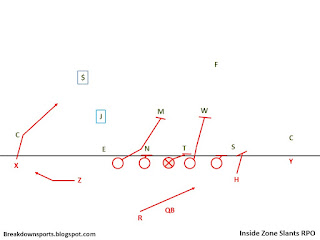
Everybody knows the basic zone read scheme. Block inside zone  (or one of many types of zone ) while leaving the backside DE unblocked for the QB to read. If the DE crashes the mesh point, the QB pulls and runs off the backside. If the DE stays home, the QB gives to the RB who runs basic inside zone. But as defenses get more athletic and more nuanced in their defense of zone read, making this "read" becomes more challenging for the QB. You now have games like scrape exchange, where the DE crashes and the LB fills behind. You have more athletic edge players that can force a give but get back into the play from the backside. One option is to change the read defender , another option is to utilize additional backs to modify the blocking scheme . In this post, I'll talk about an option that utilizes a little of both which dates back to Meyer's time at Florida, in the Book and Rifle schemes.

Inside the Playbook: Wisconsin Swap Boot Part II

Image
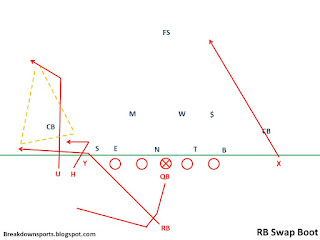
Previously, we touched on Wisconsin’s use of the Swap Boot in their 2-TE personnel package. In this post, we are going to look at the same concept, but instead of utilizing a TE in the flat, the RB is going to be incorporated into the pass concept. What we’ll see is a way of utilizing receiver’s in different spots on the field while keeping the reads and timing consistent for the QB.

Inside the Playbook: Wisconsin's use of Dos, Tight Bunch, and Wings in Formation

Image
As we cover Wisconsin over the next few pieces, we are predominately going to focus on three formations: Dos (Tight Double Wing), Tight Bunch, and I-Form. Wisconsin finds ways to use FBs and H-Backs within the offense, to lead block, to run rubs, or to even to cross flow. In this post we will first cover the high level benefits of these formations for Wisconsin. In the next posts, we will go into depth into specific plays, predominately run out of these formations.

Film Review: The OSU Drag and Go Concept

Image
Ohio State has been feasting through in the pass game with one of the core tenets of the Air Raid offense: drag routes. Go into any Air Raid passing playbook from Kevin Wilson (or Mike Leach), or looking back at Chip Kelly's Oregon offenses (the current OSU QB coach is Kelly's former QB coach) and you'll notice that probably 50% of the pass plays contain some sort of drag route. Go to your basic pass game concepts  and you'll see that these playbooks are littered with Over, Cab, Crash, Crease, Mesh , and NCAA concepts . Air Raid coaches love these concepts, and so they rep these concepts constantly, because in man coverage their better athletes can run away from LBs or safeties or get beneficial rubs to allow them to run away from CBs. Against zone you can find a void and settle there and wait for the QB to throw you open. In theory, it works against everything. Yet, it still has it's detractors, because if you don't practice it enough, if you don't put in t...

Inside the Playbook: Michigan State Pin and Pull

Image
Coming off of one of the least productive years for the MSU OL in some time, the Spartans have largely retooled the unit and are planning to press quite a bit of youth into the starting lineup. Their current starting line up and key rotational players  look like this : Position LT LG C RG RT LT2 OG2 C2 OT3 Player C. Chewins T. Higby B. Allen D. Beedle L. Campbell D. Finley K. Jarvis M. Allen J. Reid Year RS-SO RS-SO SR RS-JR RS-FR RS-SR FR RS-FR FR Height 6-8 6-5 6-2 6-5 6-5 6-7 6-4 6-3 6-4 Weight 284 293 302 329 293 307 312 301 271 I would argue some of these weights are likely getting a "college roster" bump as well. This is not the beefiest of beef units to set foot in Spartan Stadium. Not that long ago though, Michigan State featured one of the most diverse run blocking playbooks in the league, right up there with Harbaugh's Michigan teams. They ran Power, Counter, Sweeps, Traps, Inside Zone, Outside Zone, and yes, Pin and Pull. But as the skill diminis...

Inside the Playbook: The Pin and Fold Inside Zone Scheme

Image
In an MGoBlog piece "Fee Fi Foe Film: Illinois Offense" , Ace pointed out an interesting wrinkle that Illinois utilizes on the backside of their inside zone, which I call "Pin and Fold". I had seen this wrinkle previous in an article from Ian Boyd at least partially about current Iowa St. coach Matt Campbell, and I've also written briefly about it on my own . Now that it has appeared again, this time in the Big Ten, I have the opportunity to write a little more about it.

Inside the Playbook: Iowa's Lead Stretch Zone

Image
Iowa football has been utilizing the base stretch run scheme that made the likes of the Washington Redskins and Denver Broncos dominant in the 90s and into the new century. I’ve discussed outside zone quite a bit before , as have many other places ; rather than continue along the same lines, I’m now going to make a distinction and a further distinction with regards to Iowa football. There is Outside Zone – also known as wide zone – where the intent is to out flank the defense and get to the edge; this is most commonly seen from spread teams. Then there is zone stretch, where the ball can bounce to the outside, but more often than not will be cut inside the EMOL, this is the classic Joe Gibbs and Shanahan offense. Both can be called stretch or wide or outside zone, it’s more of a philosophical difference (though in Gibb's case, he had a play called "bounce" and a play called "Outside", that were just that very distinction). Iowa also adds in the lead bl...

Inside the Playbook: Minnesota's Use of TEs to Attack the Hole

Image
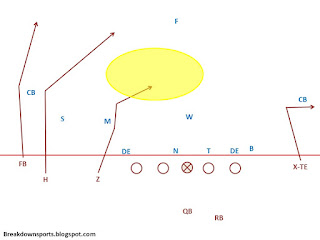
I’ve talked previously about the advantage of having good H-backs in an offensive system. Minnesota, coming off the Maxx Williams era, has continued to use TEs/H-Backs/FBs in a variety of ways to present match up issues through the use of formations/keys. Against Michigan – a team that primarily plays Cover 1 with a very deep center-field safety – they used the position of the H-Back to attack what is known as the “hole” of the defense. The hole – typically associated with Cover 2 teams – is the void in the defense in front of the safety level (typically directly between the two-high safeties) and behind the LB level. Let’s take a look at how Minnesota attacked this void through the air, and how it was set up with their formations.

Football Fundamentals: Pin and Pull Scheme

Image
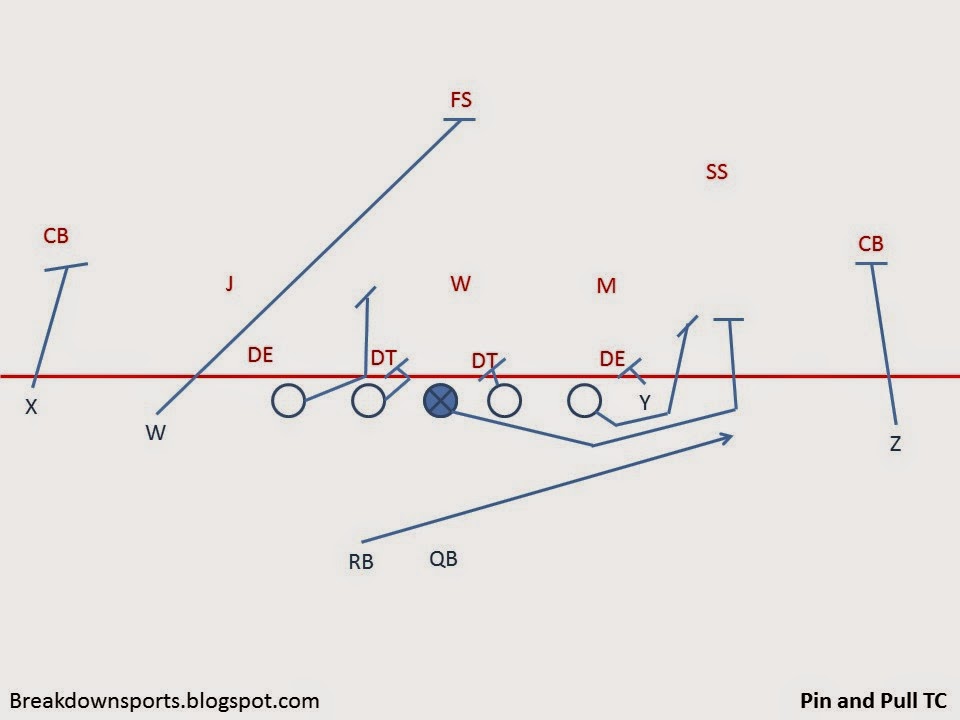
The zone stretch scheme (outside zone or wide zone) has long been a favorite was for zone-based offenses to get to the outside, or at least stress the defense horizontally. Teams like Iowa have long used it as their base run play from a single back, pro-style set (often 12 personnel), while teams like Northwestern have often used it to threated defenses from a spread formation. Many other squads, including Maryland, Indiana, Penn State, OSU, Michigan, and MSU have recently had this play in their dossier. But when it is known to be the base of your rushing attack, it has fairly obvious keys that allow defenses to attack it and shut it down, either through formation or through how they attack post-snap, so at times it helps to have variants of the same play. That is where the pin and pull concept comes into play. The pin and pull concept is essentially a gap/man tag for the OL to switch to in order to attack with what is essentially the stretch scheme. Let’s take a look.

Football Fundamentals: Route Tree

Image
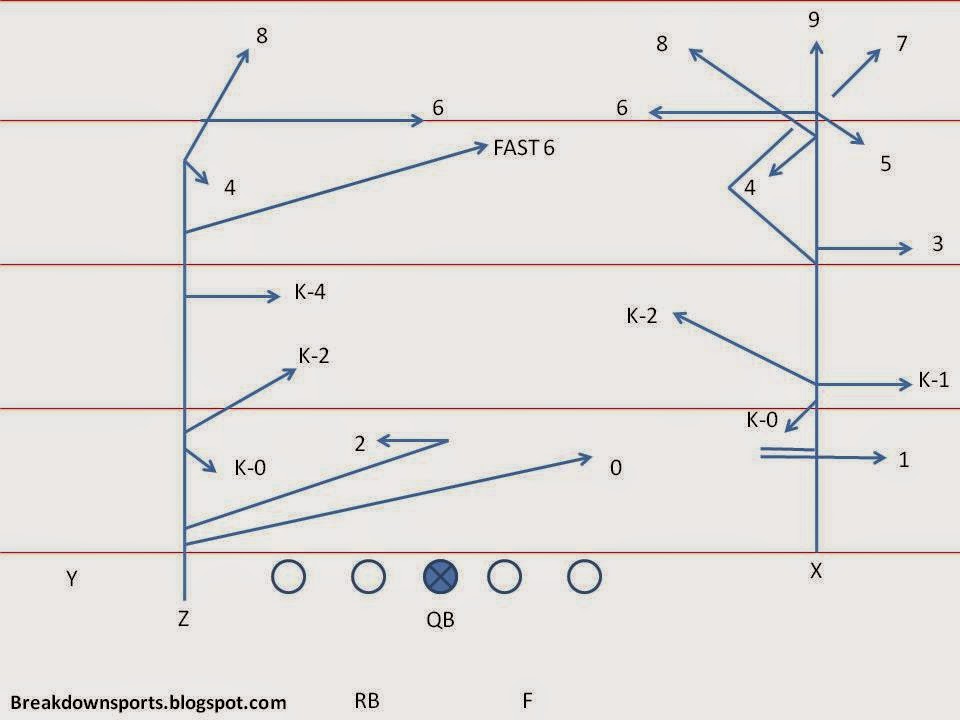
This post is intended to look at the fundamental route trees for WRs, TEs, and RBs. These show and give a brief description for receivers in most every system. WR Route Tree

Football Fundamentals: The Advantages and Disadvantages of Implementing Tempo into Your Offense

Image
All coaches will admit that differentiating and controlling tempo are benefits of any modern offense. But then why are not all offenses running it in this day and age? In the modern B1G, you see some teams that utlize it heavily, others marginally, and others not at all. Why such a difference if it's known as an advantage for any offense using it. In this piece, we will discuss just that. Chris Howell - Herald-Times  [Indiana is known as being one of the fastest teams  in college football and have had a very successful offense in recent years. Some would say their struggles on defense are an effect of practicing with up-tempo offense, though]