Posts

Showing posts with the label Inside the Playbook

Inside the Playbook - Michigan's Counter Game - Part 3: Execution and Technique
Image
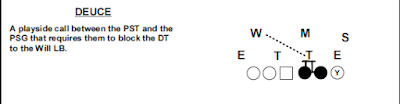
 We've now had an opportunity to look at the general scheme and various run tags Michigan deploys , as well as how they can modify things post-snap . But as any football coach will tell you, all the scheme in the world can't make up for poor execution. Michigan, in their run game, was a well oiled machine. It was clear on film that they were well coached and I want to take a look at some of that now.

Inside the Playbook - Michigan's Counter Game - Part 2 - Post Snap Modifiers

Image
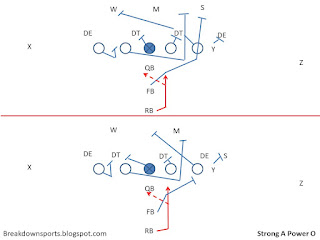
In Part 1 of this series, we looked at the basics of the Michigan Counter package, including the five basic schemes (Counter OH, Counter OF, Counter OT, Counter HF, and Counter O). We also looked at run game tags that can be applied pre-snap to modify blocking assignments, and when to incorporate them. In this part, we are going to look at Post-Snap Modifiers (i.e. reads), and how Counter serves as protection of other schemes, and how Michigan protected Counter within their scheme.

Inside the Playbook - A-Gap Power

Image
 In this post, we're going to look at A-Gap Power. A-Gap Power itself is not new. As I detailed in "History and Evolution: Power O" , what we know today as standard power was really the B/C gap constraint to the more traditionally Power Sweep. But by the late 70s and early 80s, you started to see variants of A-Gap Power schemes appear as teams wanted to protect their off tackle runs by showing a puller, but hitting inside. Teams like NDSU and Wyoming made a lot of hay off a specific type of A-gap Power, and as they've had success and their former coaches and disciples and knowledge have branched out all across football, you see this specific type of A-Gap Power arise elsewhere. This post is going to go over a few of the basics of A-Gap Power.

Inside the Playbook - Unbalanced Counter CH/OH

Image
 A quick look at Michigan running Unbalanced Counter CH/OH to the weakside of the formation.

Inside the Playbook - Michigan's Counter HF

Image
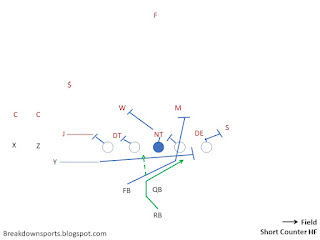
Despite heavily featuring gap run schemes throughout the year, Michigan's plan when facing the vaunted Wisconsin run defense included almost the total elimination of pulling offensive line. In an effort to maintain part of their core playbook, they leaned on a 3-back style offense and "Pull Replace" (replacing a traditional offensive line pull with a back executing the assignment) to retain part of their Counter playbook. In this post, we are going to look at how the Wolverines executed Counter HF from an unbalanced look, how the Badgers responded, and how this scheme can be sequenced off of and run against a variety of formations.

Inside the Playbook - Michigan State Insert Zone Play Action, Sail Concept from 2x2

Image
 An interesting twist on a fairly simple sail concept from Michigan State. Let's take a look.

Inside the Playbook - Michigan State 3x1 Counter OT vs 2-High Coverage

Image
Against Northwestern's primarily two-high defense, Michigan State found a wrinkle that was effective for their run scheme out of a 3x1 formations (three receivers to one side of the formation, one receiver to the other side). Primarily a zone team, MSU attacked the Wildcats with a mix of Zone Windback and Counter OT . Let's take a quick look at their use of Counter.

Inside the Playbook - Minnesota Mug Green Cover 2

Image
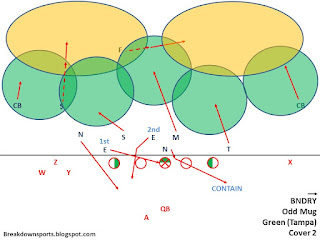
 Against Ohio State, the Golden Gophers got two critical 3rd down stops going to their Cover 2 from their 3-Down, mugged up look. Let's take a look at how it works.

Inside the Playbook - Throw Back Play Designs

Image
Previously, we looked at why throw back plays work. Next, we looked at OSU taking advantage of the throw back in their play against Minnesota This post will look at different version of the throw back that can be added to your playbook. Elsewhere - Leak Everyone has talked about leak, but at least on my blog, I've never explicitly wrote about it. So let's say this is the chance. Here is a diagram of leak: 2016 Falcons Playbook There are lots of iterations of Leak now, but I want to point out a few things that I like better than others.

Inside the Playbook - Ohio State Sequencing with Throwback

Image
I talked previously about how teams sequence the throw back into their run and boot gam e. By threatening run, boot, and throwback, you maintain a threat over the full field. In the Buckeye's opening game against Minnesota in 2021, they actually started attacking Minnesota with the throwback plays before even really delving into the boot action. Seeing how Minnesota reacted to the stretch action and boot action, Ohio State felt that they could win their matchups with their WRs in a space. Let's take a look at how OSU attacked three of the four levels in their throw back game. RB Rail, TE Delay An inversion of the standard "Leak" concept . What I like about this is that the initial alert is the RB running the rail. I've often talked about how the most forgotten person on the field is the player that just received the fake handoff. Defenses naturally eliminate that player as an eligible receiver, and as such, he often becomes the most dangerous person on the field.

Inside the Playbook: Sequencing to the Throw Back

Image
 In offensive football, we often talk about the act of "sequencing plays". What this means is that we initially build a base play. Once a defense does something unsound to stop that base play, we "sequence" a "constraint" play designed to take advantage of that unsoundness. Once the defense responds to that "constraint", we further the iteration to take advantage of that response. In this post, we are going to look at the sequence of events that leads to running throw back plays. 2014 Falcons Playbook -  Sequencing

Inside the Playbook: Different Ways of Blocking Jet Sweep

Image
 Jet sweep is one of the core concepts teams use to attack the edge with speed. It's relatively cheap to install, serves as a great constraint for your primary run game, and serves as a great tool to diagnose defensive coverage/rotation as well as trigger down safeties to support the vertical play action pass. But not all teams run it the same, and teams that lean on it more tend to treat the blocking of it a bit different. This post is going to examine some of the ways you see jet sweep blocked. Don't Block the 3-Technique The way I was always taught Jet Sweep was as simple as: Backside to the 3-tech, block the run fake Outside the 3-tech, arc to the 2nd level (seal) or alley, depending on defensive numbers This is a great way of selling the run fake to the backside of the sweep, while gaining back blocking numbers by not blocking the 3-Tech, who will struggle to quickly redirect (either vertically or horizontally) to be able to make a play on the ball carrier. Having it be th...

Inside the Playbook: Why Run to the Short Side of the Field

Image
 It’s a question regularly asked, “ Why is my favorite team constantly running to the short side of the field ?” People really do not enjoy jet sweep to the short side . In almost every sport you are taught the concept of using the sideline as an extra defender, and in football it is no different. And in the current era of football, the idea of space is emphasized as much as it has ever been: you have extra wide WR splits, you have light personnel groupings, stretch the field not just horizontally but laterally. So then why does it always feel like the runs aren’t utilizing that space? Space is a fundamental source of success in modern football, but it is not only the offense that controls space and how it can be used; defense also plays a role. Space is also only a single fundamental facet, others include leverage and numbers. And when you take all those traits into account, that will explain why runs into the boundary are run as often as they are. Let’s take a ...

Inside the Playbook: Michigan's Down G Run Play

Image
Against Notre Dame, when attempting to attack the edge, Michigan attempted to utilize their traditional pin and pull run scheme . In this scheme, they are traditionally trying to "reach" with the TE to set the edge and pull around and up from there. But against Western Michigan, they adjusted their attack by running a "Down" scheme, rather than attempting to reach at the point of attack. This can be a different play call altogether, or it can be a scouted aspect of the offense and a line call. Either way, let's take a look at how it works.

Inside the Playbook: Banjo Coverage and Minnesota's Switch Double Slants

Image
Against Indiana in the Red Zone, Minnesota went to a switch release concept  which paired a basic twins passing concept  to take advantage of bracket coverage. I've long advocated utilizing switch releases from bunch/stacked formations because it often helps the QB better define the coverage and take advantage of defensive coverage tendencies. In this case, Minnesota knew they were going to get a banjo coverage  (effectively, the outside defender will take the first defender to release outside or the second receiver to go inside, and the inside defender will take the first receiver inside or the second outside). Let's take a closer look.

Inside the Playbook: Wisconsin Play Action Power O Wheel

Image
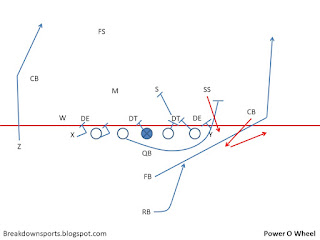
Against Iowa, Wisconsin was finally able to get things going offensively when they returned to an old friend in the offense: the wheel route off of Power O. I knew I had seen it previously, and mistakenly noted it was a few years ago in a bowl game, but actually it was against Indiana last year. The basics of the play are a hard Power O play action out of a heavy formation. Rather than kicking out, the FB plants and runs upfield on the wheel route. What ensues is beautiful, beautiful FBs rumbling in wide open spaces. Let's take a look.

Inside the Playbook: Penn State, Wisconsin, and Michigan and the Use of False Blocks

Image
As a defender, you are tasked with reading your keys in order to properly diagnose the play and fulfill your assignment. Gap responsibility and run fits and execution all start with properly seeing what is happening in front of you, and based on what the offensive line does, will change your path to success. But offenses know this. To a degree, and offense does what it does because that's the easiest and most efficient way of finding success. Other times, they find success with mind games, by showing something and doing another. This post is going to look at "False Blocks", the art of pass setting on runs and false pulls.

Film Review: Michigan Iterating to Gain an Advantage in the Pass Game

Image
The best concepts in football tend to build off of other known tendencies. In both the run game and the pass game (and the play action pass game), it is easiest to scheme success when telling the defense one thing, initially, and then turning it into something different. In this post, we're going to look at how Michigan has built off of established tendencies to force the defense to respect multiple things. Kirthmon F Dozier, Detroit Free Press

Inside the Playbook: Michigan's Arc Belly Read

Image
Against Wisconsin, Michigan expanded their QB run package by introducing a Belly Read Option with an arc block from the opposite H-back. In this post, we'll go over some of the advantages of this play and some of the intricacies that make it a successful run within Michigan's overall run scheme. Harbaugh starting to break out the read runs from his 49ers days with Colin Kaepernick. Big run by Shea Patterson was "12/13 EAT". It's zone read arc from 12/21 personnel twins. Closed formation dictates predictable coverage. F arcs for the CB. pic.twitter.com/dt1Hwp74CN — James Light (@JamesALight) October 14, 2018

Inside the Playbook: Nebraska's Insert Iso - Bubble Slant RPO

Image
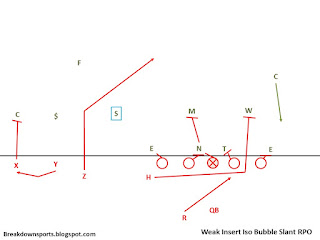
Nebraska struggled to get much traction on either side of the ball against Michigan the past weekend, but it's not necessarily due to a lack of interesting scheme. On their first drive, they ran this interesting little wrinkle. While I liked it more before I dissected it further, it still is a nice scheme that could have likely resulted in a TD had it not been tipped by a DL. So let's take a closer look.