Posts

Showing posts with the label man scheme

Football Fundamentals: I-Formation RB Gap and Pull Run Plays

Image
This is a series post with lots of play diagrams. Where it lacks depth, it hopefully makes up for with breadth. The goal of this post is to demonstrate the many run game nuances that are at your disposal, outside the very basics that you can find almost anywhere. I will point out some key attributes for the plays, but for the most part the diagrams will stand alone outside a brief description. This post is limited (out of necessity) to strongside plays that are given directly to the RB. It does not include FB runs, or QB runs, or H-Back, Wing, TE, or WR runs. It also doesn't include option plays. Those are things for future posts. Why did I select an I-formation, which is mostly going out of fashion, and how do I expect this information to be utilized? The I-Formation is a classic 2-back set that, by the time it was implemented, had the benefit of a lot of football history. It is also a highly adaptable run formation, along for offsets, for H-backs, and other aspects that allow es...
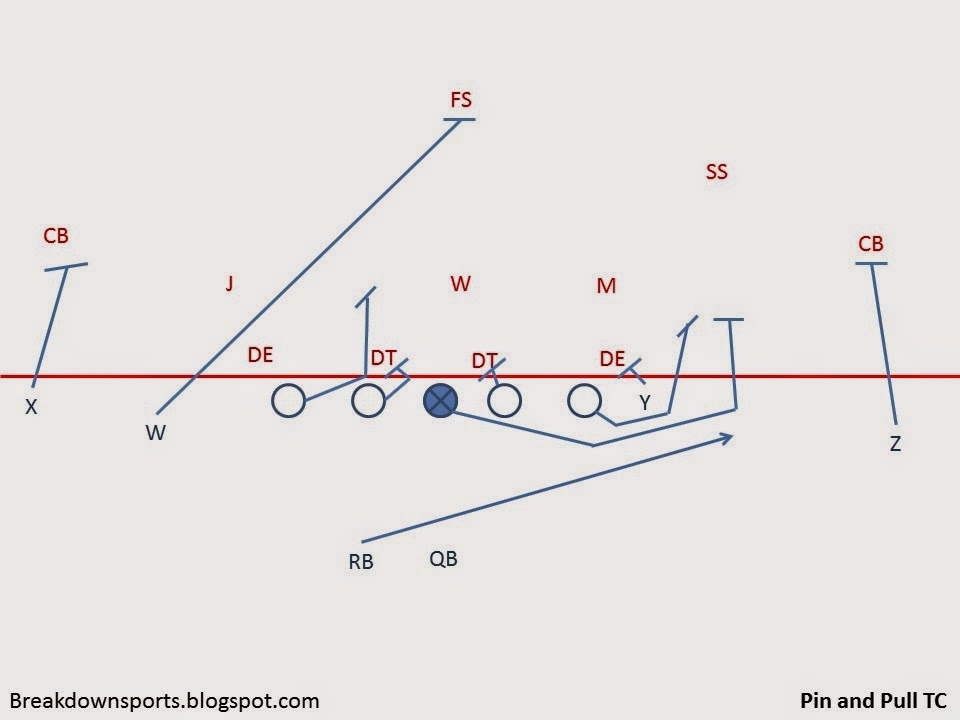
Football Fundamentals: Pin and Pull Scheme

Image
The zone stretch scheme (outside zone or wide zone) has long been a favorite was for zone-based offenses to get to the outside, or at least stress the defense horizontally. Teams like Iowa have long used it as their base run play from a single back, pro-style set (often 12 personnel), while teams like Northwestern have often used it to threated defenses from a spread formation. Many other squads, including Maryland, Indiana, Penn State, OSU, Michigan, and MSU have recently had this play in their dossier. But when it is known to be the base of your rushing attack, it has fairly obvious keys that allow defenses to attack it and shut it down, either through formation or through how they attack post-snap, so at times it helps to have variants of the same play. That is where the pin and pull concept comes into play. The pin and pull concept is essentially a gap/man tag for the OL to switch to in order to attack with what is essentially the stretch scheme. Let’s take a look.

Inside the Playbook: Michigan's Use of Multiple FBs and Additional Gaps

Image
Previously, I talked about gap discipline , and focused a portion of the article on pulling OL and inserting a FB into the mix. These things present a difficulty for the defense, as they need to adjust on the fly to ever-shifting gap responsibilities. Pulling OL add gaps to the point of attack and FBs can be inserted to add gaps at any location along the LOS; and the defense must adjust post-snap to these new gaps. Jim Harbaugh loves to use this to his advantage. Adding gaps to the POA forces the defense to think and hesitate, and when they do that, his Power-based offense can start churning out yards. Furthermore, with more and more teams going to spread formations and a zone based rushing attack (though this is starting to revert again to tighter formations and man/gap schemes again, as all things are cyclical in football), defenders are less comfortable with how to execute soundly (as Spielman has said multiple times the last few weeks). The downside of doing this is that it gives...

Inside the Playbook: Pass Protection Schemes

Image
One of the big issues Michigan has been having is in pass protection. If I went into all the complexities and calls of all the different pass protections, you would quickly realize why young players have trouble with this part of the game (to go along with the vast complexities of the run game). There is a reason that offensive linemen are often considered the smartest guys on the field. Well, we're going to go over the basics just to try to get you up to speed a little bit. For briefing sake, there are three different types of blocking schemes: man, gap (zone), and combination. Man Blocking BOB. Big on Big; Back on Backer. This is a man blocking scheme that is optimal for many teams because of its ability to get a hat on a hat, an offensive lineman on a defensive lineman, and a back on a preferred LB (if a back is in to block). First let's look at a world where 5 person blocks exist. Whoever is the uncovered lineman is will be the "double read" blocker. The OL al...