Posts

Showing posts with the label Iso run

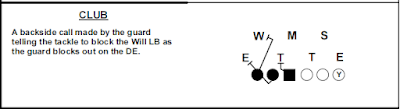
Let's Speak Technique - Club Block
Image
Along the offensive line, it is important to have various techniques and calls that can optimize player strengths, match ups, and angles, and give the opponent different looks. A "Club Block" is a backside combination block in which the backside end man on the LOS (EMOL) will work immediately to the second level, and the blocker inside of him will work out to the end. Club Block 2014 49ers Playbook In our case, we'll use it as an exchange block between the Back Side Guard (BSG) and Back Side Tackle (BST) as well as between a Back Side TE (BSTE) and BST, with the caveat that it is always the EMOL that is releasing directly to the 2nd level.
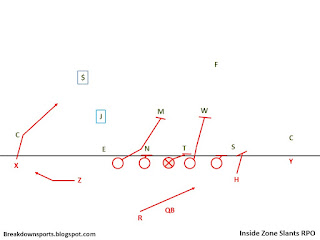
Football Fundamentals - RPO Run Concepts

Image
If you've been following along, we've offered up a lot of pass concepts that can be paired with a run play to make an "RPO". We looked at passes behind the LOS , quick passes , and even downfield reads . We've also looked at pass first RPOs, known here as PRO . And if you've been really paying attention, you'll have noticed that those RPOs were attached to pretty much every kind of run scheme. Here we are going to summarize those run schemes and discuss briefly the types of routes to look for given the type of run.

Football Fundamentals: I-Formation RB Isolation Run Plays

Image
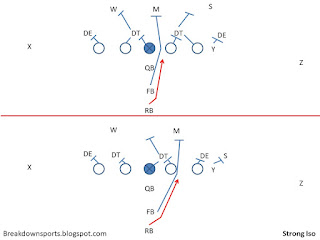
This is a series post with lots of play diagrams. Where it lacks depth, it hopefully makes up for with breadth. The goal of this post is to demonstrate the many run game nuances that are at your disposal, outside the very basics that you can find almost anywhere. I will point out some key attributes for the plays, but for the most part the diagrams will stand alone outside a brief description. This post is limited (out of necessity) to strongside plays that are given directly to the RB. It does not include FB runs, or QB runs, or H-Back, Wing, TE, or WR runs. It also doesn't include option plays. Those are things for future posts. Why did I select an I-formation, which is mostly going out of fashion, and how do I expect this information to be utilized? The I-Formation is a classic 2-back set that, by the time it was implemented, had the benefit of a lot of football history. It is also a highly adaptable run formation, along for offsets, for H-backs, and other aspects that allow es...

Film Study: Michigan Duo and Counter Iso vs D Focus on Stopping Interior Run

Image
From the recent Upon Further Review - Michigan Offense vs Florida Defense  a couple plays came up that I think could benefit from a bit more depth. In this article, we talk Duo And Counter Iso

Inside the Playbook: Michigan's Use of Multiple FBs and Additional Gaps

Image
Previously, I talked about gap discipline , and focused a portion of the article on pulling OL and inserting a FB into the mix. These things present a difficulty for the defense, as they need to adjust on the fly to ever-shifting gap responsibilities. Pulling OL add gaps to the point of attack and FBs can be inserted to add gaps at any location along the LOS; and the defense must adjust post-snap to these new gaps. Jim Harbaugh loves to use this to his advantage. Adding gaps to the POA forces the defense to think and hesitate, and when they do that, his Power-based offense can start churning out yards. Furthermore, with more and more teams going to spread formations and a zone based rushing attack (though this is starting to revert again to tighter formations and man/gap schemes again, as all things are cyclical in football), defenders are less comfortable with how to execute soundly (as Spielman has said multiple times the last few weeks). The downside of doing this is that it gives...

Football Fundamentals: Iso Primer

Image
ORIGINALLY POSTED AT MAIZE N BREW ON OCT 3, 2013 The Iso run is a quick hitting run play that works by dominating the LOS. Creating double teams on both sides of the run lane and gaining momentum with a lead FB allows the offense to ram the football down the defense's throat. Because of it's strength at the point of attack and relative quickness in its development, it's a great play to run against quick hitting defenses (goal line situations or against a heavy blitz) because the defense must react to it quickly and defiantly, or else be caught behind the ball. In this post, we are going to go over the fundamentals of the Iso scheme. Diagram Video Note here that this is a strongside Iso. The center comes off his combo block almost instantly because of the aggressive nature of Notre Dame's LBs. He is letting the LB take himself out of the play, essentially combo blocking to him without doubling at the point of attack.

Inside the Playbook: Iso Blocking Primer

Image
With the move of Glasgow to center and the insertion of Bryant into the lineup at LG, it means a few changes may be in order. Bryant, less the fleet of foot and more the very large, squatty man that is more of a hitter and less of a reacher, probably indicates that Michigan will go to more of a traditional man blocking scheme. Add on that Glasgow isn't the quickest of players for the center position in a stretch run team, and it's likely that Michigan will be running less zone stretch and more gap blocking type activities (with the occasional inside zone mixed in). Because of that, it seems a good time to add onto Power O blocking piece and look at how Iso is blocked and what the RB is looking at. Diagram Video Note here that this is a strongside Iso. The center comes off his combo block almost instantly because of the aggressive nature of Notre Dame's LBs. He is letting the LB take himself out of the play, essentially combo blocking to him without doubling ...