Posts

Showing posts with the label Draw

Let's Speak Technique - Club Block
Image
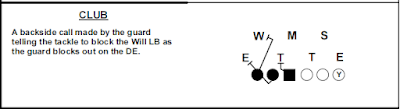
Along the offensive line, it is important to have various techniques and calls that can optimize player strengths, match ups, and angles, and give the opponent different looks. A "Club Block" is a backside combination block in which the backside end man on the LOS (EMOL) will work immediately to the second level, and the blocker inside of him will work out to the end. Club Block 2014 49ers Playbook In our case, we'll use it as an exchange block between the Back Side Guard (BSG) and Back Side Tackle (BST) as well as between a Back Side TE (BSTE) and BST, with the caveat that it is always the EMOL that is releasing directly to the 2nd level.

Football Fundamentals: I-Formation RB Draw Plays

Image
This is a series post with lots of play diagrams. Where it lacks depth, it hopefully makes up for with breadth. The goal of this post is to demonstrate the many run game nuances that are at your disposal, outside the very basics that you can find almost anywhere. I will point out some key attributes for the plays, but for the most part the diagrams will stand alone outside a brief description. This post is limited (out of necessity) to strongside plays that are given directly to the RB. It does not include FB runs, or QB runs, or H-Back, Wing, TE, or WR runs. It also doesn't include option plays. Those are things for future posts. Why did I select an I-formation, which is mostly going out of fashion, and how do I expect this information to be utilized? The I-Formation is a classic 2-back set that, by the time it was implemented, had the benefit of a lot of football history. It is also a highly adaptable run formation, along for offsets, for H-backs, and other aspects that allow es...

Inside the Playbook: Penn State, Wisconsin, and Michigan and the Use of False Blocks

Image
As a defender, you are tasked with reading your keys in order to properly diagnose the play and fulfill your assignment. Gap responsibility and run fits and execution all start with properly seeing what is happening in front of you, and based on what the offensive line does, will change your path to success. But offenses know this. To a degree, and offense does what it does because that's the easiest and most efficient way of finding success. Other times, they find success with mind games, by showing something and doing another. This post is going to look at "False Blocks", the art of pass setting on runs and false pulls.

Let's Speak Technique - Blocking the Draw Play

Image
The Draw play is one of the most effective run plays in any playbook. It's versatile. It works just as well on 1st and 10 as it does on 3rd and long. It presents a false read to the defense which sows seeds of doubt for the remainder of the game by looking initially like a pass play and then firing out and knocking some guys around. But it also allows an offensive line to get by without tons of movement. Sure, it's great when a DL gets into a pass rush and then you shotput him out of existence, but just as often you only need to utilize good footwork to position yourself between the ball carrier and the defender. In this post, I'm going to discuss the techniques employed on draw plays in a little more detail.

Football Fundamentals - Pass First RPOs - PRO and PPO

Image
We are now going to turn our attention to something similar to an RPO , but instead of the first option being run (i.e. there is always a mesh point in the backfield), the first option is to pass. This is going to not only include plays where both a run and pass option exist, but also plays where there are separate pass options in a single play, that we've labeled Pass-Pass Options .

Inside the Playbook: Michigan's Bounce Draw

Image
Jim Harbaugh and Tim Drevno must have been watching their Barry Sanders highlights when they decided to add the bounce draw to the playbook it to the playbook. Or, at least, they were catching up on their Run and Shoot Mouse Davis offense. It’s commonly stated that, at heart, Harbaugh runs a west-coast offense (WCO). More or less that is true, but he has also – like most great offensive minds – borrowed pieces from a variety of other offenses. In that past we’ve seen forays into the spread attack with Colin Kaepernick and some T-offense randomly against Maryland that one time. In this instance, he borrowed from a Run and Shoot offense and integrated it relatively seamlessly into how he utilization trips formations to the field within his nominal WCO (a short, quick, spacing passing attack to the trips side and G Lead sweeps run plays to the trips side) and downfield attack. In this article, we are going to look at how this play functions and why it works within the Harbaugh framework....