Posts

Showing posts with the label H-back

Inside the Playbook: Wisconsin's use of Dos, Tight Bunch, and Wings in Formation

Image
As we cover Wisconsin over the next few pieces, we are predominately going to focus on three formations: Dos (Tight Double Wing), Tight Bunch, and I-Form. Wisconsin finds ways to use FBs and H-Backs within the offense, to lead block, to run rubs, or to even to cross flow. In this post we will first cover the high level benefits of these formations for Wisconsin. In the next posts, we will go into depth into specific plays, predominately run out of these formations.

Inside the Playbook: Michigan Offense Reaction to Pursuit with False Keys

Image
Previously, we discussed how Michigan and teams like MSU are playing pulling blockers . They key in both schemes can be boiled down to taking away the numbers advantage the offense is trying to gain at the point of attack. This is down by flowing across the formation by a backside LB or by inserting safeties into the run fills. As teams start keying pulling OL, they begin diagnosing plays faster and taking away the offense's advantage. That's where the offense can begin doing things to take away those keys or use the pull as a false key. Let's look at how Michigan's playbook handles this. Patrick Semansky / AP

Inside the Playbook: Minnesota's Use of TEs to Attack the Hole

Image
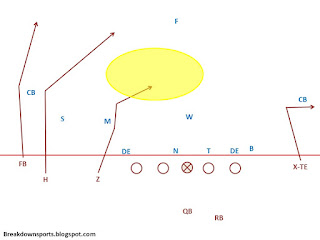
I’ve talked previously about the advantage of having good H-backs in an offensive system. Minnesota, coming off the Maxx Williams era, has continued to use TEs/H-Backs/FBs in a variety of ways to present match up issues through the use of formations/keys. Against Michigan – a team that primarily plays Cover 1 with a very deep center-field safety – they used the position of the H-Back to attack what is known as the “hole” of the defense. The hole – typically associated with Cover 2 teams – is the void in the defense in front of the safety level (typically directly between the two-high safeties) and behind the LB level. Let’s take a look at how Minnesota attacked this void through the air, and how it was set up with their formations.

Film Review: How MSU Defends Power O

Image
Michigan’s base run play is Power O . Over the past half decade, MSU has specialized in shutting down pro-style rushing attacks, and with that comes shutting down the Power O run play. It got to the point that Stanford, during the 2014 Rose Bowl, rarely even tried to execute their most standard play. In this post, we want to investigate what makes so effective against the Power O run.

Football Fundamentals: Defensive Gap Discipline vs Formations, Pulling OL, and FBs

Image
For a defense to be successful, they need to have "gap discipline". Being "gap sound" means having a defender in place to stop the offense on both sides of every blocker. By having a defender responsible for stuffing the play in each gap, the defense forms a wall at the LOS, and the offense has no way to be successful. It's the offense's goal to force the defense to lose gap discipline or be unable to cover the gap (by creating space). Each gap is an option for the ball carrier, and each open gap is potential for the offense to spring a play. In this post, we'll look at how gaps form against a few formations, and how lead blockers and pulling blockers change the numbers at the point of attack.

Inside the Playbook: Wisconsin's Rushing Attack Bread and Butter

Image
Originally posted at Land-Grant Holy Land on 9/24/13 Over the past, oh, I dunno... Let's just leave it as in the past, Wisconsin has been known for their potent run game. While Alan Ameche, that old Iron Horse, isn't walking through to run his offense any time soon, the Badgers seem to be doing pretty well dating back to the Alvarez era, er, the Alvarez coaching era, er, that first time Alvarez was coaching Wisconsin on the sideline, and, well, this introduction is all over the place. But I *do* have a great Alan Ameche story for those willing to hear, for those who like old timey stories that may or may not be true about really old Wisconsin Heisman Trophy winners. For another time, I suppose.

Inside the Playbook: Quick Look at Versatility of H-Back in Passing Attack

Image
Originally posted at Maize n Brew August 27, 2013 Note One of the primary strengths of utilizing an H-back (U-back) is the versatility they give to the pass game. They can split wide, play the wing, play in-line TE, or play FB. In this way, offenses can put them in different positions, in different formations that have a variety of strengths, yet continue to run the same plays. Likewise, an H-back can always flex into a position to become a vertical threat. This post is quick look at the versatility an H-back gives to the pass game when combined with the run game  using an H-back. Introduction While each of these formations have their own strengths and weaknesses, as we've discussed, they also have a lot in common. The pass game is no different. While clearly you can move around a U-back, put him on the other side of the formation or something else to take advantage of different pass concepts, you can also run what are essentially the same plays with different initial looks....

Inside the Playbook: Utilizing the H-Back in the Run Game

Image
Originally written over at Maize n Brew  on 8/22/13 Editors Note: The H-back has been a valuable position in modern offenses dating back to the single-wing era of the football. It returned in full force during the implementation of zone blocking offenses of the 80s, and then again fell a little bit to the way side. In the past decade or so, the reemergence of the H-back position has come on full force. Almost every modern offense utilizes an H-back to some degree, both spread and pro-style. The reason is this: it can be used as a lead blocker similar to a FB, a reach blocker in zone schemes similar to a TE (by stretching the front you are opening lanes to run), and as a vertical pass threat, aligned in the slot matched up against LBs, or closed to the LOS. The H-back position brings a lot of run blocking variety into play, adds numbers to the box, but doesn't necessarily diminish your ability to pass. That is why you'll see it's importance in almost any m...