Posts

Showing posts with the label Inside zone

History and Evolution: Power O - Bonus - "Power" within the Zone Architecture

Image
 It always bugged me when at Michigan, Rich Rod would call his Lead Outside Zone play "Power". Football terminology is notoriously inconsistent from program-to-program, where the same word can mean very different things. But Power had established a sort of agreement and consistency, it is down blocks on the frontside with a backside puller, a true gap/man scheme. Yet here was Rich Rod calling Outside Zone "Power." It made my head hurt for a long time, until one day I was looking through the Joe Gibbs's playbook, and the rationale behind it struck me.  As I noted in the History and Evolution Series , power itself was originally focused on the Power Sweep, as a sort of variant to the inside run and option series. As Option Teams (often Wing T types) moved more toward zone blocking in the 70s, Power had to be adapted in ways to fit what they did. Rarely did these teams pull within the formation, it was mostly zone blocking, occasional traps as a change up, and mayb...

Jay Johnson: Coaching Primer

Image
With an incredible defense, Mark Dantonio ushered in one of the most successful coaching tenures in Michigan State football history. While the highs of his tenure will almost certainly be remembered by those quarters-heavy, no-fly zone defenses, his downfall will at least be partially linked to the ineptness of the offense overall. While I don’t believe scheme was the primary issue for the 2019 Michigan State offense, fans will be interested in understanding what Mel Tucker brings in with his new staff. Due to the timing of the coaching change, Tucker heavy relied on bringing his old staff from Colorado with him to East Lansing. With Tucker comes his former Colorado offensive coordinator Jay Johnson. I’ve taken the task of watching the 2019 Buffaloes in an effort to highlight what to expect from the Spartans offense in Tucker’s first year. MSU Athletics

Inside the Playbook: Bluff and Go RPO

Image
Introduction At the college (and high school) level, RPOs continue to grow more and more challenging to defend. With relaxed rules against linemen downfield, defenses have been forced to maintain coverage longer and longer following the mesh point. No play demonstrates this more than the “Bluff and Go” RPO.

Football Fundamentals: I-Formation RB Zone and Zone Counter Plays

Image
This is a series post with lots of play diagrams. Where it lacks depth, it hopefully makes up for with breadth. The goal of this post is to demonstrate the many run game nuances that are at your disposal, outside the very basics that you can find almost anywhere. I will point out some key attributes for the plays, but for the most part the diagrams will stand alone outside a brief description. This post is limited (out of necessity) to strongside plays that are given directly to the RB. It does not include FB runs, or QB runs, or H-Back, Wing, TE, or WR runs. It also doesn't include option plays. Those are things for future posts. Why did I select an I-formation, which is mostly going out of fashion, and how do I expect this information to be utilized? The I-Formation is a classic 2-back set that, by the time it was implemented, had the benefit of a lot of football history. It is also a highly adaptable run formation, along for offsets, for H-backs, and other aspects that allow es...

Film Review: OSU vs PSU - 4th and 5 to Stay Alive

Image
Twitter is a mean place. It's a place full of hot takes. It's a place, where if you mess up or are wrong, you're going to get killed for it. And on Saturday night, James Franklin and Ricky Rohne were wrong. They went against convention and decided to run the football on 4th and 5, and got stopped for a loss. So not only did they break convention and not succeed, they tried their best and failed miserably; the lesson is never try . But, here's the thing, it's not that there isn't logic to the PSU play call. There is.  And, in fact, I find it odd that if there wasn't logic to it, if it was so stupid to in fact be beyond reason and rationale, that Greg Schiano and the Ohio State Buckees would just go happen to dial up the perfect defense to stop it. "Huh?" you say. Yes, the RPO play call was in fact so logical, that OSU dialed up a play almost specifically to stop it. Better put: Schiano drank a delicious Penn State Berkey Creamery Milkshake . And...

Film Review: OSU vs PSU, 4th and 5 Inside Zone RPO

Image
Whoa boy is there some people given Franklin thee ole business for his call to go with an Inside Zone - Bubble RPO on 4th and 5 on his final possession last Saturday. I mean, his own fans were calling him out on the way to the locker room and he was ready to have a nice, pleasant, parliamentary debate about the grievance. So what were Franklin and offensive coordinator thinking Ricky Rahne thinking with that call? Let's at least try to give them the benefit of the doubt and take a look.

Football Fundamentals: RPO Pass Concepts - Quick Hitters

Image
Now that we've covered the "read" offense and concepts that occur behind the LOS , let's now turn our focus down field a bit. This is where the RPO scheme is currently most dangerous, both at the lower levels, as well as at the college and NFL level. This is the quick passing concepts that are tied to the run threat. Let's take a look.

Inside the Playbook: Ohio State's Book and Run Scheme and Arrow/Slide RPO

Image
Everybody knows the basic zone read scheme. Block inside zone  (or one of many types of zone ) while leaving the backside DE unblocked for the QB to read. If the DE crashes the mesh point, the QB pulls and runs off the backside. If the DE stays home, the QB gives to the RB who runs basic inside zone. But as defenses get more athletic and more nuanced in their defense of zone read, making this "read" becomes more challenging for the QB. You now have games like scrape exchange, where the DE crashes and the LB fills behind. You have more athletic edge players that can force a give but get back into the play from the backside. One option is to change the read defender , another option is to utilize additional backs to modify the blocking scheme . In this post, I'll talk about an option that utilizes a little of both which dates back to Meyer's time at Florida, in the Book and Rifle schemes.

Football Fundamentals: Belly, Tight, Inside, Middle, Outside, Wide Zone Runs

Image
You see it everywhere. You see it on this blog. People talk zone running and they inherently talk "Inside Zone" and "Outside Zone" . Then you hear some football minds talking, and you might hear "Tight Zone" and "Wide Zone". In many cases, those will be fully synonymous with the former. But they aren't always, and in fact, there can be a small distinction, even if everyone doesn’t agree on the nomenclature. And what if I told you ('30 for 30' voice) there was something called "Middle Zone", or "Mid Zone" (not to be confused with midline). These are all concepts that exist at certain levels of football. Many coaches will combine these schemes and utilize pre- and post- snap adjustments to bridge the gap. Some will teach only some of them to get really good at those few concepts without having to worry their players about subtle nuance. But some really dedicated coaches will teach all of these concepts. I'm going...

Film Review: PSU Belly Read and Belly Counter Speed Option

Image
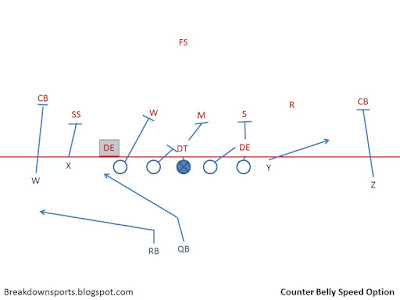
Against Michigan, Penn State pulled out a nice wrinkle to their run action. While most teams that run out of gun incorporate an inside zone read, the Nittany Lions prefer more of a belly read approach. In this post we are going to look at the difference between the more common Inside Zone run , the Belly Option that PSU prefers, and the counter action off of it with the utilization of a speed option . A couple weeks later Rutgers tried to utilize a similar strategy but had much less success. We're going to poke at the difference between teams in this post as well.

Film Review: Michigan Changing the Handoff Point

Image
At some point on Saturday, the Michigan vs. Purdue matchup turned into a battle of "who can out execute you" vs "who can out scheme you". Jeff Brohm utilized some wonderfully designed misdirection plays to get guys open in space, while Michigan was confident they could line up and wear the Boilermakers down via execution. But as the game wore on and the two teams continued to play nearly equally, Michigan pulled out a change up that allowed them to get a walk-in touchdown. In this post, I want to look at some little things that happen in the Michigan run game that impact the defense's reaction. Bryon Fuller/MGoBlog

Inside the Playbook: The Pin and Fold Inside Zone Scheme

Image
In an MGoBlog piece "Fee Fi Foe Film: Illinois Offense" , Ace pointed out an interesting wrinkle that Illinois utilizes on the backside of their inside zone, which I call "Pin and Fold". I had seen this wrinkle previous in an article from Ian Boyd at least partially about current Iowa St. coach Matt Campbell, and I've also written briefly about it on my own . Now that it has appeared again, this time in the Big Ten, I have the opportunity to write a little more about it.

Inside the Playbook: Indiana Breaking Tendencies to Run Outside the OTs

Image
Indiana, predominately, was an Inside Zone Read based team with Tevin Coleman. Coleman’s ability to pick through traffic and utilize his power allowed him to churn out a bunch of yards between the tackles, and his vision and cutback ability made him deadly to turn a modest frontside gain into an explosive cutback run. But what I enjoyed most about Indiana’s scheme when utilizing Coleman was their changeup plays for getting outside the tackles. When talking about Inside Zone, you’re looking for vertical displacement of the defense. You punish the first level defenders with powerful double teams and release into the second level defenders to form multiple run alleys along the LOS. To counter this, defenses are forced to start shooting down in an effort to form a wall at the LOS. This makes it so OL have to get off doubles earlier, and so doesn’t allow for that vertical displacement. But through Outside Zone, Pin and Pull Zone, and OG Sweeps, the Hoosiers were able to take advantage of t...

Inside the Playbook - Jim Harbaugh's Rushing Attack

Image
With the arrival of Jim Harbaugh in Ann Arbor, Michigan goes from a predominately inside zone blocking scheme back to a mostly man/gap blocking scheme. But it isn’t limited to that. Harbaugh’s offenses have been able to utilize zone as anything from a means of keeping defenses honest, to it providing the base run scheme for his offense. Furthermore, he has continually added elements to both his gap and zone schemes in order to keep them fresh and in ways unpredictable. Some of these schemes developed in his time at Stanford, while others became more prevalent when he arrived in the NFL. While all the run plays he used for the 49ers won’t likely make their way immediately to his Wolverines team, it is more likely that the Michigan offense features a similar amount of plays he incorporated at Stanford (fewer than he utilized in the NFL due to practice time constraints) but pull from both eras. In this article, we will look at Jim Harbaugh’s rushing attack.

Film Review: OSU Tight Zone Wham vs Oregon

Image
 Against a 3-4 Okie front, one of the keys for any offense will be “how can we block the ILBs”. With a standard Tight Zone or Power O scheme, that can be difficult, particularly when the DL can handle double teams and the OLBs can funnel everything back into fast flowing interior defenders. But the Buckeyes found several ways to exploit the Oregon front, getting both outside and punching it right between the tackles. In this post, we are going to look at how Ohio State utilized Tight Zone with a Wham blocking tag to seal the Oregon front and get OL into the ILBs. Eleven Warriors

Inside the Playbook: Ohio State's Split Zone Run Play

Image
Ohio State essentially started their third different QB of the season a couple weeks ago. Most teams talking up this type of fact are on the wrong end of an unexpected season, however, in this instance it wasn’t following a disappointing season. In fact, this discussion happened before and after the Buckeyes were able to put up 31 first half points on offense against a previously stout Wisconsin Badgers defense. And this wasn’t just any regular season game, it was the conference championship game. But it wasn’t because Cardale Jones – the new starting QB for OSU – came in and played lights out with the full plethora of the playbook. Instead, the surrounding Buckeye cast stepped up their game, including the coaching staff. While receivers bailed out dubiously thrown balls, Head Coach Urban Meyer and Offensive Coordinators Tom Herman and Ed Warinner planned and called a simple, straight forward, and forgiving gameplan that allowed Jones to be productive while being protected, despite on...

Football Fundamentals: Multiple Read Option Attack with Two Backs

Image
We’ve talked about the basics of zone running ; we’ve talked about adding an additional back into the backfield ; we’ve talked about the various ways you can utilize outside zone and inside zone and multiple reads to make like more maddening for the defense; now let’s mash it all together and look at a zone read option based approach with multiple backs. Having multiple backs allows us to utilize all the advantages we talked about in the multiple back piece, but the threat of the read and the option allows for some other creative means of attacking a defense. In this post, we will explore those options.

Football Fundamentals: A Multiple Inside Zone Read Attack

Image
Previously, we looked at how the Outside Zone Blocking scheme could be utilized with a variety of option reads to attack the defense. This time, we’ll move on to look at Inside Zone in the same manner. The options are a bit less up front, but note that it is typically a bit easier to cut back across the grain on inside zone (thus making it a bit more versatile in and of itself) and is typically easier to counter with man/gap schemes. So as pure zone variants go, there aren’t quite as many.

Football Fundamentals: Zone Blocking Schemes

Image
Zone based blocking schemes have become the primary blocking scheme of many modern day football teams. As defenses have made their formations and run blitz packages more complex and confusing for offensive units to block, the zone blocking scheme provides simplification in some ways. While it may take more reps to get the feel for how to come off combination blocks, secure the first level, and attack the second level than a traditional man/gap blocked scheme does, it provides a relatively straight forward plan for how and who to block after the snap has been made. In this post, we are going to look at the basics of the zone blocked scheme before we get into some of the greater intricacies at another time.

Film Review: Nebraska Schemed By Northwestern's Cover 4; Then Schemed Them Back

Image
Northwestern threw a lot of cover 4 at Nebraska in an effort to get bodies down into the run game. One thing that Cover 4 allows is for the LBs to flow a bit more freely and quickly to the initial look, because the safety takes care of backside cutbacks . What we saw in the Nebraska vs Northwestern game was Northwestern initially having success bottling up Nebraska because of this. The safety crashing down from depth allows him to defend either the QB keep or the RB cutting back across the grain. Later on, however, we saw Nebraska adjust some of their play calls to take advantage of this scheme. In this post, we’ll look at just that.