Posts

Showing posts with the label Counter F

Inside the Playbook - Michigan's Counter Game - Part 1 - Scheme and Run Tags

Image
 While the most utilized run scheme for Michigan throughout the duration of 2021 may have been Inside Zone  (specifically, split zone ), it was Counter that ended up as their most effective play . This post is going to look at how Michigan utilized a few counter schemes and a number of tags in order to execute the play at a high level. We’re also going to look at a few variations that they included to break tendencies, and a few other plays that serves as protection for the rest of the playbook.  
Football Fundamentals - RPO Run Concepts

Image
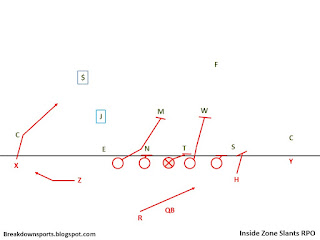
If you've been following along, we've offered up a lot of pass concepts that can be paired with a run play to make an "RPO". We looked at passes behind the LOS , quick passes , and even downfield reads . We've also looked at pass first RPOs, known here as PRO . And if you've been really paying attention, you'll have noticed that those RPOs were attached to pretty much every kind of run scheme. Here we are going to summarize those run schemes and discuss briefly the types of routes to look for given the type of run.

Football Fundamentals: I-Formation RB Counter Plays

Image
This is a series post with lots of play diagrams. Where it lacks depth, it hopefully makes up for with breadth. The goal of this post is to demonstrate the many run game nuances that are at your disposal, outside the very basics that you can find almost anywhere. I will point out some key attributes for the plays, but for the most part the diagrams will stand alone outside a brief description. This post is limited (out of necessity) to strongside plays that are given directly to the RB. It does not include FB runs, or QB runs, or H-Back, Wing, TE, or WR runs. It also doesn't include option plays. Those are things for future posts. Why did I select an I-formation, which is mostly going out of fashion, and how do I expect this information to be utilized? The I-Formation is a classic 2-back set that, by the time it was implemented, had the benefit of a lot of football history. It is also a highly adaptable run formation, along for offsets, for H-backs, and other aspects that allow es...

Written in Chalk - RPOs from Pro Personnel - Utilizing FBs/TEs in a Spread World

Image
A lot of talk surrounding Michigan's supposed lean on more RPO schemes has had to do with what is at the base of Jim Harbaugh's scheme: lots of heavy personnel sets and a complex number of run concepts. Some have wondered how the two ideas can converge, despite the fact that Harbaugh himself had previously incorporated RPOs into his offense (albeit with a different type of QB). I've already discussed how Harbaugh can utilize many of his run concepts within an RPO framework , but the question still remains, how do you do that and utilize the bevy of TEs and FBs that are currently on the roster. This post is going to explore utilizing 12 and 21 personnel (pro personnel for short) within an RPO scheme.

Inside the Playbook: Wisconsin Lead Power O, Power O, and Counter with F/H Part II

Image
In this post, we'll continue to look at how Wisconsin utilizes the Wing to run Power O. Wisconsin will utilize 12 personnel most often, but will also sprinkle in 11 personnel or even 13 personnel to run this play. And while they can still run a traditional, I-Form Power O, I want to focus specifically on what they do with a TE off the LOS, and how they utilize that as well as anyone in college football to add a blocker from the backside, and insert him at the point of attack. Part 1 can be found here

Inside the Playbook: Wisconsin Lead Power O, Power O, and Counter with F/H Part I

Image
In this post, we are going to look at how Wisconsin utilizes the Wing to run Power O. Wisconsin will utilize 12 personnel most often, but will also sprinkle in 11 personnel or even 13 personnel to run this play. And while they can still run a traditional, I-Form Power O, I want to focus specifically on what they do with a TE off the LOS, and how they utilize that as well as anyone in college football to add a blocker from the backside, and insert him at the point of attack.

Inside the Playbook: Michigan's Use of Multiple FBs and Additional Gaps

Image
Previously, I talked about gap discipline , and focused a portion of the article on pulling OL and inserting a FB into the mix. These things present a difficulty for the defense, as they need to adjust on the fly to ever-shifting gap responsibilities. Pulling OL add gaps to the point of attack and FBs can be inserted to add gaps at any location along the LOS; and the defense must adjust post-snap to these new gaps. Jim Harbaugh loves to use this to his advantage. Adding gaps to the POA forces the defense to think and hesitate, and when they do that, his Power-based offense can start churning out yards. Furthermore, with more and more teams going to spread formations and a zone based rushing attack (though this is starting to revert again to tighter formations and man/gap schemes again, as all things are cyclical in football), defenders are less comfortable with how to execute soundly (as Spielman has said multiple times the last few weeks). The downside of doing this is that it gives...

Inside the Playbook: Wham! and The Return of the Trap

Image
Wham I love trap plays; I believe they are one of the best and probably the most under-utilized run scheme in modern football. With more and more emphasis on getting upfield for the pass rush and getting penetration to stop the run game, trap and wham schemes should only become more effective. Yet they continue to go under-utilized. There are several legitimate reasons for this: 1) you’re leaving a first level defender unblocked for some time, which is dangerous as those first level defenders get more and more athletic; 2) simplified defensive rules (i.e. block-down, step-dow n) have mitigated some of the initial success of the scheme. Still, there are ways around all of this to continue to use of one of my favorite schemes: trap and wham. Long Trap

Inside the Playbook - Jim Harbaugh's Rushing Attack

Image
With the arrival of Jim Harbaugh in Ann Arbor, Michigan goes from a predominately inside zone blocking scheme back to a mostly man/gap blocking scheme. But it isn’t limited to that. Harbaugh’s offenses have been able to utilize zone as anything from a means of keeping defenses honest, to it providing the base run scheme for his offense. Furthermore, he has continually added elements to both his gap and zone schemes in order to keep them fresh and in ways unpredictable. Some of these schemes developed in his time at Stanford, while others became more prevalent when he arrived in the NFL. While all the run plays he used for the 49ers won’t likely make their way immediately to his Wolverines team, it is more likely that the Michigan offense features a similar amount of plays he incorporated at Stanford (fewer than he utilized in the NFL due to practice time constraints) but pull from both eras. In this article, we will look at Jim Harbaugh’s rushing attack.

Football Fundamentals: Counter H/F Primer

Image
Counter OH and Counter OF are great run plays within a Power O based offense or an Inside Zone based offense. For a Power O offense, it utilizes a pulling OG and a lead blocking FB or H-back, while utilizing misdirection in the backfield with the RB running a counter step (often allowing this play to be a very effective Weakside run). For an Inside Zone based offense, the initial movement of the FB/HB is the same as a standard split zone block, while the backside (away from the initial RB step) looks very similar to zone steps. In this post, we’ll look more closely how Counter H/F (that’s Counter OH or Counter OF) fits within these schemes, when to run it, why it’s so effective, and how it fits into a spread architecture.