Posts

Showing posts with the label run schemes

Inside the Playbook - A-Gap Power
Image
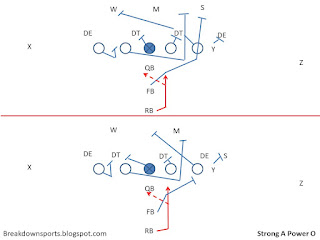
 In this post, we're going to look at A-Gap Power. A-Gap Power itself is not new. As I detailed in "History and Evolution: Power O" , what we know today as standard power was really the B/C gap constraint to the more traditionally Power Sweep. But by the late 70s and early 80s, you started to see variants of A-Gap Power schemes appear as teams wanted to protect their off tackle runs by showing a puller, but hitting inside. Teams like NDSU and Wyoming made a lot of hay off a specific type of A-gap Power, and as they've had success and their former coaches and disciples and knowledge have branched out all across football, you see this specific type of A-Gap Power arise elsewhere. This post is going to go over a few of the basics of A-Gap Power.

Inside the Playbook: Sequencing to the Throw Back

Image
 In offensive football, we often talk about the act of "sequencing plays". What this means is that we initially build a base play. Once a defense does something unsound to stop that base play, we "sequence" a "constraint" play designed to take advantage of that unsoundness. Once the defense responds to that "constraint", we further the iteration to take advantage of that response. In this post, we are going to look at the sequence of events that leads to running throw back plays. 2014 Falcons Playbook -  Sequencing

Written in Chalk: How to Attack Loose Alignment Tite/Mint Defenses in Run Game

Image
Tite and Mint continue to be the defense du jour among Twitter followers, and as college teams start looking at what some of the best defenses did last year, I anticipate even more will start to implement the front into their package in some form or another. As it becomes more prominent, offenses are going to need to start adapting playcalls for the defense in order to maximize their output. But, of course, you don’t know necessarily a defense is going to run Tite on a given down or stay in that basic look post-snap, so you have to work within your system and not have plays that blowup if you see anything else. This post is going to look at ways of tagging specific base plays and adding wrinkles to better run your base scheme against 4i-0-4i looks. Previously we’ve looked at the Fundamentals of Tite and Mint , and also some Pre-snap Adjustments to thing about in terms of split, motion, and blocking rules .

Inside the Playbook: Michigan's Down G Run Play

Image
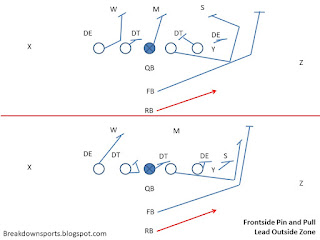
Against Notre Dame, when attempting to attack the edge, Michigan attempted to utilize their traditional pin and pull run scheme . In this scheme, they are traditionally trying to "reach" with the TE to set the edge and pull around and up from there. But against Western Michigan, they adjusted their attack by running a "Down" scheme, rather than attempting to reach at the point of attack. This can be a different play call altogether, or it can be a scouted aspect of the offense and a line call. Either way, let's take a look at how it works.

Football Fundamentals: I-Formation RB Draw Plays

Image
This is a series post with lots of play diagrams. Where it lacks depth, it hopefully makes up for with breadth. The goal of this post is to demonstrate the many run game nuances that are at your disposal, outside the very basics that you can find almost anywhere. I will point out some key attributes for the plays, but for the most part the diagrams will stand alone outside a brief description. This post is limited (out of necessity) to strongside plays that are given directly to the RB. It does not include FB runs, or QB runs, or H-Back, Wing, TE, or WR runs. It also doesn't include option plays. Those are things for future posts. Why did I select an I-formation, which is mostly going out of fashion, and how do I expect this information to be utilized? The I-Formation is a classic 2-back set that, by the time it was implemented, had the benefit of a lot of football history. It is also a highly adaptable run formation, along for offsets, for H-backs, and other aspects that allow es...

Football Fundamentals: I-Formation RB Zone/Gap Combo Plays

Image
This is a series post with lots of play diagrams. Where it lacks depth, it hopefully makes up for with breadth. The goal of this post is to demonstrate the many run game nuances that are at your disposal, outside the very basics that you can find almost anywhere. I will point out some key attributes for the plays, but for the most part the diagrams will stand alone outside a brief description. This post is limited (out of necessity) to strongside plays that are given directly to the RB. It does not include FB runs, or QB runs, or H-Back, Wing, TE, or WR runs. It also doesn't include option plays. Those are things for future posts. Why did I select an I-formation, which is mostly going out of fashion, and how do I expect this information to be utilized? The I-Formation is a classic 2-back set that, by the time it was implemented, had the benefit of a lot of football history. It is also a highly adaptable run formation, along for offsets, for H-backs, and other aspects that allow es...

Football Fundamentals: I-Formation RB Zone and Zone Counter Plays

Image
This is a series post with lots of play diagrams. Where it lacks depth, it hopefully makes up for with breadth. The goal of this post is to demonstrate the many run game nuances that are at your disposal, outside the very basics that you can find almost anywhere. I will point out some key attributes for the plays, but for the most part the diagrams will stand alone outside a brief description. This post is limited (out of necessity) to strongside plays that are given directly to the RB. It does not include FB runs, or QB runs, or H-Back, Wing, TE, or WR runs. It also doesn't include option plays. Those are things for future posts. Why did I select an I-formation, which is mostly going out of fashion, and how do I expect this information to be utilized? The I-Formation is a classic 2-back set that, by the time it was implemented, had the benefit of a lot of football history. It is also a highly adaptable run formation, along for offsets, for H-backs, and other aspects that allow es...

Football Fundamentals: I-Formation RB Pull Replace Plays

Image
This is a series post with lots of play diagrams. Where it lacks depth, it hopefully makes up for with breadth. The goal of this post is to demonstrate the many run game nuances that are at your disposal, outside the very basics that you can find almost anywhere. I will point out some key attributes for the plays, but for the most part the diagrams will stand alone outside a brief description. This post is limited (out of necessity) to strongside plays that are given directly to the RB. It does not include FB runs, or QB runs, or H-Back, Wing, TE, or WR runs. It also doesn't include option plays. Those are things for future posts. Why did I select an I-formation, which is mostly going out of fashion, and how do I expect this information to be utilized? The I-Formation is a classic 2-back set that, by the time it was implemented, had the benefit of a lot of football history. It is also a highly adaptable run formation, along for offsets, for H-backs, and other aspects that allow es...

Football Fundamentals: I-Formation RB Counter Plays

Image
This is a series post with lots of play diagrams. Where it lacks depth, it hopefully makes up for with breadth. The goal of this post is to demonstrate the many run game nuances that are at your disposal, outside the very basics that you can find almost anywhere. I will point out some key attributes for the plays, but for the most part the diagrams will stand alone outside a brief description. This post is limited (out of necessity) to strongside plays that are given directly to the RB. It does not include FB runs, or QB runs, or H-Back, Wing, TE, or WR runs. It also doesn't include option plays. Those are things for future posts. Why did I select an I-formation, which is mostly going out of fashion, and how do I expect this information to be utilized? The I-Formation is a classic 2-back set that, by the time it was implemented, had the benefit of a lot of football history. It is also a highly adaptable run formation, along for offsets, for H-backs, and other aspects that allow es...

Football Fundamentals: I-Formation RB Fold and Trap Run Plays

Image
This is a series post with lots of play diagrams. Where it lacks depth, it hopefully makes up for with breadth. The goal of this post is to demonstrate the many run game nuances that are at your disposal, outside the very basics that you can find almost anywhere. I will point out some key attributes for the plays, but for the most part the diagrams will stand alone outside a brief description. This post is limited (out of necessity) to strongside plays that are given directly to the RB. It does not include FB runs, or QB runs, or H-Back, Wing, TE, or WR runs. It also doesn't include option plays. Those are things for future posts. Why did I select an I-formation, which is mostly going out of fashion, and how do I expect this information to be utilized? The I-Formation is a classic 2-back set that, by the time it was implemented, had the benefit of a lot of football history. It is also a highly adaptable run formation, along for offsets, for H-backs, and other aspects that allow es...

Football Fundamentals: I-Formation RB Gap and Pull Run Plays

Image
This is a series post with lots of play diagrams. Where it lacks depth, it hopefully makes up for with breadth. The goal of this post is to demonstrate the many run game nuances that are at your disposal, outside the very basics that you can find almost anywhere. I will point out some key attributes for the plays, but for the most part the diagrams will stand alone outside a brief description. This post is limited (out of necessity) to strongside plays that are given directly to the RB. It does not include FB runs, or QB runs, or H-Back, Wing, TE, or WR runs. It also doesn't include option plays. Those are things for future posts. Why did I select an I-formation, which is mostly going out of fashion, and how do I expect this information to be utilized? The I-Formation is a classic 2-back set that, by the time it was implemented, had the benefit of a lot of football history. It is also a highly adaptable run formation, along for offsets, for H-backs, and other aspects that allow es...

Football Fundamentals: I-Formation RB Isolation Run Plays

Image
This is a series post with lots of play diagrams. Where it lacks depth, it hopefully makes up for with breadth. The goal of this post is to demonstrate the many run game nuances that are at your disposal, outside the very basics that you can find almost anywhere. I will point out some key attributes for the plays, but for the most part the diagrams will stand alone outside a brief description. This post is limited (out of necessity) to strongside plays that are given directly to the RB. It does not include FB runs, or QB runs, or H-Back, Wing, TE, or WR runs. It also doesn't include option plays. Those are things for future posts. Why did I select an I-formation, which is mostly going out of fashion, and how do I expect this information to be utilized? The I-Formation is a classic 2-back set that, by the time it was implemented, had the benefit of a lot of football history. It is also a highly adaptable run formation, along for offsets, for H-backs, and other aspects that allow es...

Inside the Playbook: Iowa's Outside Zone Gap Counter

Image
Iowa has long been known for its use of the stretch zone run scheme , and they love to use a FB within this scheme for a variety of reasons. In fact, one of their favorite runs is the lead outside zone play . Because it is such a staple of the offense, opponents have stressed the importance of defending this play whenever they face Iowa, to the point that Iowa has established a number of "counters" to take advantage of those defensive strategies. The most common strategy that Iowa utilizes is a pin and pull scheme, but they also incorporate other variations. In this post, we will look briefly at how defenses defend Iowa's stretch scheme, and how Iowa deployed a "gap counter" to effectively counter those strategies.

Football Fundamentals: Belly, Tight, Inside, Middle, Outside, Wide Zone Runs

Image
You see it everywhere. You see it on this blog. People talk zone running and they inherently talk "Inside Zone" and "Outside Zone" . Then you hear some football minds talking, and you might hear "Tight Zone" and "Wide Zone". In many cases, those will be fully synonymous with the former. But they aren't always, and in fact, there can be a small distinction, even if everyone doesn’t agree on the nomenclature. And what if I told you ('30 for 30' voice) there was something called "Middle Zone", or "Mid Zone" (not to be confused with midline). These are all concepts that exist at certain levels of football. Many coaches will combine these schemes and utilize pre- and post- snap adjustments to bridge the gap. Some will teach only some of them to get really good at those few concepts without having to worry their players about subtle nuance. But some really dedicated coaches will teach all of these concepts. I'm going...

Film Review: Michigan Changing the Handoff Point

Image
At some point on Saturday, the Michigan vs. Purdue matchup turned into a battle of "who can out execute you" vs "who can out scheme you". Jeff Brohm utilized some wonderfully designed misdirection plays to get guys open in space, while Michigan was confident they could line up and wear the Boilermakers down via execution. But as the game wore on and the two teams continued to play nearly equally, Michigan pulled out a change up that allowed them to get a walk-in touchdown. In this post, I want to look at some little things that happen in the Michigan run game that impact the defense's reaction. Bryon Fuller/MGoBlog

Film Study: Michigan Duo and Counter Iso vs D Focus on Stopping Interior Run

Image
From the recent Upon Further Review - Michigan Offense vs Florida Defense  a couple plays came up that I think could benefit from a bit more depth. In this article, we talk Duo And Counter Iso

Inside the Playbook: Michigan State Pin and Pull

Image
Coming off of one of the least productive years for the MSU OL in some time, the Spartans have largely retooled the unit and are planning to press quite a bit of youth into the starting lineup. Their current starting line up and key rotational players  look like this : Position LT LG C RG RT LT2 OG2 C2 OT3 Player C. Chewins T. Higby B. Allen D. Beedle L. Campbell D. Finley K. Jarvis M. Allen J. Reid Year RS-SO RS-SO SR RS-JR RS-FR RS-SR FR RS-FR FR Height 6-8 6-5 6-2 6-5 6-5 6-7 6-4 6-3 6-4 Weight 284 293 302 329 293 307 312 301 271 I would argue some of these weights are likely getting a "college roster" bump as well. This is not the beefiest of beef units to set foot in Spartan Stadium. Not that long ago though, Michigan State featured one of the most diverse run blocking playbooks in the league, right up there with Harbaugh's Michigan teams. They ran Power, Counter, Sweeps, Traps, Inside Zone, Outside Zone, and yes, Pin and Pull. But as the skill diminis...

Inside the Playbook: Michigan's Bounce Draw

Image
Jim Harbaugh and Tim Drevno must have been watching their Barry Sanders highlights when they decided to add the bounce draw to the playbook it to the playbook. Or, at least, they were catching up on their Run and Shoot Mouse Davis offense. It’s commonly stated that, at heart, Harbaugh runs a west-coast offense (WCO). More or less that is true, but he has also – like most great offensive minds – borrowed pieces from a variety of other offenses. In that past we’ve seen forays into the spread attack with Colin Kaepernick and some T-offense randomly against Maryland that one time. In this instance, he borrowed from a Run and Shoot offense and integrated it relatively seamlessly into how he utilization trips formations to the field within his nominal WCO (a short, quick, spacing passing attack to the trips side and G Lead sweeps run plays to the trips side) and downfield attack. In this article, we are going to look at how this play functions and why it works within the Harbaugh framework....

Inside the Playbook: Wham! and The Return of the Trap

Image
Wham I love trap plays; I believe they are one of the best and probably the most under-utilized run scheme in modern football. With more and more emphasis on getting upfield for the pass rush and getting penetration to stop the run game, trap and wham schemes should only become more effective. Yet they continue to go under-utilized. There are several legitimate reasons for this: 1) you’re leaving a first level defender unblocked for some time, which is dangerous as those first level defenders get more and more athletic; 2) simplified defensive rules (i.e. block-down, step-dow n) have mitigated some of the initial success of the scheme. Still, there are ways around all of this to continue to use of one of my favorite schemes: trap and wham. Long Trap

Football Fundamentals: Iso Primer

Image
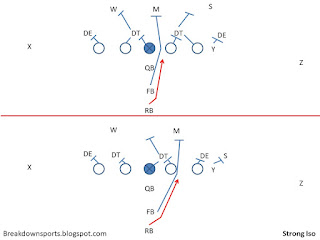
ORIGINALLY POSTED AT MAIZE N BREW ON OCT 3, 2013 The Iso run is a quick hitting run play that works by dominating the LOS. Creating double teams on both sides of the run lane and gaining momentum with a lead FB allows the offense to ram the football down the defense's throat. Because of it's strength at the point of attack and relative quickness in its development, it's a great play to run against quick hitting defenses (goal line situations or against a heavy blitz) because the defense must react to it quickly and defiantly, or else be caught behind the ball. In this post, we are going to go over the fundamentals of the Iso scheme. Diagram Video Note here that this is a strongside Iso. The center comes off his combo block almost instantly because of the aggressive nature of Notre Dame's LBs. He is letting the LB take himself out of the play, essentially combo blocking to him without doubling at the point of attack.