Posts

Showing posts matching the search for screen action

Inside the Playbook: Indiana's Screen Package

Image
Indiana heavily utilizes the screen game to act like a rushing attack. In fact, a lot of their success comes off of screen misdirection and screen action, both things that are commonly associated with the run game. By doing this, they create conditions exactly what the spread offenses was designed for: to stretch offenses laterally as well as vertically. For defenses, this means a couple things, they must be extremely disciplined with their eyes and they must tackle in space. Brief Screen Primer A brief background on screen blocking first. The lineman that release depend on who isn’t covered and which defenders present a risk to the ball in the air or the receiver. This means any defender that will try to get in an alley between the passer and receiver must be cut down or washed away. Preferably on any outside screen you’ll have at least one blocker sealing off the inside to outside pursuit, another acting as a lead blocker in the alley, and another acting as a support blocker, whic...
Inside the Playbook: OSU's Tunnel Screen and Slip Screen Action

Image
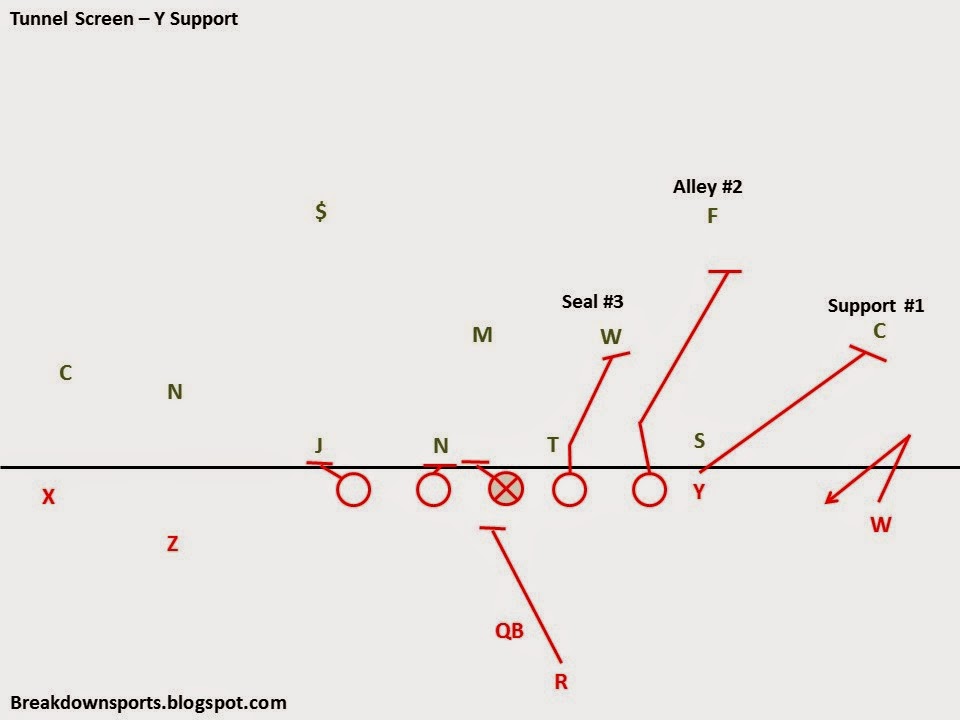
I wanted to quickly go over a play design I really liked but didn’t work out due to poor execution in the Ohio State spring game. One thing I think that happens quite often in football is fans complaining about play calling. If the play call works, it was a great play call; if it doesn’t work, it was a bad play call. There is some truth to that in retrospect, but it’s rarely because of the play design or the conceptual idea behind the play. What I want to look at today is the tunnel screen and then the slip screen off the tunnel screen action. Hit them with: And once they cheat:

Inside the Playbook: Bluff and Go RPO

Image
Introduction At the college (and high school) level, RPOs continue to grow more and more challenging to defend. With relaxed rules against linemen downfield, defenses have been forced to maintain coverage longer and longer following the mesh point. No play demonstrates this more than the “Bluff and Go” RPO.

Football Fundamentals: Flare Control

Image
A great addition to any playbook is a concept known as flare control. Flare control is a RB route intended for the primary purpose of hold and/or manipulating the underneath coverage. It can act as a block on a LB, it can force defensive flow, and it can prevent the underneath coverage from sinking into downfield developing routes. Likewise, “bubble control” can be used in much the same way. Indiana, along with many other teams, use flare control and bubble control as a part of their screen action and double screenpackage . Flare Control The most common application of flare control is to hold underneath coverage to prevent them from sinking underneath deeper routes. It helps prevent that defender from bringing pressure, it forces them to respect the underneath threat, and it doesn't allow them to gain depth. On this play , the RB is no more than third or fourth in the QB’s progression, depending on the QB’s read of the safeties. He is not intended to be a primary receive...

Inside the Playbook - Throw Back Play Designs

Image
Previously, we looked at why throw back plays work. Next, we looked at OSU taking advantage of the throw back in their play against Minnesota This post will look at different version of the throw back that can be added to your playbook. Elsewhere - Leak Everyone has talked about leak, but at least on my blog, I've never explicitly wrote about it. So let's say this is the chance. Here is a diagram of leak: 2016 Falcons Playbook There are lots of iterations of Leak now, but I want to point out a few things that I like better than others.

Inside the Playbook - MSU Jet Sweep Package

Image
Originally posted at The Only Colors on 12/6/13 The jet sweep has become increasingly popular over the past decade or so, really coming into form when Houston Nutt first introduced his wildcat formation at Arkansas. It's important to distinguish this from an end around and a reverse. Reverses, End Arounds, and Jet Sweeps are 3 different plays designed to take advantage of different things from a defense. Reverse initially attacks 1 side before reversing fields and takes advantage of horizontal over-pursuit. End-Around has middle action attached & takes advantage of vertical over pursuit (by getting depth and around squeezing EMOL). A jet sweep has no misdirection in and of itself (though it will often be paired with a run call and used in its own right as misdirection) and is simply a sweep with jet motion attached. It is designed to get to the edge before the defense and is often utilized by teams with receivers that have more speed than their power backs. So Michigan S...

LINKS: Ohio State vs Michigan, 2015

Image
The Game

Inside the Playbook: Threatening the Width of the Field from Tight Formations

Image
As many people know, a nucleate notion in the modern spread offense is to “spread the field vertically as well as horizontally.” They look at the formations utilized by Rich Rodriguez at Arizona or Art Briles at Baylor and they see at the snap of the ball a team that is spread along the width of the field. But this nefarious knowledge isn’t some cozened concept defined distinctly within spread offenses, this is something that dates back much, much further. From a passing game standpoint, Jim Harbaugh’s offense derives very much from Bill Walsh’s “West Coast Offense”. Walsh had a trenchant affinity for forcing the defense to cover the width of the field in order to open up interior run lanes for the offense. Harbaugh differs a bit from the Walsh philosophy in that he still generally prefers to setup the pass with the run. At heart, the soul of Bo Schembechler can still be found with his desire to run the ball first. Some will surely deride “three yards and a cloud of dust”, b...

Football Fundamentals: Play Action Pass Protection

Image
As a philosophy, I think an optimal offense needs to be able to threaten to run from every pass look (draw, screen, etc) and pass from every run look. This doesn’t just mean be able to do both from any formation, but be able to give an initial look while attacking with the other. Play action is a fundamental piece to almost every offense, even the most pass heavy, but particularly the more run heavy. However, it’s not enough to simply call play action, it is essential that the correct protection is paired with the run action look given the situation. Likewise, the correct type of fake should be employed  by the QB.

Written in Chalk: Releasing through the OL

I love receivers releasing inside of the offensive EMOL. This can be done from the RB position after receiving a play fake. It can come from the FB or blocking back (sniffer), where it looks like he is executing a lead block. Or even from a TE aligned inside another TE. In this post, I'm going to explain why this fairly basic design (and not all together new design, but one that is coming back to light), is so effective. Example of the TE Throwback the Falcons ran in '16 season. 3 TEs in the game. Clear-out over the top. Sneak a guy back across the field. pic.twitter.com/xI6kM7WFHB — Matt Bowen (@MattBowen41) November 21, 2017

Inside the Playbook: Penn State, Wisconsin, and Michigan and the Use of False Blocks

Image
As a defender, you are tasked with reading your keys in order to properly diagnose the play and fulfill your assignment. Gap responsibility and run fits and execution all start with properly seeing what is happening in front of you, and based on what the offensive line does, will change your path to success. But offenses know this. To a degree, and offense does what it does because that's the easiest and most efficient way of finding success. Other times, they find success with mind games, by showing something and doing another. This post is going to look at "False Blocks", the art of pass setting on runs and false pulls.

Coaching Points: Maryland vs PSU, 2014

Image
Normal day for PSU defense. Maryland had 17 real drives, 12 went four plays or fewer, three went more than 5 plays. Only three drives longer than 17 yards. 11 Punts, three fumbles A normal day for the PSU Offense. 16 real drives (really 17, because they tried to gain yards before getting sacked before halftime). 11 drives went five plays or fewer, six went more than five plays. Went longer than 50 yards once. 8 punts, three turnovers. Moderate success early, leading to consistent lack of success late. After first six drives, 7/8 went three plays or less, 9/11 went four plays or less. Maryland O: Mostly 11 personnel from Gun PSU D: 4-3 Over or Nickel Over; mix of coverage, lots of Cover 6 PSU O: Mostly gun, 12 personnel. Lots of man blocking schemes in 1st half, zone in 2nd Maryland D: 3-4 Under

Film Review: PSU Belly Read and Belly Counter Speed Option

Image
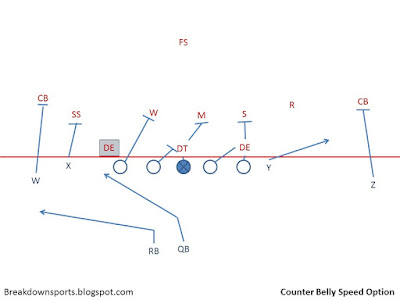
Against Michigan, Penn State pulled out a nice wrinkle to their run action. While most teams that run out of gun incorporate an inside zone read, the Nittany Lions prefer more of a belly read approach. In this post we are going to look at the difference between the more common Inside Zone run , the Belly Option that PSU prefers, and the counter action off of it with the utilization of a speed option . A couple weeks later Rutgers tried to utilize a similar strategy but had much less success. We're going to poke at the difference between teams in this post as well.

Inside the Playbook: Nebraska's Insert Iso - Bubble Slant RPO

Image
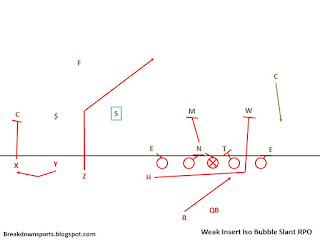
Nebraska struggled to get much traction on either side of the ball against Michigan the past weekend, but it's not necessarily due to a lack of interesting scheme. On their first drive, they ran this interesting little wrinkle. While I liked it more before I dissected it further, it still is a nice scheme that could have likely resulted in a TD had it not been tipped by a DL. So let's take a closer look.

Coaching Points: Northwestern vs Minnesota, 2014

Image
Photo by Hannah Foslien/Getty Images Minn O: Mostly 12/21 personnel, zone run, PA pass attack. NU D: Losts of 4-3 Under NU O: 11 personnel mostly zone run scheme with some gap/man counters. Minn D: Mostly Cover 4 with some Cover 1 mixed in.

Inside the Playbook: Cover 4 Safety Play

Image
The aspect of MSU’s defense that gets the most focus is undoubtedly the CB position. Fans and media folk love to point out the fact that the CBs are often left on an island by themselves, remaining hip-to-hip with their receiver from the snap of the football to the play is dead. But it is my opinion that CB may not even be the most important position in the Spartans Cover 4 secondary. In fact, it is the safeties that are consistently taxed mentally, pulled between run support and coverage. While CBs receiver the brunt of the bait, the safeties are left with the largest quandary. It has long been my opinion that, at the heart of attacking MSU’s defense, lies attacking the safeties. Unfortunately for teams facing the Spartans, Michigan State’s safety rarely make that an easy task either.

Film Review: Michigan Iterating to Gain an Advantage in the Pass Game

Image
The best concepts in football tend to build off of other known tendencies. In both the run game and the pass game (and the play action pass game), it is easiest to scheme success when telling the defense one thing, initially, and then turning it into something different. In this post, we're going to look at how Michigan has built off of established tendencies to force the defense to respect multiple things. Kirthmon F Dozier, Detroit Free Press

A Coach's POV - Michigan vs PSU - 4Q Play-by-Play

Link to Quarter 3 Michigan drive 14 - 13:09 4th 27-24 Play 1 - 1st and 10 - Michigan stacks Funchess over Gallon and run the PA tunnel screen to Gallon. This is a play to take advantage of soft coverage on the outside, by forcing them to retreat and getting a block down field. Would have liked to have seen this a couple more times this game, but it's another way to stretch the box horizontally that isn't a bubble screen. Play 2 - 1st and 10 - Pro I from Michigan. The PA and the screen have effectively backed off PSU. There are no 7 defenders in the box. PSU in a standard 4-3 Over. Gardner checks to weakside Iso. Why? He's likely running power to the strong side here, or even stretch, but PSU has essentially stacked both LBs over their DL on the strong side, making it very difficult to get out on players. Meanwhile, on the weakside, its 3 blockers for three defenders. Good check by Gardner to attack the correct side of the formation for a nice first down pick u...

Coaching Points: OSU vs Maryland, 2014

Image
Photo by Jonathan Ernst/Getty Images OSU O: Mostly 11 personnel Maryland D: Mostly Tight Cover 1 and really deep FS Maryland O: Lots of 11 personnel OSU D: Cover 4 on standard downs, 3-3-5 nickel on passing situations

Football Fundamentals: Cover 4 Front Seven Leverage

Image
We talked previously about the variety of Cover 4 coverages that allow defenses to mix up their look and reaction to routes while still playing what is essentially the same basic scheme. This time, I’m going to move away a bit from what is done post snap and look at how a defense can be benefitted by pre-snap positioning; that is: leverage and depth. In this way, you can combat some of the offense’s strengths while still maintaining your base scheme. This article will focus on the position of the front 7 and what they can do to benefit the coverage scheme.