Posts

Showing posts with the label Wham

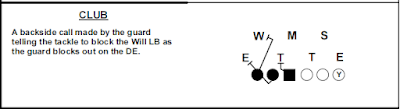
Let's Speak Technique - Club Block
Image
Along the offensive line, it is important to have various techniques and calls that can optimize player strengths, match ups, and angles, and give the opponent different looks. A "Club Block" is a backside combination block in which the backside end man on the LOS (EMOL) will work immediately to the second level, and the blocker inside of him will work out to the end. Club Block 2014 49ers Playbook In our case, we'll use it as an exchange block between the Back Side Guard (BSG) and Back Side Tackle (BST) as well as between a Back Side TE (BSTE) and BST, with the caveat that it is always the EMOL that is releasing directly to the 2nd level.

Football Fundamentals: I-Formation RB Pull Replace Plays

Image
This is a series post with lots of play diagrams. Where it lacks depth, it hopefully makes up for with breadth. The goal of this post is to demonstrate the many run game nuances that are at your disposal, outside the very basics that you can find almost anywhere. I will point out some key attributes for the plays, but for the most part the diagrams will stand alone outside a brief description. This post is limited (out of necessity) to strongside plays that are given directly to the RB. It does not include FB runs, or QB runs, or H-Back, Wing, TE, or WR runs. It also doesn't include option plays. Those are things for future posts. Why did I select an I-formation, which is mostly going out of fashion, and how do I expect this information to be utilized? The I-Formation is a classic 2-back set that, by the time it was implemented, had the benefit of a lot of football history. It is also a highly adaptable run formation, along for offsets, for H-backs, and other aspects that allow es...

Film Review: How MSU Defends Power O

Image
Michigan’s base run play is Power O . Over the past half decade, MSU has specialized in shutting down pro-style rushing attacks, and with that comes shutting down the Power O run play. It got to the point that Stanford, during the 2014 Rose Bowl, rarely even tried to execute their most standard play. In this post, we want to investigate what makes so effective against the Power O run.

Inside the Playbook: Wham! and The Return of the Trap

Image
Wham I love trap plays; I believe they are one of the best and probably the most under-utilized run scheme in modern football. With more and more emphasis on getting upfield for the pass rush and getting penetration to stop the run game, trap and wham schemes should only become more effective. Yet they continue to go under-utilized. There are several legitimate reasons for this: 1) you’re leaving a first level defender unblocked for some time, which is dangerous as those first level defenders get more and more athletic; 2) simplified defensive rules (i.e. block-down, step-dow n) have mitigated some of the initial success of the scheme. Still, there are ways around all of this to continue to use of one of my favorite schemes: trap and wham. Long Trap

Film Review: OSU Tight Zone Wham vs Oregon

Image
 Against a 3-4 Okie front, one of the keys for any offense will be “how can we block the ILBs”. With a standard Tight Zone or Power O scheme, that can be difficult, particularly when the DL can handle double teams and the OLBs can funnel everything back into fast flowing interior defenders. But the Buckeyes found several ways to exploit the Oregon front, getting both outside and punching it right between the tackles. In this post, we are going to look at how Ohio State utilized Tight Zone with a Wham blocking tag to seal the Oregon front and get OL into the ILBs. Eleven Warriors

Football Fundamentals: Multiple Read Option Attack with Two Backs

Image
We’ve talked about the basics of zone running ; we’ve talked about adding an additional back into the backfield ; we’ve talked about the various ways you can utilize outside zone and inside zone and multiple reads to make like more maddening for the defense; now let’s mash it all together and look at a zone read option based approach with multiple backs. Having multiple backs allows us to utilize all the advantages we talked about in the multiple back piece, but the threat of the read and the option allows for some other creative means of attacking a defense. In this post, we will explore those options.

Football Fundamentals: Zone Running Scheme Variety Utilizing Multiple Backs

Image
Previously we looked at the basics of the zone blocking scheme . To do so, I drew up the plays in 12 personnel. While 12 and 11 personnel served as the catalyst for many of the early success of the zone blocking scheme, many teams began adding complexity and different looks to the scheme by implementing variety through the use of FBs and H-backs. Previously, in man/gap schemes, FBs used as lead/kick blockers or as deception for the backfield flow was deemed as a near necessity to run the football. Zone offenses saw this advantage, and as the scheme has developed, many of these advantages have been implemented into a zone based scheme as well. In this post, we will look at how tags can be used to modify the zone blocking scheme and attack defensive strengths and weaknesses and provide various looks for the opponent. The player identified by the red box will be the player the back is attempting to block. I don’t show all the multiple options and formations (obviously) that you can run ...