Posts

Showing posts with the label Outside Zone

History and Evolution: Power O - Bonus - "Power" within the Zone Architecture

Image
 It always bugged me when at Michigan, Rich Rod would call his Lead Outside Zone play "Power". Football terminology is notoriously inconsistent from program-to-program, where the same word can mean very different things. But Power had established a sort of agreement and consistency, it is down blocks on the frontside with a backside puller, a true gap/man scheme. Yet here was Rich Rod calling Outside Zone "Power." It made my head hurt for a long time, until one day I was looking through the Joe Gibbs's playbook, and the rationale behind it struck me.  As I noted in the History and Evolution Series , power itself was originally focused on the Power Sweep, as a sort of variant to the inside run and option series. As Option Teams (often Wing T types) moved more toward zone blocking in the 70s, Power had to be adapted in ways to fit what they did. Rarely did these teams pull within the formation, it was mostly zone blocking, occasional traps as a change up, and mayb...

Inside the Playbook: Why Run to the Short Side of the Field

Image
 It’s a question regularly asked, “ Why is my favorite team constantly running to the short side of the field ?” People really do not enjoy jet sweep to the short side . In almost every sport you are taught the concept of using the sideline as an extra defender, and in football it is no different. And in the current era of football, the idea of space is emphasized as much as it has ever been: you have extra wide WR splits, you have light personnel groupings, stretch the field not just horizontally but laterally. So then why does it always feel like the runs aren’t utilizing that space? Space is a fundamental source of success in modern football, but it is not only the offense that controls space and how it can be used; defense also plays a role. Space is also only a single fundamental facet, others include leverage and numbers. And when you take all those traits into account, that will explain why runs into the boundary are run as often as they are. Let’s take a ...

Written in Chalk: How to Attack Loose Alignment Tite/Mint Defenses in Run Game

Image
Tite and Mint continue to be the defense du jour among Twitter followers, and as college teams start looking at what some of the best defenses did last year, I anticipate even more will start to implement the front into their package in some form or another. As it becomes more prominent, offenses are going to need to start adapting playcalls for the defense in order to maximize their output. But, of course, you don’t know necessarily a defense is going to run Tite on a given down or stay in that basic look post-snap, so you have to work within your system and not have plays that blowup if you see anything else. This post is going to look at ways of tagging specific base plays and adding wrinkles to better run your base scheme against 4i-0-4i looks. Previously we’ve looked at the Fundamentals of Tite and Mint , and also some Pre-snap Adjustments to thing about in terms of split, motion, and blocking rules .

Jay Johnson: Coaching Primer

Image
With an incredible defense, Mark Dantonio ushered in one of the most successful coaching tenures in Michigan State football history. While the highs of his tenure will almost certainly be remembered by those quarters-heavy, no-fly zone defenses, his downfall will at least be partially linked to the ineptness of the offense overall. While I don’t believe scheme was the primary issue for the 2019 Michigan State offense, fans will be interested in understanding what Mel Tucker brings in with his new staff. Due to the timing of the coaching change, Tucker heavy relied on bringing his old staff from Colorado with him to East Lansing. With Tucker comes his former Colorado offensive coordinator Jay Johnson. I’ve taken the task of watching the 2019 Buffaloes in an effort to highlight what to expect from the Spartans offense in Tucker’s first year. MSU Athletics

Inside the Playbook: Michigan's Down G Run Play

Image
Against Notre Dame, when attempting to attack the edge, Michigan attempted to utilize their traditional pin and pull run scheme . In this scheme, they are traditionally trying to "reach" with the TE to set the edge and pull around and up from there. But against Western Michigan, they adjusted their attack by running a "Down" scheme, rather than attempting to reach at the point of attack. This can be a different play call altogether, or it can be a scouted aspect of the offense and a line call. Either way, let's take a look at how it works.

Football Fundamentals: I-Formation RB Zone and Zone Counter Plays

Image
This is a series post with lots of play diagrams. Where it lacks depth, it hopefully makes up for with breadth. The goal of this post is to demonstrate the many run game nuances that are at your disposal, outside the very basics that you can find almost anywhere. I will point out some key attributes for the plays, but for the most part the diagrams will stand alone outside a brief description. This post is limited (out of necessity) to strongside plays that are given directly to the RB. It does not include FB runs, or QB runs, or H-Back, Wing, TE, or WR runs. It also doesn't include option plays. Those are things for future posts. Why did I select an I-formation, which is mostly going out of fashion, and how do I expect this information to be utilized? The I-Formation is a classic 2-back set that, by the time it was implemented, had the benefit of a lot of football history. It is also a highly adaptable run formation, along for offsets, for H-backs, and other aspects that allow es...

Inside the Playbook: Wisconsin Swap Boot Part II

Image
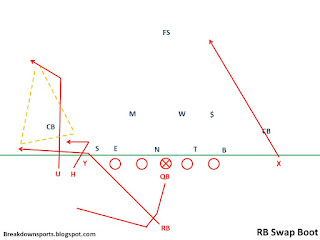
Previously, we touched on Wisconsin’s use of the Swap Boot in their 2-TE personnel package. In this post, we are going to look at the same concept, but instead of utilizing a TE in the flat, the RB is going to be incorporated into the pass concept. What we’ll see is a way of utilizing receiver’s in different spots on the field while keeping the reads and timing consistent for the QB.

Inside the Playbook: Iowa's Outside Zone Gap Counter

Image
Iowa has long been known for its use of the stretch zone run scheme , and they love to use a FB within this scheme for a variety of reasons. In fact, one of their favorite runs is the lead outside zone play . Because it is such a staple of the offense, opponents have stressed the importance of defending this play whenever they face Iowa, to the point that Iowa has established a number of "counters" to take advantage of those defensive strategies. The most common strategy that Iowa utilizes is a pin and pull scheme, but they also incorporate other variations. In this post, we will look briefly at how defenses defend Iowa's stretch scheme, and how Iowa deployed a "gap counter" to effectively counter those strategies.

Football Fundamentals: Belly, Tight, Inside, Middle, Outside, Wide Zone Runs

Image
You see it everywhere. You see it on this blog. People talk zone running and they inherently talk "Inside Zone" and "Outside Zone" . Then you hear some football minds talking, and you might hear "Tight Zone" and "Wide Zone". In many cases, those will be fully synonymous with the former. But they aren't always, and in fact, there can be a small distinction, even if everyone doesn’t agree on the nomenclature. And what if I told you ('30 for 30' voice) there was something called "Middle Zone", or "Mid Zone" (not to be confused with midline). These are all concepts that exist at certain levels of football. Many coaches will combine these schemes and utilize pre- and post- snap adjustments to bridge the gap. Some will teach only some of them to get really good at those few concepts without having to worry their players about subtle nuance. But some really dedicated coaches will teach all of these concepts. I'm going...

Inside the Playbook: Wisconsin's use of Dos, Tight Bunch, and Wings in Formation

Image
As we cover Wisconsin over the next few pieces, we are predominately going to focus on three formations: Dos (Tight Double Wing), Tight Bunch, and I-Form. Wisconsin finds ways to use FBs and H-Backs within the offense, to lead block, to run rubs, or to even to cross flow. In this post we will first cover the high level benefits of these formations for Wisconsin. In the next posts, we will go into depth into specific plays, predominately run out of these formations.

Inside the Playbook: Michigan State Pin and Pull

Image
Coming off of one of the least productive years for the MSU OL in some time, the Spartans have largely retooled the unit and are planning to press quite a bit of youth into the starting lineup. Their current starting line up and key rotational players  look like this : Position LT LG C RG RT LT2 OG2 C2 OT3 Player C. Chewins T. Higby B. Allen D. Beedle L. Campbell D. Finley K. Jarvis M. Allen J. Reid Year RS-SO RS-SO SR RS-JR RS-FR RS-SR FR RS-FR FR Height 6-8 6-5 6-2 6-5 6-5 6-7 6-4 6-3 6-4 Weight 284 293 302 329 293 307 312 301 271 I would argue some of these weights are likely getting a "college roster" bump as well. This is not the beefiest of beef units to set foot in Spartan Stadium. Not that long ago though, Michigan State featured one of the most diverse run blocking playbooks in the league, right up there with Harbaugh's Michigan teams. They ran Power, Counter, Sweeps, Traps, Inside Zone, Outside Zone, and yes, Pin and Pull. But as the skill diminis...

Inside the Playbook: Iowa's Lead Stretch Zone

Image
Iowa football has been utilizing the base stretch run scheme that made the likes of the Washington Redskins and Denver Broncos dominant in the 90s and into the new century. I’ve discussed outside zone quite a bit before , as have many other places ; rather than continue along the same lines, I’m now going to make a distinction and a further distinction with regards to Iowa football. There is Outside Zone – also known as wide zone – where the intent is to out flank the defense and get to the edge; this is most commonly seen from spread teams. Then there is zone stretch, where the ball can bounce to the outside, but more often than not will be cut inside the EMOL, this is the classic Joe Gibbs and Shanahan offense. Both can be called stretch or wide or outside zone, it’s more of a philosophical difference (though in Gibb's case, he had a play called "bounce" and a play called "Outside", that were just that very distinction). Iowa also adds in the lead bl...

Football Fundamentals: Pin and Pull Scheme

Image
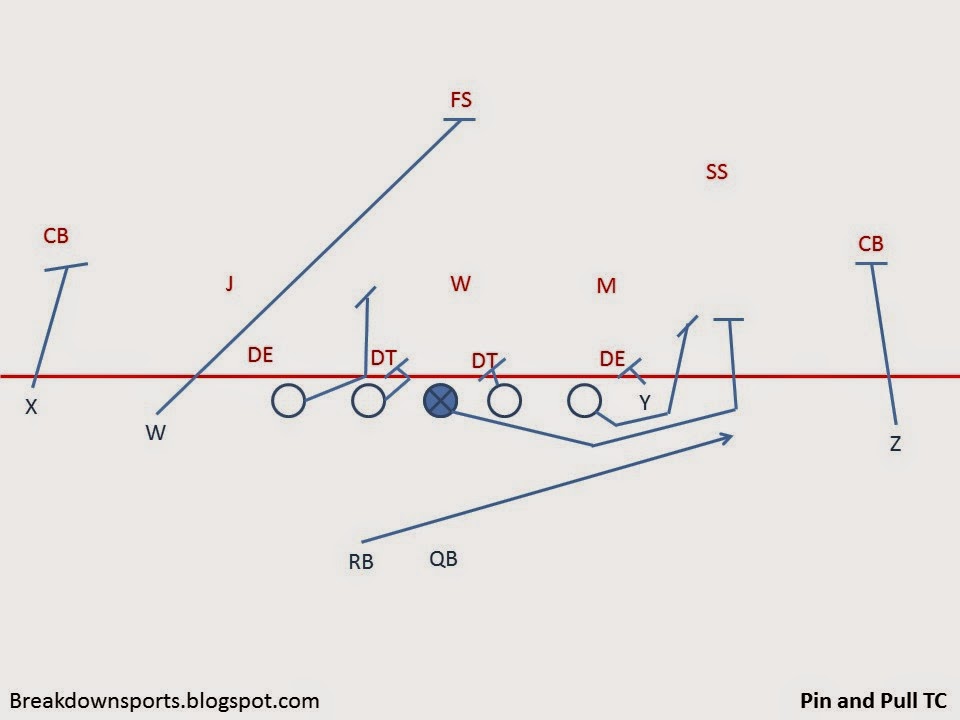
The zone stretch scheme (outside zone or wide zone) has long been a favorite was for zone-based offenses to get to the outside, or at least stress the defense horizontally. Teams like Iowa have long used it as their base run play from a single back, pro-style set (often 12 personnel), while teams like Northwestern have often used it to threated defenses from a spread formation. Many other squads, including Maryland, Indiana, Penn State, OSU, Michigan, and MSU have recently had this play in their dossier. But when it is known to be the base of your rushing attack, it has fairly obvious keys that allow defenses to attack it and shut it down, either through formation or through how they attack post-snap, so at times it helps to have variants of the same play. That is where the pin and pull concept comes into play. The pin and pull concept is essentially a gap/man tag for the OL to switch to in order to attack with what is essentially the stretch scheme. Let’s take a look.

Inside the Playbook: Indiana Breaking Tendencies to Run Outside the OTs

Image
Indiana, predominately, was an Inside Zone Read based team with Tevin Coleman. Coleman’s ability to pick through traffic and utilize his power allowed him to churn out a bunch of yards between the tackles, and his vision and cutback ability made him deadly to turn a modest frontside gain into an explosive cutback run. But what I enjoyed most about Indiana’s scheme when utilizing Coleman was their changeup plays for getting outside the tackles. When talking about Inside Zone, you’re looking for vertical displacement of the defense. You punish the first level defenders with powerful double teams and release into the second level defenders to form multiple run alleys along the LOS. To counter this, defenses are forced to start shooting down in an effort to form a wall at the LOS. This makes it so OL have to get off doubles earlier, and so doesn’t allow for that vertical displacement. But through Outside Zone, Pin and Pull Zone, and OG Sweeps, the Hoosiers were able to take advantage of t...

Inside the Playbook - Jim Harbaugh's Rushing Attack

Image
With the arrival of Jim Harbaugh in Ann Arbor, Michigan goes from a predominately inside zone blocking scheme back to a mostly man/gap blocking scheme. But it isn’t limited to that. Harbaugh’s offenses have been able to utilize zone as anything from a means of keeping defenses honest, to it providing the base run scheme for his offense. Furthermore, he has continually added elements to both his gap and zone schemes in order to keep them fresh and in ways unpredictable. Some of these schemes developed in his time at Stanford, while others became more prevalent when he arrived in the NFL. While all the run plays he used for the 49ers won’t likely make their way immediately to his Wolverines team, it is more likely that the Michigan offense features a similar amount of plays he incorporated at Stanford (fewer than he utilized in the NFL due to practice time constraints) but pull from both eras. In this article, we will look at Jim Harbaugh’s rushing attack.

Film Review: Ohio State's OZ Pin and Pull BOB Read

Image
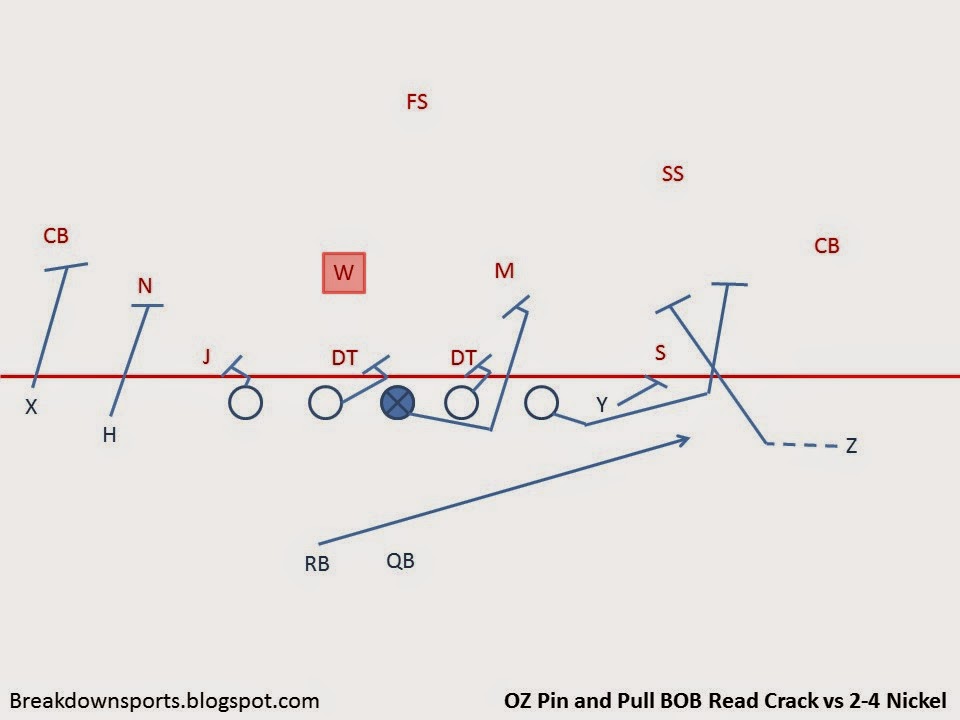
Wisconsin utilized a one-gap 3-4 defense (and 2-4 Nickel package) this past season that forced a lot of teams to stagnate. This was done by having the three DL account for interior gaps, while keeping the inside LBs clean to crash down and scrape over the top. Meanwhile, the OLBs forced everything back inside to help. In theory this constricted the offenses the Badgers faced and forced them to play in a tighter area, which is an advantage for the defense. One of the proverbial ways teams adjust for this is by running what is known as pin and pull. The Buckeyes were well aware of that outside zone adjustment, and along with a change in the QB Read, saw them able to get to the edge of the defense for several big first half gains on the ground.

Football Fundamentals: Multiple Read Option Attack with Two Backs

Image
We’ve talked about the basics of zone running ; we’ve talked about adding an additional back into the backfield ; we’ve talked about the various ways you can utilize outside zone and inside zone and multiple reads to make like more maddening for the defense; now let’s mash it all together and look at a zone read option based approach with multiple backs. Having multiple backs allows us to utilize all the advantages we talked about in the multiple back piece, but the threat of the read and the option allows for some other creative means of attacking a defense. In this post, we will explore those options.

Football Fundamentals: A Multiple Outside Zone Read Option Attack

Image
Previously, we looked at the basics of a zone scheme and the multiple ways a lead blocker can be incorporated into that scheme. This time, we’ll excommunicate the lead blocker if favor of some sort of option read. The option play – often referred to as a read play when the option is performed with a mesh point – is a way of essentially adding an additional blocker to the run game. The defender being optioned off must choose between two options, and either way he chooses, he is theoretically wrong (provided the correct read is made). Likewise, by adding the QB as a viable run threat, another defender is accounted for in the blocking scheme outside of standard play action. This post focuses strictly on outside zone blocking and doesn’t include inside zone (next piece), gap blocking (down the road), or other schemes.

Football Fundamentals: Zone Running Scheme Variety Utilizing Multiple Backs

Image
Previously we looked at the basics of the zone blocking scheme . To do so, I drew up the plays in 12 personnel. While 12 and 11 personnel served as the catalyst for many of the early success of the zone blocking scheme, many teams began adding complexity and different looks to the scheme by implementing variety through the use of FBs and H-backs. Previously, in man/gap schemes, FBs used as lead/kick blockers or as deception for the backfield flow was deemed as a near necessity to run the football. Zone offenses saw this advantage, and as the scheme has developed, many of these advantages have been implemented into a zone based scheme as well. In this post, we will look at how tags can be used to modify the zone blocking scheme and attack defensive strengths and weaknesses and provide various looks for the opponent. The player identified by the red box will be the player the back is attempting to block. I don’t show all the multiple options and formations (obviously) that you can run ...

Football Fundamentals: Zone Blocking Schemes

Image
Zone based blocking schemes have become the primary blocking scheme of many modern day football teams. As defenses have made their formations and run blitz packages more complex and confusing for offensive units to block, the zone blocking scheme provides simplification in some ways. While it may take more reps to get the feel for how to come off combination blocks, secure the first level, and attack the second level than a traditional man/gap blocked scheme does, it provides a relatively straight forward plan for how and who to block after the snap has been made. In this post, we are going to look at the basics of the zone blocked scheme before we get into some of the greater intricacies at another time.