Posts

Showing posts with the label zone read

Inside the Playbook: Bluff and Go RPO

Image
Introduction At the college (and high school) level, RPOs continue to grow more and more challenging to defend. With relaxed rules against linemen downfield, defenses have been forced to maintain coverage longer and longer following the mesh point. No play demonstrates this more than the “Bluff and Go” RPO.

Football Fundamentals: Belly, Tight, Inside, Middle, Outside, Wide Zone Runs

Image
You see it everywhere. You see it on this blog. People talk zone running and they inherently talk "Inside Zone" and "Outside Zone" . Then you hear some football minds talking, and you might hear "Tight Zone" and "Wide Zone". In many cases, those will be fully synonymous with the former. But they aren't always, and in fact, there can be a small distinction, even if everyone doesn’t agree on the nomenclature. And what if I told you ('30 for 30' voice) there was something called "Middle Zone", or "Mid Zone" (not to be confused with midline). These are all concepts that exist at certain levels of football. Many coaches will combine these schemes and utilize pre- and post- snap adjustments to bridge the gap. Some will teach only some of them to get really good at those few concepts without having to worry their players about subtle nuance. But some really dedicated coaches will teach all of these concepts. I'm going...

Film Review: PSU Belly Read and Belly Counter Speed Option

Image
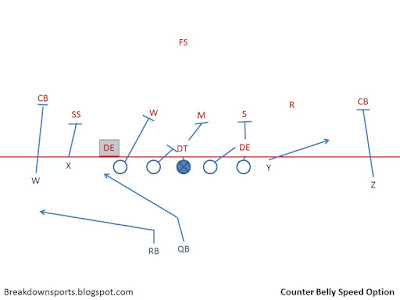
Against Michigan, Penn State pulled out a nice wrinkle to their run action. While most teams that run out of gun incorporate an inside zone read, the Nittany Lions prefer more of a belly read approach. In this post we are going to look at the difference between the more common Inside Zone run , the Belly Option that PSU prefers, and the counter action off of it with the utilization of a speed option . A couple weeks later Rutgers tried to utilize a similar strategy but had much less success. We're going to poke at the difference between teams in this post as well.

Inside the Playbook: Ohio State's 2-Back Offense

Image
ORIGINALLY POSTED AT MAIZE N BREW ON 7-25-14 In 2013, Ohio State had one of the best run offenses in the nation. Part of their success came from two-back sets, or more accurately, by motioning a slot receiver - their Percy Harvin role - into the backfield. They lost, in my opinion, the best college RB in football last year, but returning the dynamic Braxton Miller and all their Harvinites, two back sets will likely become more prominent in this year's offensive iteration. In this piece, we will look at why these sets are so difficult for defenses to defend, both from a pre-snap standpoint, and after the snap.

Inside the Playbook: Minnesota's Basic Run Game Attack

Image
Originally posted at Maize n Brew on 5/29/2014 Associated Press Minnesota is one of the most run heavy teams not only in the B1G, but in all of college football. And not only are they just heavy in terms of how much they run the football, but they are the true essence of a team that wants to be a powerful running force. The majority of their runs come between the tackles in the form of inside zone, Power O to the RB, or Power O from the QB. With so much power on the field though, they tend to lack the speed to threaten the edges. Their way of getting the football to the edge then, isn't by subbing in different personnel or by running WR screens, but utilizing in a variety of ways their WRs to run sweeps. Not only has this become prevalent in their offense, but they have used it very well to set up other runs as well. In this article, we will look quickly at the Golden Gophers base run game, and more how they work off of that to set up the rest of their playbook.

Film Review: OSU Tight Zone Wham vs Oregon

Image
 Against a 3-4 Okie front, one of the keys for any offense will be “how can we block the ILBs”. With a standard Tight Zone or Power O scheme, that can be difficult, particularly when the DL can handle double teams and the OLBs can funnel everything back into fast flowing interior defenders. But the Buckeyes found several ways to exploit the Oregon front, getting both outside and punching it right between the tackles. In this post, we are going to look at how Ohio State utilized Tight Zone with a Wham blocking tag to seal the Oregon front and get OL into the ILBs. Eleven Warriors

Inside the Playbook: Ohio State's Split Zone Run Play

Image
Ohio State essentially started their third different QB of the season a couple weeks ago. Most teams talking up this type of fact are on the wrong end of an unexpected season, however, in this instance it wasn’t following a disappointing season. In fact, this discussion happened before and after the Buckeyes were able to put up 31 first half points on offense against a previously stout Wisconsin Badgers defense. And this wasn’t just any regular season game, it was the conference championship game. But it wasn’t because Cardale Jones – the new starting QB for OSU – came in and played lights out with the full plethora of the playbook. Instead, the surrounding Buckeye cast stepped up their game, including the coaching staff. While receivers bailed out dubiously thrown balls, Head Coach Urban Meyer and Offensive Coordinators Tom Herman and Ed Warinner planned and called a simple, straight forward, and forgiving gameplan that allowed Jones to be productive while being protected, despite on...

Film Review: Ohio State's OZ Pin and Pull BOB Read

Image
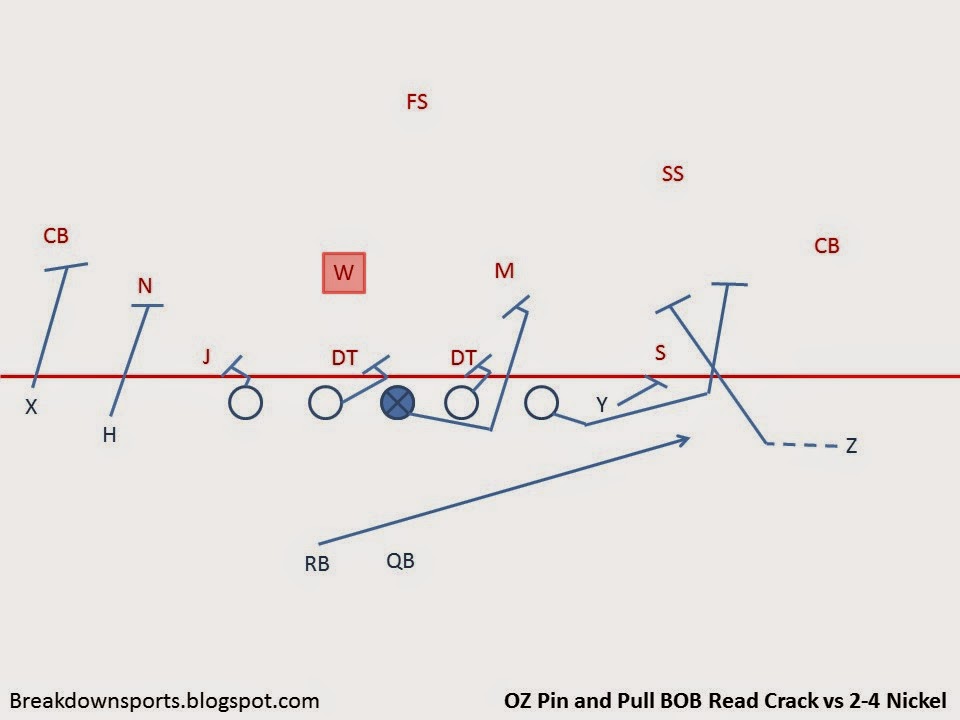
Wisconsin utilized a one-gap 3-4 defense (and 2-4 Nickel package) this past season that forced a lot of teams to stagnate. This was done by having the three DL account for interior gaps, while keeping the inside LBs clean to crash down and scrape over the top. Meanwhile, the OLBs forced everything back inside to help. In theory this constricted the offenses the Badgers faced and forced them to play in a tighter area, which is an advantage for the defense. One of the proverbial ways teams adjust for this is by running what is known as pin and pull. The Buckeyes were well aware of that outside zone adjustment, and along with a change in the QB Read, saw them able to get to the edge of the defense for several big first half gains on the ground.

Football Fundamentals: Multiple Read Option Attack with Two Backs

Image
We’ve talked about the basics of zone running ; we’ve talked about adding an additional back into the backfield ; we’ve talked about the various ways you can utilize outside zone and inside zone and multiple reads to make like more maddening for the defense; now let’s mash it all together and look at a zone read option based approach with multiple backs. Having multiple backs allows us to utilize all the advantages we talked about in the multiple back piece, but the threat of the read and the option allows for some other creative means of attacking a defense. In this post, we will explore those options.

Football Fundamentals: A Multiple Inside Zone Read Attack

Image
Previously, we looked at how the Outside Zone Blocking scheme could be utilized with a variety of option reads to attack the defense. This time, we’ll move on to look at Inside Zone in the same manner. The options are a bit less up front, but note that it is typically a bit easier to cut back across the grain on inside zone (thus making it a bit more versatile in and of itself) and is typically easier to counter with man/gap schemes. So as pure zone variants go, there aren’t quite as many.

Football Fundamentals: A Multiple Outside Zone Read Option Attack

Image
Previously, we looked at the basics of a zone scheme and the multiple ways a lead blocker can be incorporated into that scheme. This time, we’ll excommunicate the lead blocker if favor of some sort of option read. The option play – often referred to as a read play when the option is performed with a mesh point – is a way of essentially adding an additional blocker to the run game. The defender being optioned off must choose between two options, and either way he chooses, he is theoretically wrong (provided the correct read is made). Likewise, by adding the QB as a viable run threat, another defender is accounted for in the blocking scheme outside of standard play action. This post focuses strictly on outside zone blocking and doesn’t include inside zone (next piece), gap blocking (down the road), or other schemes.

Inside the Playbook: Minnesota's Run Attack (Preview)

Image
PREVIEW Minnesota is one of the most run heavy teams not only in the B1G, but in all of college football. And not only are they just heavy in terms of how much they run the football, but they are the true essence of a team that wants to be a powerful running force. The majority of their runs come between the tackles in the form of inside zone, Power O to the RB, or Power O from the QB. With so much power on the field though, they tend to lack the speed to threaten the edges. Their way of getting the football to the edge then, isn't by subbing in different personnel or by running WR screens, but utilizing in a variety of ways their WRs to run sweeps. Not only has this become prevalent in their offense, but they have used it very well to set up other runs as well. In this article, we will look quickly at the Golden Gophers base run game, and more how they work off of that to set up the rest of their playbook. Power O The base scheme for the Golden Gophers is the traditional Powe...