Posts

Showing posts with the label Play Action Pass

Film Review: Northwestern Sequencing Down G

Image
 Down G is a play that once featured heavily in a lot of prostyle offenses, only to go out of vogue in the modern spread era. But as teams have begun incorporating more TEs back into the formation, and have felt the need to implement more gap schemes back into the zone dominant offenses, Down G has been a play that has allowed them to get there. I've previously written about Down G , and how it acts as zone on the backside, and guard kick out on the front side. It is essentially a frontside version of pin and pull, and many will even run it that way if the Center is also uncovered and free to pull. Against Michigan State in the opening game of the season, Northwestern to get outside the Spartan defensive ends setting the edge. With a mismatch also on the interior of the OL, Northwestern started dabbling in Down G to utilize the DE's momentum upfield and out, and pin the defensive front inside. From their TE-Wing look, they were also able to sequence the play with a vertical pla...
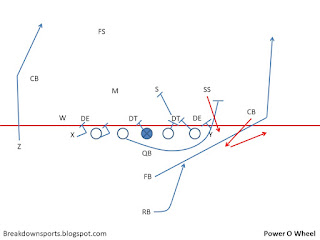
Inside the Playbook: Wisconsin Play Action Power O Wheel

Image
Against Iowa, Wisconsin was finally able to get things going offensively when they returned to an old friend in the offense: the wheel route off of Power O. I knew I had seen it previously, and mistakenly noted it was a few years ago in a bowl game, but actually it was against Indiana last year. The basics of the play are a hard Power O play action out of a heavy formation. Rather than kicking out, the FB plants and runs upfield on the wheel route. What ensues is beautiful, beautiful FBs rumbling in wide open spaces. Let's take a look.

Film Review: "Bad Play Calls" Aren't Really Bad; and You Should Feel Bad About It.

Image
If you've followed me elsewhere besides just my blog, you probably have an inkling that one of my biggest peeves is fans selecting specific play calls to complain about postmortem. It takes a conclusion - that a play was not successful - and applies no additional logic to apply a critique. Certainly, like wins, all that matters in the end is that you got one or you didn't; in the end it doesn't matter if it was close or it shoulda or coulda or woulda. But if you want to honestly evaluate anything, you need to dig deeper than that. You need to understand your own teams strengths and weaknesses and those of your opponent. You need to understand tendencies, again, both your own and your opponents. What have you practiced (and the success of what you practiced) and what haven't you. There are a lot of unknowns we can't glean, but if we take some time, we can better understand inputs and give a much more thoughtful, thorough, and accurate critique of "play calling...

Inside the Playbook: Wisconsin's Flood Play

Image
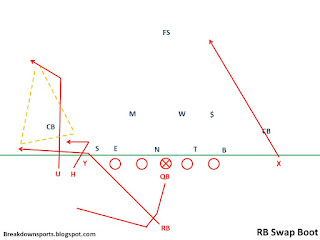
The last rollout play we are going to look at from Wisconsin (for now) is a basic sail concept. I’ve previously discussed how they’ve utilized swap boot ( in two parts ), in which TEs are primary attacking the flat and underneath off of delayed routes. With the sail route, they now have an opportunity to work vertical to threaten the deep outside of the field.

Inside the Playbook: Wisconsin Swap Boot Part II

Image
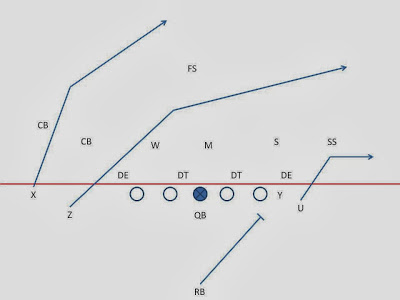
Previously, we touched on Wisconsin’s use of the Swap Boot in their 2-TE personnel package. In this post, we are going to look at the same concept, but instead of utilizing a TE in the flat, the RB is going to be incorporated into the pass concept. What we’ll see is a way of utilizing receiver’s in different spots on the field while keeping the reads and timing consistent for the QB.

Inside the Playbook: Wisconsin Swap Boot Scheme

Image
I’ve previously discussed how Wisconsin utilizes Dos, TightBunch, and Wings in formation to run a lot of Power O , Lead, and Counter plays . Similarly, they utilize the width of the formation to successfully run a lot of zone schemes, including both Inside Zone and Outside Zone. In this post, we will look at the swap boot concept, and then in the next post, we will look at similar concepts with small tweaks to the setup.

Inside the Playbook: Indiana Cross-Wheel

Image
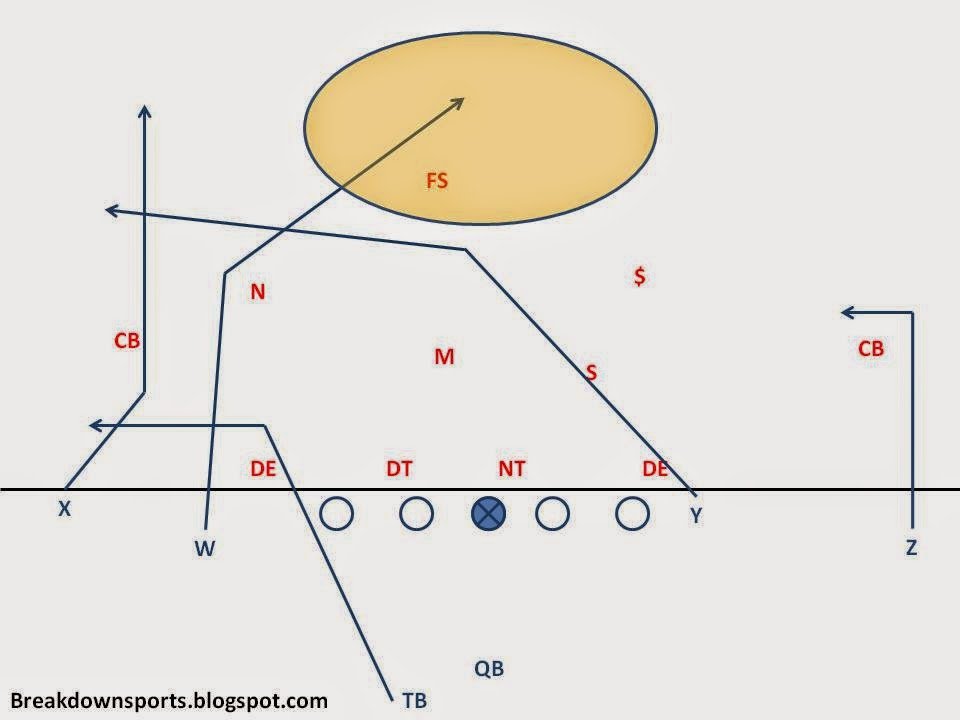
Indiana Wheel Route Everyone knows about the Post-Wheel route concept. According to 2016 Twitter and beyond, it has been and continues to be undefeated. The legitimacy of this claim can be argued, as much as anything can legitimately be argued on Twitter. Admittedly, it’s a great concept that can be run effectively with a variety of personnel and from various formations. What I want to show today is a slight variation of it, that has tons of eye-candy on top of it to really maximize the effectiveness. This comes from Indiana OC Mike DeBord (as much as Michigan fans don’t want to believe it). It is the Cross-Wheel combo.

Inside the Playbook: Michigan Offense Reaction to Pursuit with False Keys

Image
Previously, we discussed how Michigan and teams like MSU are playing pulling blockers . They key in both schemes can be boiled down to taking away the numbers advantage the offense is trying to gain at the point of attack. This is down by flowing across the formation by a backside LB or by inserting safeties into the run fills. As teams start keying pulling OL, they begin diagnosing plays faster and taking away the offense's advantage. That's where the offense can begin doing things to take away those keys or use the pull as a false key. Let's look at how Michigan's playbook handles this. Patrick Semansky / AP

Inside the Playbook: MSU Play Action Blocking and the Wheel

Image
Michigan State dug deep into their jet sweep package against Michigan, and the result was a wide-open FB near the sideline that would eventually go over 70 yards for a near TD. I want to look a bit closer at this play and why it is so successful. MSU Jet Sweep Wheel MSU has a fairly deep jet sweep and jet sweep action package that they deploy weekly as a means to attack the edge with skilled receivers. Recently, they pulled out the FB wheel. If it looked familiar, I diagramed it in October 2014 as a play MSU should add to their jet sweep package. It looks kind of like this, with an important addition that is the purpose of this article.

Inside the Playbook: Purdue's Weakside Flood and the QB Keep Concept

Image
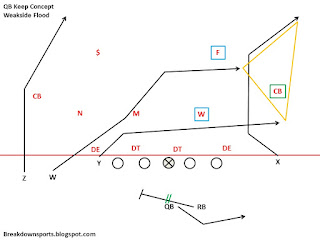
Purdue is a “concept” team; by this I mean they have a few dozen concepts (give or take) and they build an entire offense off of this. In many ways, this is a very effective way to build a simplified offense that can be executed at a high level; you combine individual concepts and your playbook can grow into the hundreds, but your players only need to learn their few dozen concepts (which includes run concepts). You’ve simplified the game for everyone: OL and QB, and maybe most importantly, for your QBs and WRs. Because what they learn is limited, they can learn it in more detail, meaning they understand the nuances and adjustments that can be made on the fly. The QBs and WRs get more reps running only a handful of plays, and they understand each other’s reads and in-play modifications. One of the concepts I want to take a closer look at is the Weakside Flood.

Inside the Playbook: Minnesota's Basic Run Game Attack

Image
Originally posted at Maize n Brew on 5/29/2014 Associated Press Minnesota is one of the most run heavy teams not only in the B1G, but in all of college football. And not only are they just heavy in terms of how much they run the football, but they are the true essence of a team that wants to be a powerful running force. The majority of their runs come between the tackles in the form of inside zone, Power O to the RB, or Power O from the QB. With so much power on the field though, they tend to lack the speed to threaten the edges. Their way of getting the football to the edge then, isn't by subbing in different personnel or by running WR screens, but utilizing in a variety of ways their WRs to run sweeps. Not only has this become prevalent in their offense, but they have used it very well to set up other runs as well. In this article, we will look quickly at the Golden Gophers base run game, and more how they work off of that to set up the rest of their playbook.

Film Review: OSU's Split Zone and the 60 Y Curl

Image
Previously, we talked about OSU utilizing split zone as a viable way to simplify the read option game for inexperienced QB Cardale Jones. But to move the football in the college game, you still need some semblance of a passing threat. Rather than forcing their QB to make complicated reads or fit the ball into tight windows, Urban Meyer and Tom Herman dialed up a simple play action pass concept to allow Jones and his receivers to be effective while not needing to over think. In this post, we’ll look how this “3-Verts” concept works, and more specifically, how it works as a great addition to the split zone play .

Inside the Playbook - MSU Jet Sweep Package

Image
Originally posted at The Only Colors on 12/6/13 The jet sweep has become increasingly popular over the past decade or so, really coming into form when Houston Nutt first introduced his wildcat formation at Arkansas. It's important to distinguish this from an end around and a reverse. Reverses, End Arounds, and Jet Sweeps are 3 different plays designed to take advantage of different things from a defense. Reverse initially attacks 1 side before reversing fields and takes advantage of horizontal over-pursuit. End-Around has middle action attached & takes advantage of vertical over pursuit (by getting depth and around squeezing EMOL). A jet sweep has no misdirection in and of itself (though it will often be paired with a run call and used in its own right as misdirection) and is simply a sweep with jet motion attached. It is designed to get to the edge before the defense and is often utilized by teams with receivers that have more speed than their power backs. So Michigan S...

Inside the Playbook: Pairing the Sail and Cab Concepts

Image
Originally posted at LGHL on 9/5/13 Urban Meyer is one of those coaches that, if you sit in a coverage and don't mix it up, he's going to take shots and he's going to put up points. Buffalo did mix up their coverages a bit on Saturday, but they did it in runs for some odd reason. Starting in Cover 1; getting burned. Move on to Cover 0, get veer read to death. Try to put two deep safeties and mix in Cover 4, yeah, alright,;show it a few times and a TD is going to happen. Well, that's what happened on Saturday. In this post, I want to look specifically at OSU's first TD this season; then, in the next piece, we'll look closer at how Kenny Guiton was able to come in and quickly throw a TD himself when Buffalo switched a two-high look.

Football Fundamentals: Play Action Pass Protection

Image
As a philosophy, I think an optimal offense needs to be able to threaten to run from every pass look (draw, screen, etc) and pass from every run look. This doesn’t just mean be able to do both from any formation, but be able to give an initial look while attacking with the other. Play action is a fundamental piece to almost every offense, even the most pass heavy, but particularly the more run heavy. However, it’s not enough to simply call play action, it is essential that the correct protection is paired with the run action look given the situation. Likewise, the correct type of fake should be employed  by the QB.

Inside the Playbook: MSU's Jet Sweep Package

Image
Preview Michigan State faces a very athletic defense on Saturday, when they meet Ohio State in Indianapolis for the Big Ten Title. For the past couple weeks, the Spartans have added several deviations of their base play calls, seemingly to set up and prepare them for the show down against the Buckeyes. In this post we are going to look at MSU's jet sweep package. *     *     *     *     *     *     * Jet Sweep Fake - Counter Trey So now you've forced the defense to flow both outside and upfield to protect against the jet sweep and the inside zone. Particularly when the inside zone looks to be going in the same direction as the jet sweep motion, it really pulls the defense in that direction and upfield. This really allows a defense to fairly easily get outside leverage and seal them inside as they get caught in the wash. This almost works similar to a reverse, in that you are heavily selling one direction and then ge...

Inside the Playbook: OSU's Inverted Veer Package

Image
Ohio State does some interesting things within their offense that make it difficult for defenses to key them correctly. For one, they effectively mix up zone blocking and man blocking schemes, especially power blocking as of lately. In this post we are going to look at 4+ different plays which all utilize and inverted veer look, and explain why it is so difficult to stop them on offense. *     *     *     *     *     *     * Counter Inverted Veer As I described the inverted veer as power blocking from an option look, let's first look at how "counter trey" is blocked. "Trey" is a bit of a misnomer, as there often isn't a trey block, but it is the most common type of double team that comes from this blocking scheme and thus it is called trey. To note: Trey is a combo block from the playside PSE (playside TE) and the PST (playside OT) to the MIKE or backside LB. Deuce is a combo block from the PST and the PSG (pla...

Inside the Playbook: Wisconsin's Heavy Use of Play Action (BDS Exclusive)

Image
Introduction Part of what makes Wisconsin’s offense so difficult to stop is the pass off the run action. In last Saturday’s game against Purdue, Wisconsin showed one of their two favorite three man routes out of their wing formation (single back, two TE to the same formation, two WR to the other side), which is their favorite formation to run their outside zone stretch running scheme. We’ll look at how Wisconsin will use run action, and the same initial route look to attack both sides of the defense, to the playside and away from the play action. Coverages Wisconsin Should Expect Out of the wing formation, you can expect to see anything but cover 3 (at least during normal down and distances). That’s because of the inherent weaknesses of a cover 3, namely: run support suffers because you are three deep across the back and your force defenders must also cover the flat; and its greatest weakness in coverage is the underneath seam, which is easily exploited by the two TE side. So wha...