Posts

Showing posts with the label Counter OT

Inside the Playbook - Michigan's Counter Game - Part 2 - Post Snap Modifiers

Image
In Part 1 of this series, we looked at the basics of the Michigan Counter package, including the five basic schemes (Counter OH, Counter OF, Counter OT, Counter HF, and Counter O). We also looked at run game tags that can be applied pre-snap to modify blocking assignments, and when to incorporate them. In this part, we are going to look at Post-Snap Modifiers (i.e. reads), and how Counter serves as protection of other schemes, and how Michigan protected Counter within their scheme.

Inside the Playbook - Michigan's Counter Game - Part 1 - Scheme and Run Tags

Image
 While the most utilized run scheme for Michigan throughout the duration of 2021 may have been Inside Zone  (specifically, split zone ), it was Counter that ended up as their most effective play . This post is going to look at how Michigan utilized a few counter schemes and a number of tags in order to execute the play at a high level. We’re also going to look at a few variations that they included to break tendencies, and a few other plays that serves as protection for the rest of the playbook.  

Inside the Playbook - Michigan State 3x1 Counter OT vs 2-High Coverage

Image
Against Northwestern's primarily two-high defense, Michigan State found a wrinkle that was effective for their run scheme out of a 3x1 formations (three receivers to one side of the formation, one receiver to the other side). Primarily a zone team, MSU attacked the Wildcats with a mix of Zone Windback and Counter OT . Let's take a quick look at their use of Counter.

Football Fundamentals - RPO Run Concepts

Image
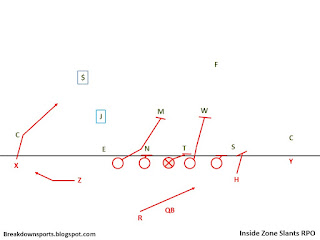
If you've been following along, we've offered up a lot of pass concepts that can be paired with a run play to make an "RPO". We looked at passes behind the LOS , quick passes , and even downfield reads . We've also looked at pass first RPOs, known here as PRO . And if you've been really paying attention, you'll have noticed that those RPOs were attached to pretty much every kind of run scheme. Here we are going to summarize those run schemes and discuss briefly the types of routes to look for given the type of run.

Football Fundamentals: I-Formation RB Counter Plays

Image
This is a series post with lots of play diagrams. Where it lacks depth, it hopefully makes up for with breadth. The goal of this post is to demonstrate the many run game nuances that are at your disposal, outside the very basics that you can find almost anywhere. I will point out some key attributes for the plays, but for the most part the diagrams will stand alone outside a brief description. This post is limited (out of necessity) to strongside plays that are given directly to the RB. It does not include FB runs, or QB runs, or H-Back, Wing, TE, or WR runs. It also doesn't include option plays. Those are things for future posts. Why did I select an I-formation, which is mostly going out of fashion, and how do I expect this information to be utilized? The I-Formation is a classic 2-back set that, by the time it was implemented, had the benefit of a lot of football history. It is also a highly adaptable run formation, along for offsets, for H-backs, and other aspects that allow es...

Written in Chalk - RPOs from Pro Personnel - Utilizing FBs/TEs in a Spread World

Image
A lot of talk surrounding Michigan's supposed lean on more RPO schemes has had to do with what is at the base of Jim Harbaugh's scheme: lots of heavy personnel sets and a complex number of run concepts. Some have wondered how the two ideas can converge, despite the fact that Harbaugh himself had previously incorporated RPOs into his offense (albeit with a different type of QB). I've already discussed how Harbaugh can utilize many of his run concepts within an RPO framework , but the question still remains, how do you do that and utilize the bevy of TEs and FBs that are currently on the roster. This post is going to explore utilizing 12 and 21 personnel (pro personnel for short) within an RPO scheme.