Posts

Showing posts with the label Michigan

Inside the Playbook - Michigan's Counter Game - Part 3: Execution and Technique
Image
 We've now had an opportunity to look at the general scheme and various run tags Michigan deploys , as well as how they can modify things post-snap . But as any football coach will tell you, all the scheme in the world can't make up for poor execution. Michigan, in their run game, was a well oiled machine. It was clear on film that they were well coached and I want to take a look at some of that now.

Inside the Playbook - Michigan's Counter Game - Part 2 - Post Snap Modifiers

Image
In Part 1 of this series, we looked at the basics of the Michigan Counter package, including the five basic schemes (Counter OH, Counter OF, Counter OT, Counter HF, and Counter O). We also looked at run game tags that can be applied pre-snap to modify blocking assignments, and when to incorporate them. In this part, we are going to look at Post-Snap Modifiers (i.e. reads), and how Counter serves as protection of other schemes, and how Michigan protected Counter within their scheme.

Quick Hit Film Review - Michigan Sequencing Short Motion Counter RPO

 Michigan only ran Counter to the wide side of the field approximately 25% of the time. But against Nebraska and their 2-high heavy, sky force favored defense, Michigan decided to aim their attack to the field more often than usual. This led to some sequencing in their Counter/RPO scheme. Counter + Short Motion In running Counter to the field, Michigan would bring the outside WR in short motion into the formation, giving him a better path to the safety and force the CB into run support. Michigan Strong Counter OH pic.twitter.com/ix4tuaKROv — TalkingDogBDS (@TalkingDogBDS) May 30, 2022 Notice how hard the safety tries to buzz down, and how delayed the CB is in their coverage scheme to commit to the run. This allows Michigan to maintain a numbers advantage at the point of attack and force secondary run defenders to clean up. They did this twice, though the second time Nebraska had on a unique coverage call. Michigan Strong Counter OH pic.twitter.com/pjIO2p1iVj — TalkingDogBDS (@Talk...

Inside the Playbook - Michigan's Counter Game - Part 1 - Scheme and Run Tags

Image
 While the most utilized run scheme for Michigan throughout the duration of 2021 may have been Inside Zone  (specifically, split zone ), it was Counter that ended up as their most effective play . This post is going to look at how Michigan utilized a few counter schemes and a number of tags in order to execute the play at a high level. We’re also going to look at a few variations that they included to break tendencies, and a few other plays that serves as protection for the rest of the playbook.  

Inside the Playbook - Unbalanced Counter CH/OH

Image
 A quick look at Michigan running Unbalanced Counter CH/OH to the weakside of the formation.

Inside the Playbook - Michigan's Counter HF

Image
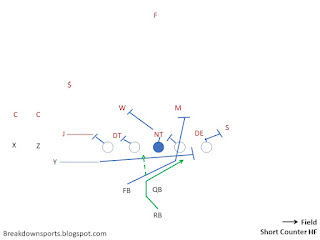
Despite heavily featuring gap run schemes throughout the year, Michigan's plan when facing the vaunted Wisconsin run defense included almost the total elimination of pulling offensive line. In an effort to maintain part of their core playbook, they leaned on a 3-back style offense and "Pull Replace" (replacing a traditional offensive line pull with a back executing the assignment) to retain part of their Counter playbook. In this post, we are going to look at how the Wolverines executed Counter HF from an unbalanced look, how the Badgers responded, and how this scheme can be sequenced off of and run against a variety of formations.

Let's Speak Technique - Club Block

Image
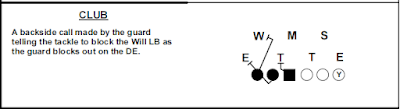
Along the offensive line, it is important to have various techniques and calls that can optimize player strengths, match ups, and angles, and give the opponent different looks. A "Club Block" is a backside combination block in which the backside end man on the LOS (EMOL) will work immediately to the second level, and the blocker inside of him will work out to the end. Club Block 2014 49ers Playbook In our case, we'll use it as an exchange block between the Back Side Guard (BSG) and Back Side Tackle (BST) as well as between a Back Side TE (BSTE) and BST, with the caveat that it is always the EMOL that is releasing directly to the 2nd level.

Inside the Playbook - Throw Back Play Designs

Image
Previously, we looked at why throw back plays work. Next, we looked at OSU taking advantage of the throw back in their play against Minnesota This post will look at different version of the throw back that can be added to your playbook. Elsewhere - Leak Everyone has talked about leak, but at least on my blog, I've never explicitly wrote about it. So let's say this is the chance. Here is a diagram of leak: 2016 Falcons Playbook There are lots of iterations of Leak now, but I want to point out a few things that I like better than others.

Inside the Playbook: Michigan's Down G Run Play

Image
Against Notre Dame, when attempting to attack the edge, Michigan attempted to utilize their traditional pin and pull run scheme . In this scheme, they are traditionally trying to "reach" with the TE to set the edge and pull around and up from there. But against Western Michigan, they adjusted their attack by running a "Down" scheme, rather than attempting to reach at the point of attack. This can be a different play call altogether, or it can be a scouted aspect of the offense and a line call. Either way, let's take a look at how it works.

Inside the Playbook: Bluff and Go RPO

Image
Introduction At the college (and high school) level, RPOs continue to grow more and more challenging to defend. With relaxed rules against linemen downfield, defenses have been forced to maintain coverage longer and longer following the mesh point. No play demonstrates this more than the “Bluff and Go” RPO.

Inside the Playbook: Banjo Coverage and Minnesota's Switch Double Slants

Image
Against Indiana in the Red Zone, Minnesota went to a switch release concept  which paired a basic twins passing concept  to take advantage of bracket coverage. I've long advocated utilizing switch releases from bunch/stacked formations because it often helps the QB better define the coverage and take advantage of defensive coverage tendencies. In this case, Minnesota knew they were going to get a banjo coverage  (effectively, the outside defender will take the first defender to release outside or the second receiver to go inside, and the inside defender will take the first receiver inside or the second outside). Let's take a closer look.

Inside the Playbook: Penn State, Wisconsin, and Michigan and the Use of False Blocks

Image
As a defender, you are tasked with reading your keys in order to properly diagnose the play and fulfill your assignment. Gap responsibility and run fits and execution all start with properly seeing what is happening in front of you, and based on what the offensive line does, will change your path to success. But offenses know this. To a degree, and offense does what it does because that's the easiest and most efficient way of finding success. Other times, they find success with mind games, by showing something and doing another. This post is going to look at "False Blocks", the art of pass setting on runs and false pulls.

Coaching Points: Michigan vs OSU, 2018

Image
I used to do more of these back in the day. Admittedly, this is more about Michigan and a response to some of the criticisms of Michigan from this game. So sorry it's light on the OSU POV. Kirthmon F. Dozier, Detroit Free Press

Film Review: Michigan Iterating to Gain an Advantage in the Pass Game

Image
The best concepts in football tend to build off of other known tendencies. In both the run game and the pass game (and the play action pass game), it is easiest to scheme success when telling the defense one thing, initially, and then turning it into something different. In this post, we're going to look at how Michigan has built off of established tendencies to force the defense to respect multiple things. Kirthmon F Dozier, Detroit Free Press

Inside the Playbook: Michigan's Arc Belly Read

Image
Against Wisconsin, Michigan expanded their QB run package by introducing a Belly Read Option with an arc block from the opposite H-back. In this post, we'll go over some of the advantages of this play and some of the intricacies that make it a successful run within Michigan's overall run scheme. Harbaugh starting to break out the read runs from his 49ers days with Colin Kaepernick. Big run by Shea Patterson was "12/13 EAT". It's zone read arc from 12/21 personnel twins. Closed formation dictates predictable coverage. F arcs for the CB. pic.twitter.com/dt1Hwp74CN — James Light (@JamesALight) October 14, 2018

Film Review: How Don Brown Adjusted Cover to Defend Slants

Image
In the first half of the Michigan-Northwestern game, the Wildcats repeatedly dialed up crucial  gains on simple slant plays. From Michigan's Base Cover 1, this caused coverage problems, especially in the slot where a safety matched up on a WR. In this post, we're going to look at why the early problems existed and what Don Brown did to stop the success of slants while staying within his scheme. Maize and Blue News

Film Review: "Bad Play Calls" Aren't Really Bad; and You Should Feel Bad About It.

Image
If you've followed me elsewhere besides just my blog, you probably have an inkling that one of my biggest peeves is fans selecting specific play calls to complain about postmortem. It takes a conclusion - that a play was not successful - and applies no additional logic to apply a critique. Certainly, like wins, all that matters in the end is that you got one or you didn't; in the end it doesn't matter if it was close or it shoulda or coulda or woulda. But if you want to honestly evaluate anything, you need to dig deeper than that. You need to understand your own teams strengths and weaknesses and those of your opponent. You need to understand tendencies, again, both your own and your opponents. What have you practiced (and the success of what you practiced) and what haven't you. There are a lot of unknowns we can't glean, but if we take some time, we can better understand inputs and give a much more thoughtful, thorough, and accurate critique of "play calling...

Inside the Playbook: Michigan Defending Flat-Back Alignment and OSU/PSU Response

Image
One of my favorite types of articles is discussing what one team does, and does well, and then seeing how other teams adjust to take advantage of that thing. I did it previously in the chess match between Wisconsin and Iowa that we saw in one game . In the future, I want to touch on Wisconsin's offensive gameplan against Iowa to see it from a scouting perspective. But this post is about the Michigan defense and how they tend to play a flat-back formation, and then the different responses we saw from it from OSU and Penn State. I love Don Brown. I want to run through a brick wall for Don Brown. THIS IS BETTER THAN THE FIRST. 🚨🚨🚨DON BROWN IS THE HYPE MAN OF THE YEAR🚨🚨🚨 (NSFW AT ALL) pic.twitter.com/mrPlA1yHoK — The Wolverine Lounge (@WolverineLounge) April 6, 2018 Ok, let's talk some football.

Written in Chalk - RPOs from Pro Personnel - Utilizing FBs/TEs in a Spread World

Image
A lot of talk surrounding Michigan's supposed lean on more RPO schemes has had to do with what is at the base of Jim Harbaugh's scheme: lots of heavy personnel sets and a complex number of run concepts. Some have wondered how the two ideas can converge, despite the fact that Harbaugh himself had previously incorporated RPOs into his offense (albeit with a different type of QB). I've already discussed how Harbaugh can utilize many of his run concepts within an RPO framework , but the question still remains, how do you do that and utilize the bevy of TEs and FBs that are currently on the roster. This post is going to explore utilizing 12 and 21 personnel (pro personnel for short) within an RPO scheme.

Film Review: Shea Patterson and What It Would Mean for Michigan

Image
I’ve fielded a few questions about my thoughts on the Shea Patterson situation. I did something similar for Jake Rudock when he transferred from Iowa to Michigan, so I figured I’d take a brief look at what he would bring to the table. In doing so, it is essentially not to just look at highlights, but also look at his weaknesses and his worst performances. Let’s make one thing clear, the primary reason, above all other reasons, that Michigan is looking to bring in Patterson is because he is incredibly talented. His game is far from without flaws, but in my opinion, bringing him in is much less about the current roster and the staff’s trust in that roster and much more about what Patterson potentially brings to the table. Let’s take a look, and hopefully this isn't all for naught. Photo: AP