Posts

Showing posts with the label Urban Meyer

Inside the Playbook: Michigan Defending Flat-Back Alignment and OSU/PSU Response

Image
One of my favorite types of articles is discussing what one team does, and does well, and then seeing how other teams adjust to take advantage of that thing. I did it previously in the chess match between Wisconsin and Iowa that we saw in one game . In the future, I want to touch on Wisconsin's offensive gameplan against Iowa to see it from a scouting perspective. But this post is about the Michigan defense and how they tend to play a flat-back formation, and then the different responses we saw from it from OSU and Penn State. I love Don Brown. I want to run through a brick wall for Don Brown. THIS IS BETTER THAN THE FIRST. 🚨🚨🚨DON BROWN IS THE HYPE MAN OF THE YEAR🚨🚨🚨 (NSFW AT ALL) pic.twitter.com/mrPlA1yHoK — The Wolverine Lounge (@WolverineLounge) April 6, 2018 Ok, let's talk some football.

Inside the Playbook: Ohio State's Book and Run Scheme and Arrow/Slide RPO

Image
Everybody knows the basic zone read scheme. Block inside zone  (or one of many types of zone ) while leaving the backside DE unblocked for the QB to read. If the DE crashes the mesh point, the QB pulls and runs off the backside. If the DE stays home, the QB gives to the RB who runs basic inside zone. But as defenses get more athletic and more nuanced in their defense of zone read, making this "read" becomes more challenging for the QB. You now have games like scrape exchange, where the DE crashes and the LB fills behind. You have more athletic edge players that can force a give but get back into the play from the backside. One option is to change the read defender , another option is to utilize additional backs to modify the blocking scheme . In this post, I'll talk about an option that utilizes a little of both which dates back to Meyer's time at Florida, in the Book and Rifle schemes.

Film Review: The OSU Drag and Go Concept

Image
Ohio State has been feasting through in the pass game with one of the core tenets of the Air Raid offense: drag routes. Go into any Air Raid passing playbook from Kevin Wilson (or Mike Leach), or looking back at Chip Kelly's Oregon offenses (the current OSU QB coach is Kelly's former QB coach) and you'll notice that probably 50% of the pass plays contain some sort of drag route. Go to your basic pass game concepts  and you'll see that these playbooks are littered with Over, Cab, Crash, Crease, Mesh , and NCAA concepts . Air Raid coaches love these concepts, and so they rep these concepts constantly, because in man coverage their better athletes can run away from LBs or safeties or get beneficial rubs to allow them to run away from CBs. Against zone you can find a void and settle there and wait for the QB to throw you open. In theory, it works against everything. Yet, it still has it's detractors, because if you don't practice it enough, if you don't put in t...

Inside the Playbook: OSU Follow Pivot Concept

Image
Perhaps one of the greatest strengths of Urban Meyer's passing attack is how simplified he makes it for his QBs. Meyer understands the capabilities of his players and the capabilities of the defenses he is facing, and because of that, he is able to limit the amount of decisions his players have to make to allow them to play fast and make the correct decisions repeatedly. In his mind, there is no reason to complicate what doesn't need to be complicated; and that not only makes perfect sense, it also shows a lot of restraint that many coaches don't have. On this play, what we see is a very simple play for the offense to run, but also a play design that gives the defense a lot to think about. Simplifying the game for your team while complicating it for the opponent allows your team to execute at a higher level, and that's a constant theme throughout Meyer's playbook. Today we're going to look at how Meyer dials up what he calls a "Follow Pivot" as a fur...

Inside the Playbook: Ohio State's 2-Back Offense

Image
ORIGINALLY POSTED AT MAIZE N BREW ON 7-25-14 In 2013, Ohio State had one of the best run offenses in the nation. Part of their success came from two-back sets, or more accurately, by motioning a slot receiver - their Percy Harvin role - into the backfield. They lost, in my opinion, the best college RB in football last year, but returning the dynamic Braxton Miller and all their Harvinites, two back sets will likely become more prominent in this year's offensive iteration. In this piece, we will look at why these sets are so difficult for defenses to defend, both from a pre-snap standpoint, and after the snap.

Inside the Playbook: Wham! and The Return of the Trap

Image
Wham I love trap plays; I believe they are one of the best and probably the most under-utilized run scheme in modern football. With more and more emphasis on getting upfield for the pass rush and getting penetration to stop the run game, trap and wham schemes should only become more effective. Yet they continue to go under-utilized. There are several legitimate reasons for this: 1) you’re leaving a first level defender unblocked for some time, which is dangerous as those first level defenders get more and more athletic; 2) simplified defensive rules (i.e. block-down, step-dow n) have mitigated some of the initial success of the scheme. Still, there are ways around all of this to continue to use of one of my favorite schemes: trap and wham. Long Trap

Inside the Playbook: OSU's Tunnel Screen and Slip Screen Action

Image
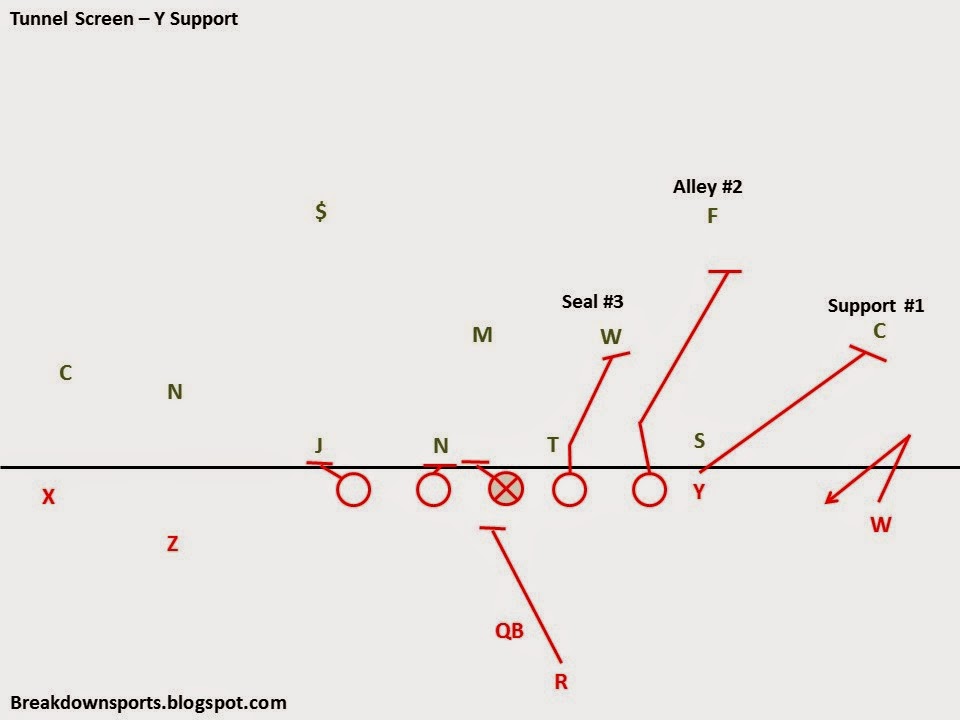
I wanted to quickly go over a play design I really liked but didn’t work out due to poor execution in the Ohio State spring game. One thing I think that happens quite often in football is fans complaining about play calling. If the play call works, it was a great play call; if it doesn’t work, it was a bad play call. There is some truth to that in retrospect, but it’s rarely because of the play design or the conceptual idea behind the play. What I want to look at today is the tunnel screen and then the slip screen off the tunnel screen action. Hit them with: And once they cheat:

Film Review: OSU Tight Zone Wham vs Oregon

Image
 Against a 3-4 Okie front, one of the keys for any offense will be “how can we block the ILBs”. With a standard Tight Zone or Power O scheme, that can be difficult, particularly when the DL can handle double teams and the OLBs can funnel everything back into fast flowing interior defenders. But the Buckeyes found several ways to exploit the Oregon front, getting both outside and punching it right between the tackles. In this post, we are going to look at how Ohio State utilized Tight Zone with a Wham blocking tag to seal the Oregon front and get OL into the ILBs. Eleven Warriors

Tim Beck: Coaching Primer

Image
Tim Beck - Used to wearing red I'm quite familiar with Beck so I can push this out rather quickly.  This is an Interesting hire, but I like It. In general, I liked Beck's scheme at Nebraska. It's more of a stretch zone base, rather than OSU's tight zone, but it typically utilizes more zone based tag schemes than Meyer has in the past (read: more blocking adjustments within zone scheme, or a lot more of this ). It'll be interesting if some of that gets implemented into Meyer's offense, which I'm fairly certain will  still be the base O as it has always been under Meyer (though he has often allowed his OCs to add wrinkles). Warriner will almost certainly be in charge of play calling now, as he's more directly familiar with Meyer's scheme and a promotion is in order to keep him around. Meyer has tended to prefer to promote from within as well. Hit the jump for more on coaching ability, fit at OSU, and offensive wrinkles he may add.

Film Review: OSU's Split Zone and the 60 Y Curl

Image
Previously, we talked about OSU utilizing split zone as a viable way to simplify the read option game for inexperienced QB Cardale Jones. But to move the football in the college game, you still need some semblance of a passing threat. Rather than forcing their QB to make complicated reads or fit the ball into tight windows, Urban Meyer and Tom Herman dialed up a simple play action pass concept to allow Jones and his receivers to be effective while not needing to over think. In this post, we’ll look how this “3-Verts” concept works, and more specifically, how it works as a great addition to the split zone play .

Inside the Playbook: Ohio State's Split Zone Run Play

Image
Ohio State essentially started their third different QB of the season a couple weeks ago. Most teams talking up this type of fact are on the wrong end of an unexpected season, however, in this instance it wasn’t following a disappointing season. In fact, this discussion happened before and after the Buckeyes were able to put up 31 first half points on offense against a previously stout Wisconsin Badgers defense. And this wasn’t just any regular season game, it was the conference championship game. But it wasn’t because Cardale Jones – the new starting QB for OSU – came in and played lights out with the full plethora of the playbook. Instead, the surrounding Buckeye cast stepped up their game, including the coaching staff. While receivers bailed out dubiously thrown balls, Head Coach Urban Meyer and Offensive Coordinators Tom Herman and Ed Warinner planned and called a simple, straight forward, and forgiving gameplan that allowed Jones to be productive while being protected, despite on...

Film Review: Ohio State's OZ Pin and Pull BOB Read

Image
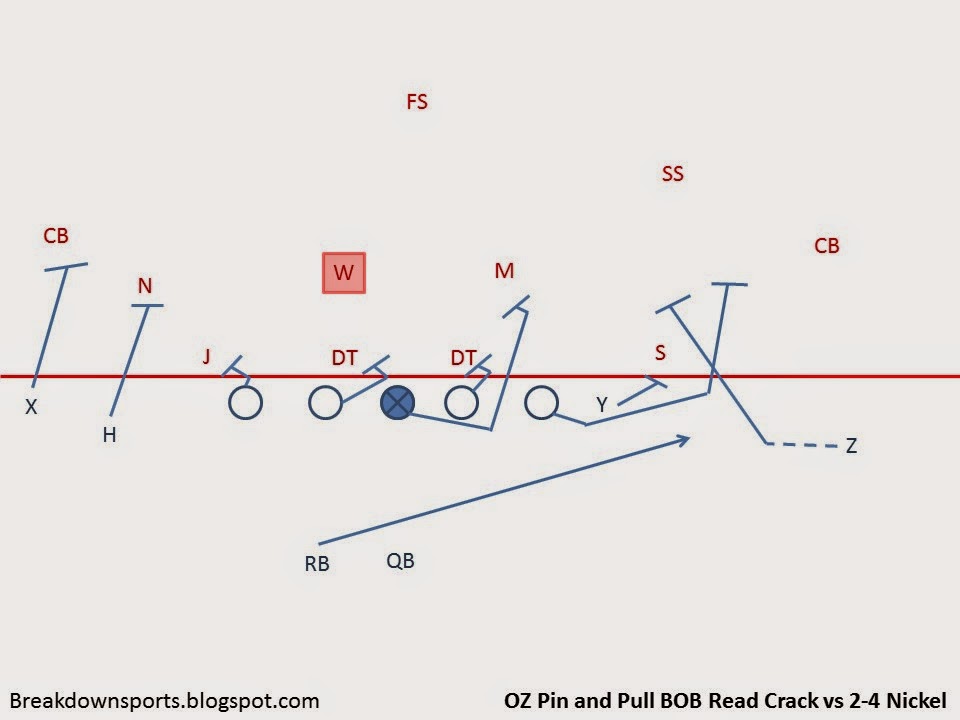
Wisconsin utilized a one-gap 3-4 defense (and 2-4 Nickel package) this past season that forced a lot of teams to stagnate. This was done by having the three DL account for interior gaps, while keeping the inside LBs clean to crash down and scrape over the top. Meanwhile, the OLBs forced everything back inside to help. In theory this constricted the offenses the Badgers faced and forced them to play in a tighter area, which is an advantage for the defense. One of the proverbial ways teams adjust for this is by running what is known as pin and pull. The Buckeyes were well aware of that outside zone adjustment, and along with a change in the QB Read, saw them able to get to the edge of the defense for several big first half gains on the ground.

Inside the Playbook: Ohio State's Speed Option Package

Image
Originally poster at Land-Grant Holy Land  on 12-5-14 Urban Meyer has developed the speed option into more than just a constraint play. Through the years, he has implemented multiple constraints that build off of the speed option threat. Against Wisconsin's 3-4 defense, the speed option can be a serious threat that isolates the OLBs away from the sealed defense. We'll look at the origins of the speed option, it's evolution, how OSU can work off of it, and why it will be so important in the 2014 B1G Championship Game against the Badgers. The speed option is one of the simplest methods of attacking the edge with an option play. Smart Football describes it as "simple" and "inexpensive" in that both the concept and scheme are simple and it takes very little teaching and practice time to do well. This is why the speed option has crept into offenses that tend to shy away from option elements, because it's a simple enough way to attack the edge with s...

Inside the Playbook - 7-Ins Concept

Image
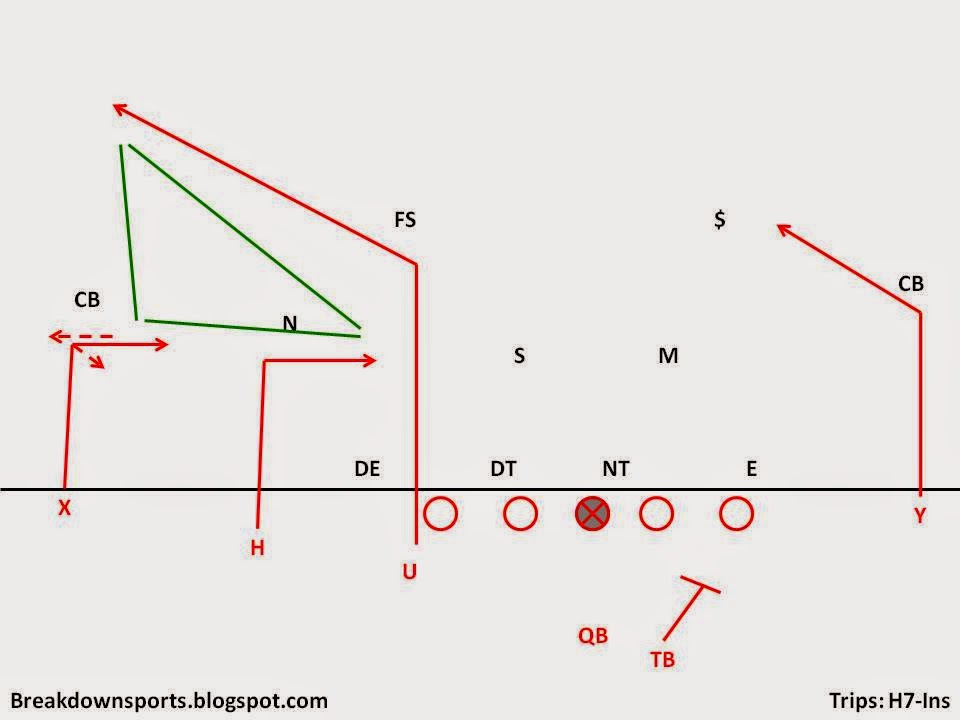
The 7-Ins passing concept pairs two of the most primitive passing concepts and puts them on the same side of the field. The Double-Ins work much the same way as Double-Slants and provide a nice single-high safety beater. The Corner route (7) paired with the outside In route works similar to a Smash concept, and creates a High-Low on near the sideline that works against most 2-high safety defenses. By putting them on the same side, you’ve simplified the amount of field that the QB is forced to read. In this way, you’ve created a delta concept toward the sideline out of two of the most standard, and effective, route concepts in modern football.

Inside the Playbook: Pairing the Sail and Cab Concepts

Image
Originally posted at LGHL on 9/5/13 Urban Meyer is one of those coaches that, if you sit in a coverage and don't mix it up, he's going to take shots and he's going to put up points. Buffalo did mix up their coverages a bit on Saturday, but they did it in runs for some odd reason. Starting in Cover 1; getting burned. Move on to Cover 0, get veer read to death. Try to put two deep safeties and mix in Cover 4, yeah, alright,;show it a few times and a TD is going to happen. Well, that's what happened on Saturday. In this post, I want to look specifically at OSU's first TD this season; then, in the next piece, we'll look closer at how Kenny Guiton was able to come in and quickly throw a TD himself when Buffalo switched a two-high look.