Posts

Showing posts with the label Defense

Quick Hit Film Review - Wisconsin Defending Gap Scheme Runs

Quickly, I wanted to talk about how Wisconsin is so good at defending gap run schemes. In the video below, I talk about what makes the Badgers defense so good in that regard. Have gotten some love from Wisconsin, so here’s some love back. Watch how well the whole front plays this gap scheme. Box player keeps it inside. 4T holds up to down block. NT fights back on combo. PSLB scrapes right off 4T butt into hole. BSLB ball hits all the way outside PSLB pic.twitter.com/wO4wkAniak — Space Coyote (@SpaceCoyoteBDS) June 15, 2022
Football Fundamentals: The Tite Front Defense

Image
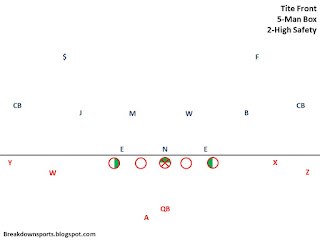
The defense du jour against modern spread attacks is what is commonly known as the “Tite” front. Over the past couple years, you’ve seen Big 12 teams run it increasingly often, and SEC and other teams start to incorporate variants of the look more often as well as they begin to deal with an increasing number of spread formations. But what exactly is the “Tite” front? Like any front, say, a 4-3 Under, it isn’t necessarily any one thing. You can have single-high, two-high, or even three-high safeties. You can attach your overhangs differently. And with Tite, it may even mean different box numbers. And of course, there are multiple techniques that can be employed along the way. This post is a primer to the Tite front. At the end, I’ll link some of the better articles that get into greater depth for those interested, but for now, we need to understand the basics, so that we can understand how to attack it.

Film Review: How Don Brown Adjusted Cover to Defend Slants

Image
In the first half of the Michigan-Northwestern game, the Wildcats repeatedly dialed up crucial  gains on simple slant plays. From Michigan's Base Cover 1, this caused coverage problems, especially in the slot where a safety matched up on a WR. In this post, we're going to look at why the early problems existed and what Don Brown did to stop the success of slants while staying within his scheme. Maize and Blue News

Inside the Playbook: Michigan Defending Flat-Back Alignment and OSU/PSU Response

Image
One of my favorite types of articles is discussing what one team does, and does well, and then seeing how other teams adjust to take advantage of that thing. I did it previously in the chess match between Wisconsin and Iowa that we saw in one game . In the future, I want to touch on Wisconsin's offensive gameplan against Iowa to see it from a scouting perspective. But this post is about the Michigan defense and how they tend to play a flat-back formation, and then the different responses we saw from it from OSU and Penn State. I love Don Brown. I want to run through a brick wall for Don Brown. THIS IS BETTER THAN THE FIRST. 🚨🚨🚨DON BROWN IS THE HYPE MAN OF THE YEAR🚨🚨🚨 (NSFW AT ALL) pic.twitter.com/mrPlA1yHoK — The Wolverine Lounge (@WolverineLounge) April 6, 2018 Ok, let's talk some football.

Football Fundamentals: Cover 2 Defense

Image
Cover 2 is often one of the first zone defenses taught in football. This is because it requires minimal movement, allowing defenders to focus on the “zone” aspect of the coverage. Just as important, because of the minimal movement and design of the coverage, it lends naturally to being a great run defense as all eyes are often focused on the backfield. Once seen as the go-to defense in football, it has fallen out of favor in the past few decades with the development of more advanced and complicated vertical passing attacks. However, recently it has seen somewhat of a resurgence with the “trap” concept, and it remains a favorite near the goal line. For completeness, man under will be treated in a different article.

Review: Has the Window Closed for Michigan State? The Growth, Dominance, and Future of the Spartan Defense

Image
Back in January, Ian Boyd dropped the disrespect alarm on many within the Spartan fan base when he seemed to indicated that the Michigan State run of success may be coming to an end. Review: Has the window closed for Michigan State I don't necessary believe that Boyd was necessary calling the demise of MSU football with his article. Nonetheless, it's understandable for MSU fans, who have been hearing that same, repetitive rallying cry for nearly a decade, to attempt to shoot him down. In the process of doing so though, I believe some pertinent points have been missed. In this post I'll discuss my thoughts on Boyd's article, where I agree with him, and where I'd like to expand on his thoughts.

Inside the Playbook - Michigan Defending the OL Pull

Image
Michigan's offense is going to pull a lot of OL. Similarly, Michigan's defense is going to see more teams increasingly go to pulling OL as more teams shift back to man/gap schemes and away from the zone oriented teams. Of those plays, Power O is probably the most relied upon for opponents. In this article, we are going to look at how Michigan defends the Power O and why they defend it this way. In my next post, I'll discuss how an offense can react to it. Previously, I've discussed how MSU defends Power .

Football Fundamentals: Defensive Gap Discipline vs Formations, Pulling OL, and FBs

Image
For a defense to be successful, they need to have "gap discipline". Being "gap sound" means having a defender in place to stop the offense on both sides of every blocker. By having a defender responsible for stuffing the play in each gap, the defense forms a wall at the LOS, and the offense has no way to be successful. It's the offense's goal to force the defense to lose gap discipline or be unable to cover the gap (by creating space). Each gap is an option for the ball carrier, and each open gap is potential for the offense to spring a play. In this post, we'll look at how gaps form against a few formations, and how lead blockers and pulling blockers change the numbers at the point of attack.

Inside the Playbook: Breaking Down Michigan's DL Scheme and Personnel

Image
Recently on MGoBlog, Brian wrote a piece previewing the defense  as far as his expectations. In the past couple days, he's also discussed the Defensive Line and looked at the recently released Michigan depth chart . A question keeps arising, unknowingly getting answered, and then asked again. It's a common confusion, and an understandable one when looking at nomenclature of football. AP Photo In this post, I'm going to look at Michigan's DL and why Henry is playing 5-Tech (nominally, from now on called End) and Wormley is playing 3-Tech (nominally, from now on called Tackle).

Football Fundamentals: Cover 4 Front Seven Leverage

Image
We talked previously about the variety of Cover 4 coverages that allow defenses to mix up their look and reaction to routes while still playing what is essentially the same basic scheme. This time, I’m going to move away a bit from what is done post snap and look at how a defense can be benefitted by pre-snap positioning; that is: leverage and depth. In this way, you can combat some of the offense’s strengths while still maintaining your base scheme. This article will focus on the position of the front 7 and what they can do to benefit the coverage scheme.

Let's Speak Technique: Form Tackling and Rugby Tackling

Image
A new trend is taking over football in the form of a tackling technique known as "the rugby tackle". Popularized initially by Pete Carroll out in Seattle, it was recently adapted by Ohio State's Defensive Coordinator Chris Ash prior to the Buckeye's 2014 run to the national title. EAMON QUEENEY | DISPATCH In this article, I want to discuss the techniques of what I term "form tackling" and "rugby tackling". I am of the opinion that form tackling is a sound, safe, an efficient form of playing defensive football. I also believe rugby tackling to be highly effective. So what is my preference? Between the two, I personally don't have one; my preference is for safe, technically sound tackling that prevents the ball carrier from picking up yards and getting my defense off the field. It is my conviction that the importance lies in the technique and the ability to get your players to buy into that importance. So let's start tackling this subje...

Film Review: Over Gut 6

Image
Two different B1G teams ran the exact same zone blitz scheme on Saturday, and both teams successfully got to the QB. The scheme: Over Gut 6. This is a scheme that Monte Kiffin loved to run dating back to his time with the Bucs, and more than a decade and a half later, it’s still working in major college football (it’s probably more accurate to say Tony Dungy loved to run it with the Vikings, but I don’t have proof of that). Let’s first go over how it is run and then show examples of both PSU and Michigan running it successfully.

Football Fundamentals: One-Gap 3-4 Defense

Image
As teams begin to get faster, more spread out, and more pass heavy on offense, a way many defenses are counteracting this is by moving to a 3-4 defense. A 3-4 defense sacrifices some of the beef, at least in terms of numbers, at the LOS in favor of an extra LB (relative to a 4-3). However, not all 3-4 defenses are equal. From a high-level POV, there are two standard types of 3-4 defenses: One-Gap and Two-Gap. Both have different strengths and weaknesses and are generally played differently. In this article, we’re going to focus on the One-Gap 3-4 defense, it’s nomenclature, it’s strengths and weaknesses, the fundamentals of the front, and how it generally plays against a variety of offensive sets.

Football Fundamentals: Cover 1 Defense Adjustments

Image
Like all coverages, coaches have developed adjustments and checks to mitigate some of the weaknesses of a coverage, or to hinder some of the methods offenses use to attack the defense without switching up the coverage entirely. This is done for teams with certain strengths, against certain formations that look to exploit some aspect of coverage, or to take advantage of offensive tendencies in certain situations. These adjustments can be called in the huddle based or they can be checked based on the offensive look or motion pre-snap. In this piece, we’ll go over some of the things Cover 1 defenses do to adjust to offenses. As a primer, here's your standard Cover 1

Inside the Playbook: Defending the Speed Option with a Two-High Defense (BDS Exclusive)

Image
Last time we looked at how Michigan attempted to stop Nebraska’s speed option attack with a Cover 1 . Not finding much success, the very next week, facing Northwestern, they turned to more two-high coverages in the face of the Kain Colter lead spread attack. In this post, we’ll look at how Michigan utilized a two-high man under and Cover 4 to defend the speed option. How the Speed Option is Run Be it under center or from the shotgun, the speed option is essentially the same. The offensive line, in the case of most modern day offenses, will run their standard outside zone blocking scheme. The one difference is that the offense will bypass the defense’s EMOL toward the play and instead work to the 2 nd level. The defender left free with be the option defender, the player that the QB will read to determine if he will keep the ball and run it himself or pitch the ball to his RB. Here is how it looks: Northwestern will also occasionally run a true triple option from th...

Inside the Playbook: Michigan State's Cover 4 Defense

Image
ORIGINALLY POSTED AT MAIZE N BREW Introduction Last time we discussed MSU's front 7 scheme . Their front 7 sets up a lot of their success, but that success is also tied to their favorite coverage: a variation of the Cover 4 . State is pretty much aggressive at every defensive position on the field, and this steps from how the back 7 play together in coverage. In this part, we are going to look at how MSU's cover 4 differs from most, how they run their cover 4, and how it all ties together to make one of the better defensive units in the nation. Cover 4 By looking at this play diagrammed, it looks like it's some sort of soft, prevent defense. The way MSU plays it is anything but. Still, most teams that run a cover 4 play a little softer on the outside, but still is far from a cover 4. In fact, the cover 4 plays more like a man coverage than a zone coverage, how so and why, well let's look at a table that describes some of the defensive responsibilities. P...

Inside the Playbook: Defending the Speed Option in Cover 1 (Preview)

Image
Leaving the offense for a minute, perhaps the most aggravating thing from the Nebraska game was Michigan's inability to defend the speed option. Unfortunately, this has seemed to be a common trend for the Mattison defenses since his arrival back in Ann Arbor. But why? Is Michigan doing something inherently too difficult to accomplish? What are they really asking their defense to do? In this post, we will look at how Michigan has tried to defend the speed option in the past, what went wrong against Nebraska, and how Michigan will look to fix this issue this year. How the Speed Option is Run Be it under center or from the shotgun, the speed option is essentially the same. The offensive line, in the case of most modern day offenses, will run their standard outside zone blocking scheme. The one difference is that the offense will bypass the defense's EMOL toward the play and instead work to the 2nd level. The defender left free with be the option defender, the player that the QB ...

Inside the Playbook - Going 4-3 (Over) MSU's Front 7

Image
Originally posted June 27, 2013 at Maize n Brew Introduction When looking at Michigan State's defense, there are two things that will be seen on almost every single play: 4-3 over front and cover 4 behind it. Unlike the coverage portion of the defense, the front 7 plays fairly similar to most of their 4-3 over counterparts. In this part of the series, I want to look at what a 4-3 over defense is, what some of the weaknesses to the front are, and how MSU adjusts in an attempt to mask the inherent weakness of the front 7 scheme. For reference, here's the gap scheme: 4-3 Over Side Align Tech Key Run To Run Away Pass Strong 9 tech TE D Gap C Gap - Chase Left Outside Contain Strong 3 tech OG B Gap B Gap - Squeeze A Gap B Gap Weak 1 tech C A Gap A Gap A Gap Weak 5 tech OT C Gap C Gap - Chase C Gap Strong 60 tech OG to RBs C Gap A Gap - Slow Pursuit* Strong Strong 00 C to RBs A Gap B Gap Weak 40 tech OG to RBs...

Film Review - Cleaning up Coverage

For the most part Michigan played pretty solid in coverage against MSU, but also had some significant busts that lead to big gains for the Spartans. There have been some questions about a few of the ways that Michigan has worked in coverage, and I'll briefly discuss how Michigan plays man coverage to help clear that up as well. At the end of the day, what you see from this exercise though, is that you can be very good most of the day, but if just a few mistakes get exploited, the opposing team can put up points. Man Coverage People have been wondering about if Michigan is doing this right. Namely, the common complaint is not turning back and looking for the ball. In man coverage, once you flip your hips, you have two basic techniques you will play: in-phase (in-sync, in-step, in-line, even) and trail. In-phase means that you have your hip on the front side of their hip and your shoulder on the front side of their shoulder, and you're using your body to gradually defl...

Film Review: How MSU Adjusted Their Cover 4 to Shut Down Notre Dame

Image
Introduction Michigan State is known for their use of the Cover 4 defense, pretty much all day every day. While they occasionally make forays into other defenses, it is more often the nuanced changes they make within their cover 4 that confuses offenses. Against Notre Dame, the Spartans rolled up their safeties and played them a bit tighter to the #2. We'll look at how this affected Notre Dame, how the Fighting Irish tried to counter this, and how Michigan State was still able to hold down their offense. Cover 4 - ND's Initial Attack Previously I have written about MSU's defense, both  their front and their  favorite coverage . Against Notre Dame, Narduzzi and Dantonio made a nuanced adjustment with how they played their safeties. One of the constraints offenses run on MSU's defense is the bubble screen to the field side. They attempt to draw the OLB in against the run and bubble outside, putting him in a quandary to defend both inside and out and be responsible fo...