Posts

Showing posts with the label 12 personnel

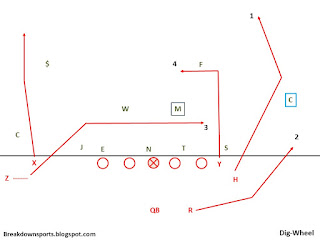
Inside the Playbook: Iowa TE-Wing Dig-Wheel Concept
Image
Iowa wasn't able to pull out a win against Wisconsin, but that doesn't mean schematically they didn't do some interesting things. On their first long TD, they brought out a TE-Wing and ran a Dig-Wheel Concept. In this post, I want to show how this concept works within their offense and why the design was something worth looking closer at.

Written in Chalk - RPOs from Pro Personnel - Utilizing FBs/TEs in a Spread World

Image
A lot of talk surrounding Michigan's supposed lean on more RPO schemes has had to do with what is at the base of Jim Harbaugh's scheme: lots of heavy personnel sets and a complex number of run concepts. Some have wondered how the two ideas can converge, despite the fact that Harbaugh himself had previously incorporated RPOs into his offense (albeit with a different type of QB). I've already discussed how Harbaugh can utilize many of his run concepts within an RPO framework , but the question still remains, how do you do that and utilize the bevy of TEs and FBs that are currently on the roster. This post is going to explore utilizing 12 and 21 personnel (pro personnel for short) within an RPO scheme.

Inside the Playbook: Wisconsin Lead Power O, Power O, and Counter with F/H Part II

Image
In this post, we'll continue to look at how Wisconsin utilizes the Wing to run Power O. Wisconsin will utilize 12 personnel most often, but will also sprinkle in 11 personnel or even 13 personnel to run this play. And while they can still run a traditional, I-Form Power O, I want to focus specifically on what they do with a TE off the LOS, and how they utilize that as well as anyone in college football to add a blocker from the backside, and insert him at the point of attack. Part 1 can be found here

Inside the Playbook: Wisconsin Lead Power O, Power O, and Counter with F/H Part I

Image
In this post, we are going to look at how Wisconsin utilizes the Wing to run Power O. Wisconsin will utilize 12 personnel most often, but will also sprinkle in 11 personnel or even 13 personnel to run this play. And while they can still run a traditional, I-Form Power O, I want to focus specifically on what they do with a TE off the LOS, and how they utilize that as well as anyone in college football to add a blocker from the backside, and insert him at the point of attack.

Inside the Playbook: Wisconsin's use of Dos, Tight Bunch, and Wings in Formation

Image
As we cover Wisconsin over the next few pieces, we are predominately going to focus on three formations: Dos (Tight Double Wing), Tight Bunch, and I-Form. Wisconsin finds ways to use FBs and H-Backs within the offense, to lead block, to run rubs, or to even to cross flow. In this post we will first cover the high level benefits of these formations for Wisconsin. In the next posts, we will go into depth into specific plays, predominately run out of these formations.

Football Fundamentals: Multiple Read Option Attack with Two Backs

Image
We’ve talked about the basics of zone running ; we’ve talked about adding an additional back into the backfield ; we’ve talked about the various ways you can utilize outside zone and inside zone and multiple reads to make like more maddening for the defense; now let’s mash it all together and look at a zone read option based approach with multiple backs. Having multiple backs allows us to utilize all the advantages we talked about in the multiple back piece, but the threat of the read and the option allows for some other creative means of attacking a defense. In this post, we will explore those options.

Football Fundamentals: Zone Running Scheme Variety Utilizing Multiple Backs

Image
Previously we looked at the basics of the zone blocking scheme . To do so, I drew up the plays in 12 personnel. While 12 and 11 personnel served as the catalyst for many of the early success of the zone blocking scheme, many teams began adding complexity and different looks to the scheme by implementing variety through the use of FBs and H-backs. Previously, in man/gap schemes, FBs used as lead/kick blockers or as deception for the backfield flow was deemed as a near necessity to run the football. Zone offenses saw this advantage, and as the scheme has developed, many of these advantages have been implemented into a zone based scheme as well. In this post, we will look at how tags can be used to modify the zone blocking scheme and attack defensive strengths and weaknesses and provide various looks for the opponent. The player identified by the red box will be the player the back is attempting to block. I don’t show all the multiple options and formations (obviously) that you can run ...

Football Fundamentals: Zone Blocking Schemes

Image
Zone based blocking schemes have become the primary blocking scheme of many modern day football teams. As defenses have made their formations and run blitz packages more complex and confusing for offensive units to block, the zone blocking scheme provides simplification in some ways. While it may take more reps to get the feel for how to come off combination blocks, secure the first level, and attack the second level than a traditional man/gap blocked scheme does, it provides a relatively straight forward plan for how and who to block after the snap has been made. In this post, we are going to look at the basics of the zone blocked scheme before we get into some of the greater intricacies at another time.

Inside the Playbook: Wisconsin's Rushing Attack Bread and Butter

Image
Originally posted at Land-Grant Holy Land on 9/24/13 Over the past, oh, I dunno... Let's just leave it as in the past, Wisconsin has been known for their potent run game. While Alan Ameche, that old Iron Horse, isn't walking through to run his offense any time soon, the Badgers seem to be doing pretty well dating back to the Alvarez era, er, the Alvarez coaching era, er, that first time Alvarez was coaching Wisconsin on the sideline, and, well, this introduction is all over the place. But I *do* have a great Alan Ameche story for those willing to hear, for those who like old timey stories that may or may not be true about really old Wisconsin Heisman Trophy winners. For another time, I suppose.

Film Review: Wisconsin's 3-4 Against Iowa's 2 TE Offense

Image
This year Wisconsin has switched to a 3-4 defense, and one of the benefits is the benefits it gives verse defenses that try to spread them out horizontally. This can mean how it adapts to spread concepts, but also, how it adapts to many 2-TE personnel groupings that try to gain an advantage by creating more gaps for the defense to fill. The 3-4 puts 5 people on the LOS, it provides outside leverage, it provides strength at the point of attack, and makes it relatively easy for the ILBs to scrape to the ball. Basically, if defenses read their keys, the 3-4 is the perfect defense to handle a 12 personnel offense. The 3-4 Against Iowa’s 2-TE Set First, here is how Iowa will want to block this: Wisconsin’s two DEs (DE and DT) are lined heads up on the OTs in a 4-tech. The ILBs are lined up in a 20 technique, which is heads up on the guards, about 3-4 yards off the LOS. The NT is lined above the center, and both OLBs are lined up in a 9-technique with their inside shoulder j...