Posts

Showing posts with the label pin and pull

Inside the Playbook: Why Run to the Short Side of the Field

Image
 It’s a question regularly asked, “ Why is my favorite team constantly running to the short side of the field ?” People really do not enjoy jet sweep to the short side . In almost every sport you are taught the concept of using the sideline as an extra defender, and in football it is no different. And in the current era of football, the idea of space is emphasized as much as it has ever been: you have extra wide WR splits, you have light personnel groupings, stretch the field not just horizontally but laterally. So then why does it always feel like the runs aren’t utilizing that space? Space is a fundamental source of success in modern football, but it is not only the offense that controls space and how it can be used; defense also plays a role. Space is also only a single fundamental facet, others include leverage and numbers. And when you take all those traits into account, that will explain why runs into the boundary are run as often as they are. Let’s take a ...

Inside the Playbook: Michigan's Down G Run Play

Image
Against Notre Dame, when attempting to attack the edge, Michigan attempted to utilize their traditional pin and pull run scheme . In this scheme, they are traditionally trying to "reach" with the TE to set the edge and pull around and up from there. But against Western Michigan, they adjusted their attack by running a "Down" scheme, rather than attempting to reach at the point of attack. This can be a different play call altogether, or it can be a scouted aspect of the offense and a line call. Either way, let's take a look at how it works.

Football Fundamentals: I-Formation RB Zone/Gap Combo Plays

Image
This is a series post with lots of play diagrams. Where it lacks depth, it hopefully makes up for with breadth. The goal of this post is to demonstrate the many run game nuances that are at your disposal, outside the very basics that you can find almost anywhere. I will point out some key attributes for the plays, but for the most part the diagrams will stand alone outside a brief description. This post is limited (out of necessity) to strongside plays that are given directly to the RB. It does not include FB runs, or QB runs, or H-Back, Wing, TE, or WR runs. It also doesn't include option plays. Those are things for future posts. Why did I select an I-formation, which is mostly going out of fashion, and how do I expect this information to be utilized? The I-Formation is a classic 2-back set that, by the time it was implemented, had the benefit of a lot of football history. It is also a highly adaptable run formation, along for offsets, for H-backs, and other aspects that allow es...

Football Fundamentals: RPO Pass Concepts - Quick Hitters

Image
Now that we've covered the "read" offense and concepts that occur behind the LOS , let's now turn our focus down field a bit. This is where the RPO scheme is currently most dangerous, both at the lower levels, as well as at the college and NFL level. This is the quick passing concepts that are tied to the run threat. Let's take a look.

Inside the Playbook: Michigan State Pin and Pull

Image
Coming off of one of the least productive years for the MSU OL in some time, the Spartans have largely retooled the unit and are planning to press quite a bit of youth into the starting lineup. Their current starting line up and key rotational players  look like this : Position LT LG C RG RT LT2 OG2 C2 OT3 Player C. Chewins T. Higby B. Allen D. Beedle L. Campbell D. Finley K. Jarvis M. Allen J. Reid Year RS-SO RS-SO SR RS-JR RS-FR RS-SR FR RS-FR FR Height 6-8 6-5 6-2 6-5 6-5 6-7 6-4 6-3 6-4 Weight 284 293 302 329 293 307 312 301 271 I would argue some of these weights are likely getting a "college roster" bump as well. This is not the beefiest of beef units to set foot in Spartan Stadium. Not that long ago though, Michigan State featured one of the most diverse run blocking playbooks in the league, right up there with Harbaugh's Michigan teams. They ran Power, Counter, Sweeps, Traps, Inside Zone, Outside Zone, and yes, Pin and Pull. But as the skill diminis...

Inside the Playbook: The Pin and Fold Inside Zone Scheme

Image
In an MGoBlog piece "Fee Fi Foe Film: Illinois Offense" , Ace pointed out an interesting wrinkle that Illinois utilizes on the backside of their inside zone, which I call "Pin and Fold". I had seen this wrinkle previous in an article from Ian Boyd at least partially about current Iowa St. coach Matt Campbell, and I've also written briefly about it on my own . Now that it has appeared again, this time in the Big Ten, I have the opportunity to write a little more about it.

Inside the Playbook: Iowa's Lead Stretch Zone

Image
Iowa football has been utilizing the base stretch run scheme that made the likes of the Washington Redskins and Denver Broncos dominant in the 90s and into the new century. I’ve discussed outside zone quite a bit before , as have many other places ; rather than continue along the same lines, I’m now going to make a distinction and a further distinction with regards to Iowa football. There is Outside Zone – also known as wide zone – where the intent is to out flank the defense and get to the edge; this is most commonly seen from spread teams. Then there is zone stretch, where the ball can bounce to the outside, but more often than not will be cut inside the EMOL, this is the classic Joe Gibbs and Shanahan offense. Both can be called stretch or wide or outside zone, it’s more of a philosophical difference (though in Gibb's case, he had a play called "bounce" and a play called "Outside", that were just that very distinction). Iowa also adds in the lead bl...

Football Fundamentals: Pin and Pull Scheme

Image
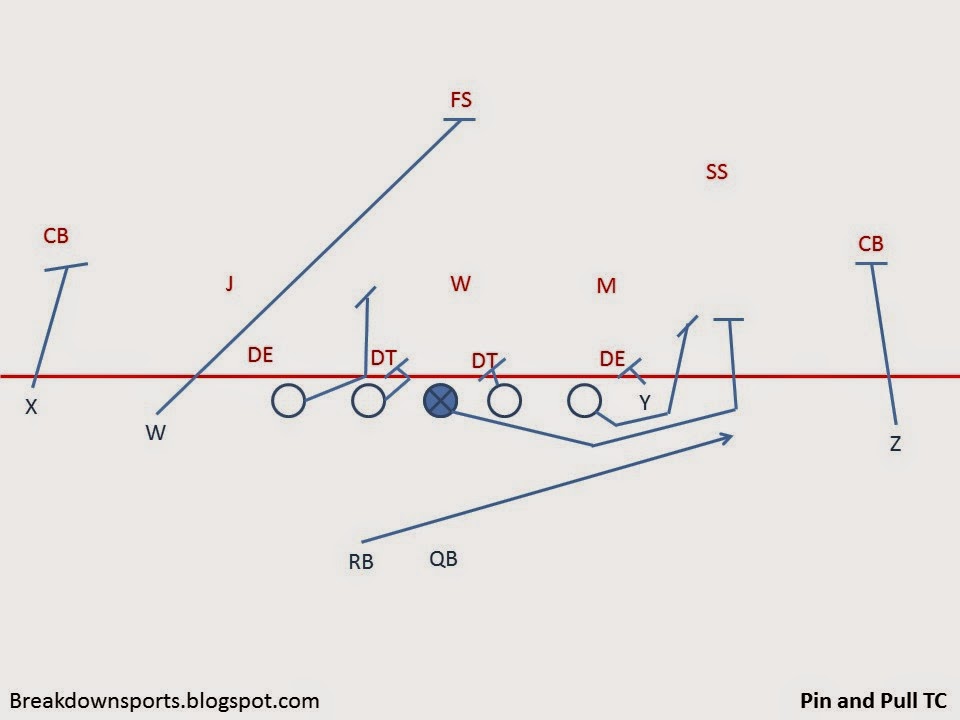
The zone stretch scheme (outside zone or wide zone) has long been a favorite was for zone-based offenses to get to the outside, or at least stress the defense horizontally. Teams like Iowa have long used it as their base run play from a single back, pro-style set (often 12 personnel), while teams like Northwestern have often used it to threated defenses from a spread formation. Many other squads, including Maryland, Indiana, Penn State, OSU, Michigan, and MSU have recently had this play in their dossier. But when it is known to be the base of your rushing attack, it has fairly obvious keys that allow defenses to attack it and shut it down, either through formation or through how they attack post-snap, so at times it helps to have variants of the same play. That is where the pin and pull concept comes into play. The pin and pull concept is essentially a gap/man tag for the OL to switch to in order to attack with what is essentially the stretch scheme. Let’s take a look.

Inside the Playbook: Indiana Breaking Tendencies to Run Outside the OTs

Image
Indiana, predominately, was an Inside Zone Read based team with Tevin Coleman. Coleman’s ability to pick through traffic and utilize his power allowed him to churn out a bunch of yards between the tackles, and his vision and cutback ability made him deadly to turn a modest frontside gain into an explosive cutback run. But what I enjoyed most about Indiana’s scheme when utilizing Coleman was their changeup plays for getting outside the tackles. When talking about Inside Zone, you’re looking for vertical displacement of the defense. You punish the first level defenders with powerful double teams and release into the second level defenders to form multiple run alleys along the LOS. To counter this, defenses are forced to start shooting down in an effort to form a wall at the LOS. This makes it so OL have to get off doubles earlier, and so doesn’t allow for that vertical displacement. But through Outside Zone, Pin and Pull Zone, and OG Sweeps, the Hoosiers were able to take advantage of t...

Film Review: Ohio State's OZ Pin and Pull BOB Read

Image
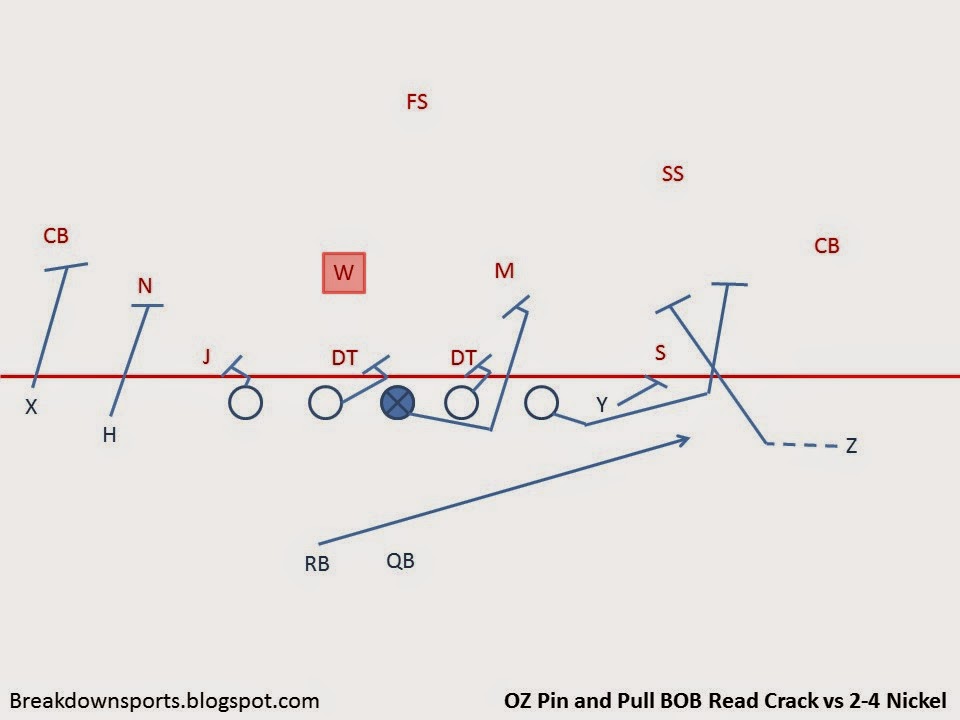
Wisconsin utilized a one-gap 3-4 defense (and 2-4 Nickel package) this past season that forced a lot of teams to stagnate. This was done by having the three DL account for interior gaps, while keeping the inside LBs clean to crash down and scrape over the top. Meanwhile, the OLBs forced everything back inside to help. In theory this constricted the offenses the Badgers faced and forced them to play in a tighter area, which is an advantage for the defense. One of the proverbial ways teams adjust for this is by running what is known as pin and pull. The Buckeyes were well aware of that outside zone adjustment, and along with a change in the QB Read, saw them able to get to the edge of the defense for several big first half gains on the ground.

Inside the Playbook - Michigan's Rushing Attack, 2014

Image
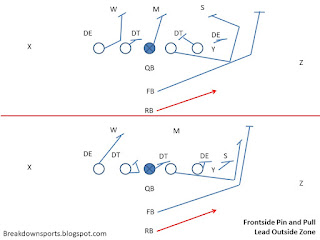
Daniel Mears / Detroit News Under Doug Nussmeier, Michigan has switched to a predominately zone scheme. There are two typical types of zone runs: Inside Zone and Outside Zone. But that’s not all Michigan runs. They also utilize several gap and man blocking schemes to counter the standard zone schemes. Furthermore, they utilize several pin and pull adjustments to their zone stretch scheme to attack the edge. One thing I'd like you to do when looking at the diagrams is to split them in half through the center. Notice the playside and the backside throughout this post. What that will show you is what the defenders to that side of the field are seeing, and why it is difficult to defend all these concepts. The diagrams below are all from an I-formation with a FB. But it's important to note that these plays can all be run from a pistol set or a shotgun set, with a FB, or H-back, or even at times simply a TE, making them diverse throughout multiple formations.

Film Review: Wisconsin's 3-4 Against Iowa's 2 TE Offense

Image
This year Wisconsin has switched to a 3-4 defense, and one of the benefits is the benefits it gives verse defenses that try to spread them out horizontally. This can mean how it adapts to spread concepts, but also, how it adapts to many 2-TE personnel groupings that try to gain an advantage by creating more gaps for the defense to fill. The 3-4 puts 5 people on the LOS, it provides outside leverage, it provides strength at the point of attack, and makes it relatively easy for the ILBs to scrape to the ball. Basically, if defenses read their keys, the 3-4 is the perfect defense to handle a 12 personnel offense. The 3-4 Against Iowa’s 2-TE Set First, here is how Iowa will want to block this: Wisconsin’s two DEs (DE and DT) are lined heads up on the OTs in a 4-tech. The ILBs are lined up in a 20 technique, which is heads up on the guards, about 3-4 yards off the LOS. The NT is lined above the center, and both OLBs are lined up in a 9-technique with their inside shoulder j...