Posts

Showing posts with the label Counter run

Written in Chalk: How to Attack Loose Alignment Tite/Mint Defenses in Run Game

Image
Tite and Mint continue to be the defense du jour among Twitter followers, and as college teams start looking at what some of the best defenses did last year, I anticipate even more will start to implement the front into their package in some form or another. As it becomes more prominent, offenses are going to need to start adapting playcalls for the defense in order to maximize their output. But, of course, you don’t know necessarily a defense is going to run Tite on a given down or stay in that basic look post-snap, so you have to work within your system and not have plays that blowup if you see anything else. This post is going to look at ways of tagging specific base plays and adding wrinkles to better run your base scheme against 4i-0-4i looks. Previously we’ve looked at the Fundamentals of Tite and Mint , and also some Pre-snap Adjustments to thing about in terms of split, motion, and blocking rules .

Inside the Playbook: Penn State, Wisconsin, and Michigan and the Use of False Blocks

Image
As a defender, you are tasked with reading your keys in order to properly diagnose the play and fulfill your assignment. Gap responsibility and run fits and execution all start with properly seeing what is happening in front of you, and based on what the offensive line does, will change your path to success. But offenses know this. To a degree, and offense does what it does because that's the easiest and most efficient way of finding success. Other times, they find success with mind games, by showing something and doing another. This post is going to look at "False Blocks", the art of pass setting on runs and false pulls.

Football Fundamentals - RPO Run Concepts

Image
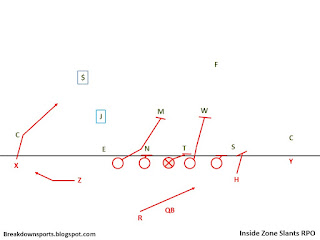
If you've been following along, we've offered up a lot of pass concepts that can be paired with a run play to make an "RPO". We looked at passes behind the LOS , quick passes , and even downfield reads . We've also looked at pass first RPOs, known here as PRO . And if you've been really paying attention, you'll have noticed that those RPOs were attached to pretty much every kind of run scheme. Here we are going to summarize those run schemes and discuss briefly the types of routes to look for given the type of run.

Football Fundamentals: I-Formation RB Pull Replace Plays

Image
This is a series post with lots of play diagrams. Where it lacks depth, it hopefully makes up for with breadth. The goal of this post is to demonstrate the many run game nuances that are at your disposal, outside the very basics that you can find almost anywhere. I will point out some key attributes for the plays, but for the most part the diagrams will stand alone outside a brief description. This post is limited (out of necessity) to strongside plays that are given directly to the RB. It does not include FB runs, or QB runs, or H-Back, Wing, TE, or WR runs. It also doesn't include option plays. Those are things for future posts. Why did I select an I-formation, which is mostly going out of fashion, and how do I expect this information to be utilized? The I-Formation is a classic 2-back set that, by the time it was implemented, had the benefit of a lot of football history. It is also a highly adaptable run formation, along for offsets, for H-backs, and other aspects that allow es...

Football Fundamentals: I-Formation RB Counter Plays

Image
This is a series post with lots of play diagrams. Where it lacks depth, it hopefully makes up for with breadth. The goal of this post is to demonstrate the many run game nuances that are at your disposal, outside the very basics that you can find almost anywhere. I will point out some key attributes for the plays, but for the most part the diagrams will stand alone outside a brief description. This post is limited (out of necessity) to strongside plays that are given directly to the RB. It does not include FB runs, or QB runs, or H-Back, Wing, TE, or WR runs. It also doesn't include option plays. Those are things for future posts. Why did I select an I-formation, which is mostly going out of fashion, and how do I expect this information to be utilized? The I-Formation is a classic 2-back set that, by the time it was implemented, had the benefit of a lot of football history. It is also a highly adaptable run formation, along for offsets, for H-backs, and other aspects that allow es...

Written in Chalk - RPOs from Pro Personnel - Utilizing FBs/TEs in a Spread World

Image
A lot of talk surrounding Michigan's supposed lean on more RPO schemes has had to do with what is at the base of Jim Harbaugh's scheme: lots of heavy personnel sets and a complex number of run concepts. Some have wondered how the two ideas can converge, despite the fact that Harbaugh himself had previously incorporated RPOs into his offense (albeit with a different type of QB). I've already discussed how Harbaugh can utilize many of his run concepts within an RPO framework , but the question still remains, how do you do that and utilize the bevy of TEs and FBs that are currently on the roster. This post is going to explore utilizing 12 and 21 personnel (pro personnel for short) within an RPO scheme.

Inside the Playbook: Iowa's Outside Zone Gap Counter

Image
Iowa has long been known for its use of the stretch zone run scheme , and they love to use a FB within this scheme for a variety of reasons. In fact, one of their favorite runs is the lead outside zone play . Because it is such a staple of the offense, opponents have stressed the importance of defending this play whenever they face Iowa, to the point that Iowa has established a number of "counters" to take advantage of those defensive strategies. The most common strategy that Iowa utilizes is a pin and pull scheme, but they also incorporate other variations. In this post, we will look briefly at how defenses defend Iowa's stretch scheme, and how Iowa deployed a "gap counter" to effectively counter those strategies.

Inside the Playbook: Wisconsin Lead Power O, Power O, and Counter with F/H Part II

Image
In this post, we'll continue to look at how Wisconsin utilizes the Wing to run Power O. Wisconsin will utilize 12 personnel most often, but will also sprinkle in 11 personnel or even 13 personnel to run this play. And while they can still run a traditional, I-Form Power O, I want to focus specifically on what they do with a TE off the LOS, and how they utilize that as well as anyone in college football to add a blocker from the backside, and insert him at the point of attack. Part 1 can be found here

Inside the Playbook: Wisconsin Lead Power O, Power O, and Counter with F/H Part I

Image
In this post, we are going to look at how Wisconsin utilizes the Wing to run Power O. Wisconsin will utilize 12 personnel most often, but will also sprinkle in 11 personnel or even 13 personnel to run this play. And while they can still run a traditional, I-Form Power O, I want to focus specifically on what they do with a TE off the LOS, and how they utilize that as well as anyone in college football to add a blocker from the backside, and insert him at the point of attack.

Film Review: PSU Belly Read and Belly Counter Speed Option

Image
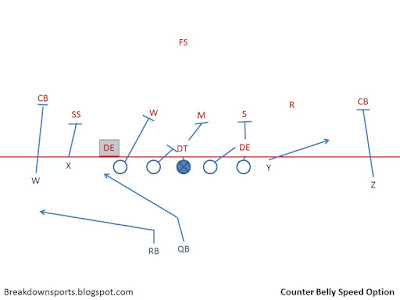
Against Michigan, Penn State pulled out a nice wrinkle to their run action. While most teams that run out of gun incorporate an inside zone read, the Nittany Lions prefer more of a belly read approach. In this post we are going to look at the difference between the more common Inside Zone run , the Belly Option that PSU prefers, and the counter action off of it with the utilization of a speed option . A couple weeks later Rutgers tried to utilize a similar strategy but had much less success. We're going to poke at the difference between teams in this post as well.

Written in Chalk: PSU's Direct Snap Power Read

Image
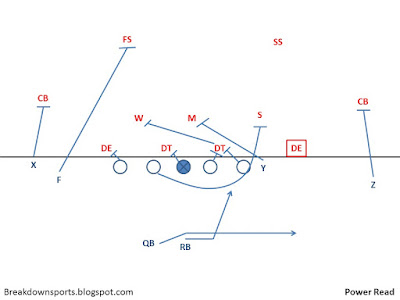
On Saturday, Penn State pulled out a direct snap offense, in which they lined up initially like a normal shotgun snap, and then shifted late such that the RB was behind the Center and the QB aligned off set. This sets up for an offense where the QB can still be utilized as a run threat, but the RB can get the ball into his hands immediately and take advantage of some of the interior run schemes while the fairly mobile QB can still threaten the edge. More specifically in this instance, it allows you to run Power O with your RB without being forced to block the "kickout" defender (he's blocked with the read). It's an interesting wrinkle that puts a lot of pressure on the play side of the defense, but it isn't without it's limitations. Now on film, defenses can react based on those limitations. So how can the Nittany Lions grow this package to take advantage of what defenses may show going forward? Let's speculate.

Film Study: Michigan Duo and Counter Iso vs D Focus on Stopping Interior Run

Image
From the recent Upon Further Review - Michigan Offense vs Florida Defense  a couple plays came up that I think could benefit from a bit more depth. In this article, we talk Duo And Counter Iso

Inside the Playbook: Ohio State's 2-Back Offense

Image
ORIGINALLY POSTED AT MAIZE N BREW ON 7-25-14 In 2013, Ohio State had one of the best run offenses in the nation. Part of their success came from two-back sets, or more accurately, by motioning a slot receiver - their Percy Harvin role - into the backfield. They lost, in my opinion, the best college RB in football last year, but returning the dynamic Braxton Miller and all their Harvinites, two back sets will likely become more prominent in this year's offensive iteration. In this piece, we will look at why these sets are so difficult for defenses to defend, both from a pre-snap standpoint, and after the snap.

Inside the Playbook: Wham! and The Return of the Trap

Image
Wham I love trap plays; I believe they are one of the best and probably the most under-utilized run scheme in modern football. With more and more emphasis on getting upfield for the pass rush and getting penetration to stop the run game, trap and wham schemes should only become more effective. Yet they continue to go under-utilized. There are several legitimate reasons for this: 1) you’re leaving a first level defender unblocked for some time, which is dangerous as those first level defenders get more and more athletic; 2) simplified defensive rules (i.e. block-down, step-dow n) have mitigated some of the initial success of the scheme. Still, there are ways around all of this to continue to use of one of my favorite schemes: trap and wham. Long Trap

Inside the Playbook: Indiana Breaking Tendencies to Run Outside the OTs

Image
Indiana, predominately, was an Inside Zone Read based team with Tevin Coleman. Coleman’s ability to pick through traffic and utilize his power allowed him to churn out a bunch of yards between the tackles, and his vision and cutback ability made him deadly to turn a modest frontside gain into an explosive cutback run. But what I enjoyed most about Indiana’s scheme when utilizing Coleman was their changeup plays for getting outside the tackles. When talking about Inside Zone, you’re looking for vertical displacement of the defense. You punish the first level defenders with powerful double teams and release into the second level defenders to form multiple run alleys along the LOS. To counter this, defenses are forced to start shooting down in an effort to form a wall at the LOS. This makes it so OL have to get off doubles earlier, and so doesn’t allow for that vertical displacement. But through Outside Zone, Pin and Pull Zone, and OG Sweeps, the Hoosiers were able to take advantage of t...

Football Fundamentals: Counter H/F Primer

Image
Counter OH and Counter OF are great run plays within a Power O based offense or an Inside Zone based offense. For a Power O offense, it utilizes a pulling OG and a lead blocking FB or H-back, while utilizing misdirection in the backfield with the RB running a counter step (often allowing this play to be a very effective Weakside run). For an Inside Zone based offense, the initial movement of the FB/HB is the same as a standard split zone block, while the backside (away from the initial RB step) looks very similar to zone steps. In this post, we’ll look more closely how Counter H/F (that’s Counter OH or Counter OF) fits within these schemes, when to run it, why it’s so effective, and how it fits into a spread architecture.

Football Fundamentals: Multiple Read Option Attack with Two Backs

Image
We’ve talked about the basics of zone running ; we’ve talked about adding an additional back into the backfield ; we’ve talked about the various ways you can utilize outside zone and inside zone and multiple reads to make like more maddening for the defense; now let’s mash it all together and look at a zone read option based approach with multiple backs. Having multiple backs allows us to utilize all the advantages we talked about in the multiple back piece, but the threat of the read and the option allows for some other creative means of attacking a defense. In this post, we will explore those options.

Inside the Playbook - Michigan's Rushing Attack, 2014

Image
Daniel Mears / Detroit News Under Doug Nussmeier, Michigan has switched to a predominately zone scheme. There are two typical types of zone runs: Inside Zone and Outside Zone. But that’s not all Michigan runs. They also utilize several gap and man blocking schemes to counter the standard zone schemes. Furthermore, they utilize several pin and pull adjustments to their zone stretch scheme to attack the edge. One thing I'd like you to do when looking at the diagrams is to split them in half through the center. Notice the playside and the backside throughout this post. What that will show you is what the defenders to that side of the field are seeing, and why it is difficult to defend all these concepts. The diagrams below are all from an I-formation with a FB. But it's important to note that these plays can all be run from a pistol set or a shotgun set, with a FB, or H-back, or even at times simply a TE, making them diverse throughout multiple formations.

Inside the Playbook: Utilizing the H-Back in the Run Game

Image
Originally written over at Maize n Brew  on 8/22/13 Editors Note: The H-back has been a valuable position in modern offenses dating back to the single-wing era of the football. It returned in full force during the implementation of zone blocking offenses of the 80s, and then again fell a little bit to the way side. In the past decade or so, the reemergence of the H-back position has come on full force. Almost every modern offense utilizes an H-back to some degree, both spread and pro-style. The reason is this: it can be used as a lead blocker similar to a FB, a reach blocker in zone schemes similar to a TE (by stretching the front you are opening lanes to run), and as a vertical pass threat, aligned in the slot matched up against LBs, or closed to the LOS. The H-back position brings a lot of run blocking variety into play, adds numbers to the box, but doesn't necessarily diminish your ability to pass. That is why you'll see it's importance in almost any m...

Inside the Playbook: OSU's Inverted Veer Package

Image
Ohio State does some interesting things within their offense that make it difficult for defenses to key them correctly. For one, they effectively mix up zone blocking and man blocking schemes, especially power blocking as of lately. In this post we are going to look at 4+ different plays which all utilize and inverted veer look, and explain why it is so difficult to stop them on offense. *     *     *     *     *     *     * Counter Inverted Veer As I described the inverted veer as power blocking from an option look, let's first look at how "counter trey" is blocked. "Trey" is a bit of a misnomer, as there often isn't a trey block, but it is the most common type of double team that comes from this blocking scheme and thus it is called trey. To note: Trey is a combo block from the playside PSE (playside TE) and the PST (playside OT) to the MIKE or backside LB. Deuce is a combo block from the PST and the PSG (pla...