Posts

Showing posts with the label Power O

Inside the Playbook - A-Gap Power
Image
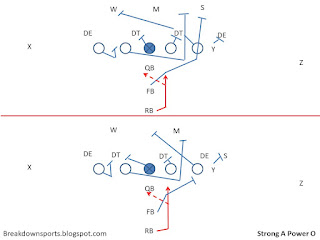
 In this post, we're going to look at A-Gap Power. A-Gap Power itself is not new. As I detailed in "History and Evolution: Power O" , what we know today as standard power was really the B/C gap constraint to the more traditionally Power Sweep. But by the late 70s and early 80s, you started to see variants of A-Gap Power schemes appear as teams wanted to protect their off tackle runs by showing a puller, but hitting inside. Teams like NDSU and Wyoming made a lot of hay off a specific type of A-gap Power, and as they've had success and their former coaches and disciples and knowledge have branched out all across football, you see this specific type of A-Gap Power arise elsewhere. This post is going to go over a few of the basics of A-Gap Power.

History and Evolution: Power O - Bonus - "Power" within the Zone Architecture

Image
 It always bugged me when at Michigan, Rich Rod would call his Lead Outside Zone play "Power". Football terminology is notoriously inconsistent from program-to-program, where the same word can mean very different things. But Power had established a sort of agreement and consistency, it is down blocks on the frontside with a backside puller, a true gap/man scheme. Yet here was Rich Rod calling Outside Zone "Power." It made my head hurt for a long time, until one day I was looking through the Joe Gibbs's playbook, and the rationale behind it struck me.  As I noted in the History and Evolution Series , power itself was originally focused on the Power Sweep, as a sort of variant to the inside run and option series. As Option Teams (often Wing T types) moved more toward zone blocking in the 70s, Power had to be adapted in ways to fit what they did. Rarely did these teams pull within the formation, it was mostly zone blocking, occasional traps as a change up, and mayb...

History and Evolution: Power O - Part III - The Modern Era of Power Diversity

Image
Previously Part I  - The Power Series Origins Part II  - Off Tackle Power Earns the Name Power Retaining the Power Series While "Power" began to be defined as the Off-Tackle Power O variant in the 1980s, most offenses, including the split back dominated West Coast Offenses, retained much of the Power Series plays within their playbook, albeit under different names. This made use of multiple backs to alter the backfield flow, changing the kick blocker, lead blockers, or sending someone elsewhere altogether. The Way Forward for Power Sweep 18/19 BOB (Big-on-Big, Back-on-Backer) is the classic Power Sweep 1982 San Francisco 49ers Playbook

History and Evolution: Power O - Part II - Off Tackle Power Earns the Name "Power"

Image
  Previously Part I  - The Power Series Origins Off-Tackle Power O becomes “Power” While the I-Formation had a scattering of purveyors dating as far back as the turn of the century, it wasn’t really until the early 1960s when a man known as Don Coryell would begin to popularize it within the Air Coryell offense. While at the upper levels of football it remained mostly unknown, by the late 1960s and into the 70s, coaches such as John Madden and Hank Stram started incorporating it within their offenses. By this time, most teams had now gone to 21 personnel, though split backs and near/far formations still held dominance. But, for instance, in the 1968 Chiefs Playbook, we immediately see what we know of today as traditional Power O (though, it should be noted, Power Sweep remained a vital part of the offense). 1968 Chiefs Playbook

History and Evolution: Power O - Part I - The Power Series Origins

Image
“God’s play.” Talk to the majority of football guys and they’ll tell you that one of, if not the best play in football is Power. It’s dynamic, dominating, explosive, yet flexible; its name alone congers up an attitude embedded within the game. But, unlike most schemes that are loved due to nostalgia of a game that no longer exists, Power remains a staple of modern football despite its history dating back to the invention of the forward pass. Like anything, it has morphed and adapted, but at its heart the play retains its core characteristics: Down blocks on the front side A lead block to handle the edge defender Backside pullers wrapping around playside. It looks like this:   And here's a primer Going back to the origins of the game, including in the various iterations that make up football around the globe, numbers and leverage have ruled the day. In American football, that is exactly what Power is. In this post, we are going to look at the origins of “God’s play” and ...

Written in Chalk: How to Attack Loose Alignment Tite/Mint Defenses in Run Game

Image
Tite and Mint continue to be the defense du jour among Twitter followers, and as college teams start looking at what some of the best defenses did last year, I anticipate even more will start to implement the front into their package in some form or another. As it becomes more prominent, offenses are going to need to start adapting playcalls for the defense in order to maximize their output. But, of course, you don’t know necessarily a defense is going to run Tite on a given down or stay in that basic look post-snap, so you have to work within your system and not have plays that blowup if you see anything else. This post is going to look at ways of tagging specific base plays and adding wrinkles to better run your base scheme against 4i-0-4i looks. Previously we’ve looked at the Fundamentals of Tite and Mint , and also some Pre-snap Adjustments to thing about in terms of split, motion, and blocking rules .

Inside the Playbook: Wisconsin Play Action Power O Wheel

Image
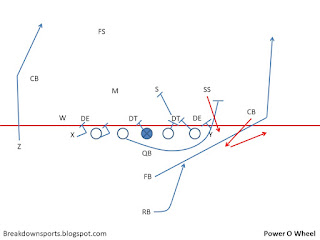
Against Iowa, Wisconsin was finally able to get things going offensively when they returned to an old friend in the offense: the wheel route off of Power O. I knew I had seen it previously, and mistakenly noted it was a few years ago in a bowl game, but actually it was against Indiana last year. The basics of the play are a hard Power O play action out of a heavy formation. Rather than kicking out, the FB plants and runs upfield on the wheel route. What ensues is beautiful, beautiful FBs rumbling in wide open spaces. Let's take a look.

Inside the Playbook: Penn State, Wisconsin, and Michigan and the Use of False Blocks

Image
As a defender, you are tasked with reading your keys in order to properly diagnose the play and fulfill your assignment. Gap responsibility and run fits and execution all start with properly seeing what is happening in front of you, and based on what the offensive line does, will change your path to success. But offenses know this. To a degree, and offense does what it does because that's the easiest and most efficient way of finding success. Other times, they find success with mind games, by showing something and doing another. This post is going to look at "False Blocks", the art of pass setting on runs and false pulls.

Football Fundamentals - RPO Run Concepts

Image
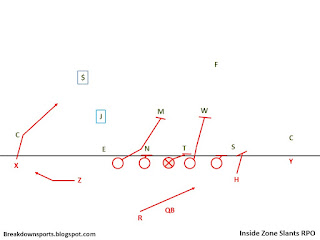
If you've been following along, we've offered up a lot of pass concepts that can be paired with a run play to make an "RPO". We looked at passes behind the LOS , quick passes , and even downfield reads . We've also looked at pass first RPOs, known here as PRO . And if you've been really paying attention, you'll have noticed that those RPOs were attached to pretty much every kind of run scheme. Here we are going to summarize those run schemes and discuss briefly the types of routes to look for given the type of run.

Football Fundamentals: I-Formation RB Gap and Pull Run Plays

Image
This is a series post with lots of play diagrams. Where it lacks depth, it hopefully makes up for with breadth. The goal of this post is to demonstrate the many run game nuances that are at your disposal, outside the very basics that you can find almost anywhere. I will point out some key attributes for the plays, but for the most part the diagrams will stand alone outside a brief description. This post is limited (out of necessity) to strongside plays that are given directly to the RB. It does not include FB runs, or QB runs, or H-Back, Wing, TE, or WR runs. It also doesn't include option plays. Those are things for future posts. Why did I select an I-formation, which is mostly going out of fashion, and how do I expect this information to be utilized? The I-Formation is a classic 2-back set that, by the time it was implemented, had the benefit of a lot of football history. It is also a highly adaptable run formation, along for offsets, for H-backs, and other aspects that allow es...

Written in Chalk - RPOs from Pro Personnel - Utilizing FBs/TEs in a Spread World

Image
A lot of talk surrounding Michigan's supposed lean on more RPO schemes has had to do with what is at the base of Jim Harbaugh's scheme: lots of heavy personnel sets and a complex number of run concepts. Some have wondered how the two ideas can converge, despite the fact that Harbaugh himself had previously incorporated RPOs into his offense (albeit with a different type of QB). I've already discussed how Harbaugh can utilize many of his run concepts within an RPO framework , but the question still remains, how do you do that and utilize the bevy of TEs and FBs that are currently on the roster. This post is going to explore utilizing 12 and 21 personnel (pro personnel for short) within an RPO scheme.

Football Fundamentals: RPO Pass Concepts - Quick Hitters

Image
Now that we've covered the "read" offense and concepts that occur behind the LOS , let's now turn our focus down field a bit. This is where the RPO scheme is currently most dangerous, both at the lower levels, as well as at the college and NFL level. This is the quick passing concepts that are tied to the run threat. Let's take a look.

Inside the Playbook: Wisconsin Lead Power O, Power O, and Counter with F/H Part II

Image
In this post, we'll continue to look at how Wisconsin utilizes the Wing to run Power O. Wisconsin will utilize 12 personnel most often, but will also sprinkle in 11 personnel or even 13 personnel to run this play. And while they can still run a traditional, I-Form Power O, I want to focus specifically on what they do with a TE off the LOS, and how they utilize that as well as anyone in college football to add a blocker from the backside, and insert him at the point of attack. Part 1 can be found here

Inside the Playbook: Wisconsin Lead Power O, Power O, and Counter with F/H Part I

Image
In this post, we are going to look at how Wisconsin utilizes the Wing to run Power O. Wisconsin will utilize 12 personnel most often, but will also sprinkle in 11 personnel or even 13 personnel to run this play. And while they can still run a traditional, I-Form Power O, I want to focus specifically on what they do with a TE off the LOS, and how they utilize that as well as anyone in college football to add a blocker from the backside, and insert him at the point of attack.

Inside the Playbook: Wisconsin's use of Dos, Tight Bunch, and Wings in Formation

Image
As we cover Wisconsin over the next few pieces, we are predominately going to focus on three formations: Dos (Tight Double Wing), Tight Bunch, and I-Form. Wisconsin finds ways to use FBs and H-Backs within the offense, to lead block, to run rubs, or to even to cross flow. In this post we will first cover the high level benefits of these formations for Wisconsin. In the next posts, we will go into depth into specific plays, predominately run out of these formations.

Inside the Playbook: Michigan Offense Reaction to Pursuit with False Keys

Image
Previously, we discussed how Michigan and teams like MSU are playing pulling blockers . They key in both schemes can be boiled down to taking away the numbers advantage the offense is trying to gain at the point of attack. This is down by flowing across the formation by a backside LB or by inserting safeties into the run fills. As teams start keying pulling OL, they begin diagnosing plays faster and taking away the offense's advantage. That's where the offense can begin doing things to take away those keys or use the pull as a false key. Let's look at how Michigan's playbook handles this. Patrick Semansky / AP

Inside the Playbook - Michigan Defending the OL Pull

Image
Michigan's offense is going to pull a lot of OL. Similarly, Michigan's defense is going to see more teams increasingly go to pulling OL as more teams shift back to man/gap schemes and away from the zone oriented teams. Of those plays, Power O is probably the most relied upon for opponents. In this article, we are going to look at how Michigan defends the Power O and why they defend it this way. In my next post, I'll discuss how an offense can react to it. Previously, I've discussed how MSU defends Power .

Film Review: How MSU Defends Power O

Image
Michigan’s base run play is Power O . Over the past half decade, MSU has specialized in shutting down pro-style rushing attacks, and with that comes shutting down the Power O run play. It got to the point that Stanford, during the 2014 Rose Bowl, rarely even tried to execute their most standard play. In this post, we want to investigate what makes so effective against the Power O run.

Inside the Playbook: Michigan's Use of Multiple FBs and Additional Gaps

Image
Previously, I talked about gap discipline , and focused a portion of the article on pulling OL and inserting a FB into the mix. These things present a difficulty for the defense, as they need to adjust on the fly to ever-shifting gap responsibilities. Pulling OL add gaps to the point of attack and FBs can be inserted to add gaps at any location along the LOS; and the defense must adjust post-snap to these new gaps. Jim Harbaugh loves to use this to his advantage. Adding gaps to the POA forces the defense to think and hesitate, and when they do that, his Power-based offense can start churning out yards. Furthermore, with more and more teams going to spread formations and a zone based rushing attack (though this is starting to revert again to tighter formations and man/gap schemes again, as all things are cyclical in football), defenders are less comfortable with how to execute soundly (as Spielman has said multiple times the last few weeks). The downside of doing this is that it gives...

Inside the Playbook: Minnesota's Basic Run Game Attack

Image
Originally posted at Maize n Brew on 5/29/2014 Associated Press Minnesota is one of the most run heavy teams not only in the B1G, but in all of college football. And not only are they just heavy in terms of how much they run the football, but they are the true essence of a team that wants to be a powerful running force. The majority of their runs come between the tackles in the form of inside zone, Power O to the RB, or Power O from the QB. With so much power on the field though, they tend to lack the speed to threaten the edges. Their way of getting the football to the edge then, isn't by subbing in different personnel or by running WR screens, but utilizing in a variety of ways their WRs to run sweeps. Not only has this become prevalent in their offense, but they have used it very well to set up other runs as well. In this article, we will look quickly at the Golden Gophers base run game, and more how they work off of that to set up the rest of their playbook.