Posts

Showing posts with the label Wisc

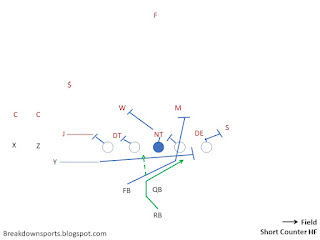
Inside the Playbook - Michigan's Counter HF
Image
Despite heavily featuring gap run schemes throughout the year, Michigan's plan when facing the vaunted Wisconsin run defense included almost the total elimination of pulling offensive line. In an effort to maintain part of their core playbook, they leaned on a 3-back style offense and "Pull Replace" (replacing a traditional offensive line pull with a back executing the assignment) to retain part of their Counter playbook. In this post, we are going to look at how the Wolverines executed Counter HF from an unbalanced look, how the Badgers responded, and how this scheme can be sequenced off of and run against a variety of formations.
Quick Hit Film Review - Wisconsin Defending Gap Scheme Runs

Quickly, I wanted to talk about how Wisconsin is so good at defending gap run schemes. In the video below, I talk about what makes the Badgers defense so good in that regard. Have gotten some love from Wisconsin, so here’s some love back. Watch how well the whole front plays this gap scheme. Box player keeps it inside. 4T holds up to down block. NT fights back on combo. PSLB scrapes right off 4T butt into hole. BSLB ball hits all the way outside PSLB pic.twitter.com/wO4wkAniak — Space Coyote (@SpaceCoyoteBDS) June 15, 2022

Let's Speak Technique - North/South Combo Block

This post features a series of tweets discussing OL technique on a north/south (veritical) double team. PSU Watch the C. Watch his 2nd step (left foot) His eyes are on LB. He knows he needs to check him. But as he opens with his right foot, he lunges forward with his left, and now is off balance. If he moves his left foot laterally or with depth, he can stay square and redirect pic.twitter.com/1MZ901ULQK — Space Coyote (@SpaceCoyoteBDS) February 10, 2022

Let's Speak Technique - Club Block

Image
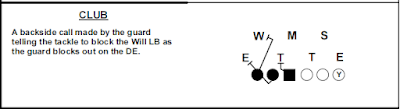
Along the offensive line, it is important to have various techniques and calls that can optimize player strengths, match ups, and angles, and give the opponent different looks. A "Club Block" is a backside combination block in which the backside end man on the LOS (EMOL) will work immediately to the second level, and the blocker inside of him will work out to the end. Club Block 2014 49ers Playbook In our case, we'll use it as an exchange block between the Back Side Guard (BSG) and Back Side Tackle (BST) as well as between a Back Side TE (BSTE) and BST, with the caveat that it is always the EMOL that is releasing directly to the 2nd level.

Inside the Playbook: Wisconsin Play Action Power O Wheel

Image
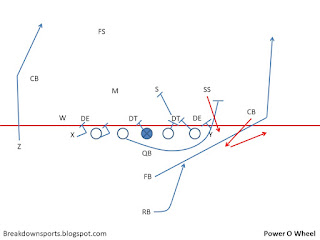
Against Iowa, Wisconsin was finally able to get things going offensively when they returned to an old friend in the offense: the wheel route off of Power O. I knew I had seen it previously, and mistakenly noted it was a few years ago in a bowl game, but actually it was against Indiana last year. The basics of the play are a hard Power O play action out of a heavy formation. Rather than kicking out, the FB plants and runs upfield on the wheel route. What ensues is beautiful, beautiful FBs rumbling in wide open spaces. Let's take a look.

Inside the Playbook: Penn State, Wisconsin, and Michigan and the Use of False Blocks

Image
As a defender, you are tasked with reading your keys in order to properly diagnose the play and fulfill your assignment. Gap responsibility and run fits and execution all start with properly seeing what is happening in front of you, and based on what the offensive line does, will change your path to success. But offenses know this. To a degree, and offense does what it does because that's the easiest and most efficient way of finding success. Other times, they find success with mind games, by showing something and doing another. This post is going to look at "False Blocks", the art of pass setting on runs and false pulls.

Inside the Playbook: Wisconsin's Inside Double Post

Image
Double Post is one of the go-to concepts in modern football. Like slants, for the QB, this concept provides a relatively clear and concise movement key: the concept side safety. Concept side safety works over top of the first post, you throw the second post. Concept side safety stays home, throw the first post. It's more popular cousin - Mills - made famous by Steve Spurrier, is similar in many ways, but double post keeps the attack vertical. Wisconsin took the double post concept and merged it with an All Verts or Seattle concept, and moved the double post inside. While All Verts can end up looking very similar, knowing that you have double posts can simplify life for your QB. It can also allow you to modify the timing of other routes to work within the double post scheme. In this post, we will look a little closer at how Wisconsin utilized this concept and why.

Inside the Playbook: Wisconsin's Flood Play

Image
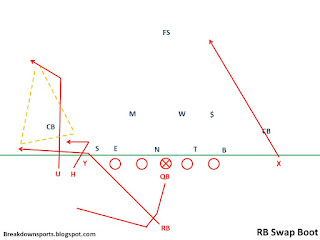
The last rollout play we are going to look at from Wisconsin (for now) is a basic sail concept. I’ve previously discussed how they’ve utilized swap boot ( in two parts ), in which TEs are primary attacking the flat and underneath off of delayed routes. With the sail route, they now have an opportunity to work vertical to threaten the deep outside of the field.

Inside the Playbook: Wisconsin Swap Boot Part II

Image
Previously, we touched on Wisconsin’s use of the Swap Boot in their 2-TE personnel package. In this post, we are going to look at the same concept, but instead of utilizing a TE in the flat, the RB is going to be incorporated into the pass concept. What we’ll see is a way of utilizing receiver’s in different spots on the field while keeping the reads and timing consistent for the QB.

Inside the Playbook: Iowa's Outside Zone Gap Counter

Image
Iowa has long been known for its use of the stretch zone run scheme , and they love to use a FB within this scheme for a variety of reasons. In fact, one of their favorite runs is the lead outside zone play . Because it is such a staple of the offense, opponents have stressed the importance of defending this play whenever they face Iowa, to the point that Iowa has established a number of "counters" to take advantage of those defensive strategies. The most common strategy that Iowa utilizes is a pin and pull scheme, but they also incorporate other variations. In this post, we will look briefly at how defenses defend Iowa's stretch scheme, and how Iowa deployed a "gap counter" to effectively counter those strategies.

Inside the Playbook: Wisconsin Swap Boot Scheme

Image
I’ve previously discussed how Wisconsin utilizes Dos, TightBunch, and Wings in formation to run a lot of Power O , Lead, and Counter plays . Similarly, they utilize the width of the formation to successfully run a lot of zone schemes, including both Inside Zone and Outside Zone. In this post, we will look at the swap boot concept, and then in the next post, we will look at similar concepts with small tweaks to the setup.

Inside the Playbook: Wisconsin Lead Power O, Power O, and Counter with F/H Part II

Image
In this post, we'll continue to look at how Wisconsin utilizes the Wing to run Power O. Wisconsin will utilize 12 personnel most often, but will also sprinkle in 11 personnel or even 13 personnel to run this play. And while they can still run a traditional, I-Form Power O, I want to focus specifically on what they do with a TE off the LOS, and how they utilize that as well as anyone in college football to add a blocker from the backside, and insert him at the point of attack. Part 1 can be found here

Inside the Playbook: Wisconsin Lead Power O, Power O, and Counter with F/H Part I

Image
In this post, we are going to look at how Wisconsin utilizes the Wing to run Power O. Wisconsin will utilize 12 personnel most often, but will also sprinkle in 11 personnel or even 13 personnel to run this play. And while they can still run a traditional, I-Form Power O, I want to focus specifically on what they do with a TE off the LOS, and how they utilize that as well as anyone in college football to add a blocker from the backside, and insert him at the point of attack.

Inside the Playbook: Wisconsin's use of Dos, Tight Bunch, and Wings in Formation

Image
As we cover Wisconsin over the next few pieces, we are predominately going to focus on three formations: Dos (Tight Double Wing), Tight Bunch, and I-Form. Wisconsin finds ways to use FBs and H-Backs within the offense, to lead block, to run rubs, or to even to cross flow. In this post we will first cover the high level benefits of these formations for Wisconsin. In the next posts, we will go into depth into specific plays, predominately run out of these formations.

B5Q - Wisconsin football: Evaluating the Badgers' defense vs. Alabama

Image
Matthew Emmons-USA TODAY Sports I participated in a Q & A over at Bucky's 5th Quarter recently about what went wrong, and a bit about what went right against Alabama. Wisconsin's defense has been a top-five squad in terms of total defense since the arrival of defensive coordinator Dave Aranda, but the Badgers ran into a very talented Alabama offense on Saturday led by junior running back Derrick Henry in a 35-17 loss at AT&T Stadium in Arlington, Texas. Following the loss of redshirt senior safety Michael Caputo, a captain and pronounced leader of the Badgers' defense, Wisconsin gave up 502 yards -- including 274 on the ground. The Badgers mostly applied a base 3-4 scheme, along with 2-4-5 "peso" nickel package of two defensive linemen as pseudo-defensive tackles, four linebackers and five defensive backs in certain situations to counter Alabama's 11 personnel and other looks the Tide used to throw off Wisconsin. To help us break down the e...

Coaching Points: Wisconsin vs Alabama, 2015

Image
 (VASHA HUNT) Offense: Inside Zone base with Power O mixed in. Lots of 21 and 12 personnel, mix of under center and gun Defense: One-gap 3-4, mostly Cover 1

Coaching Points: Wisconsin 2015 Spring Game

Image
M.P. KING, ASSOCIATED PRESS - AP Base O - 12 or 21 personnel; Inside Zone and Power O base runs. Base D - One-Gap 3-4; Cover 1 with a SS robber Also, check out the PODCAST

PODCAST: Wisconsin Spring Game Review and 2015 Preview

Image
Comes up when you Google Search "Buck Around" Had the opportunity to join the guys at Buck Around  for another podcast, this time to discuss Wisconsin's 2015 spring game and preview the 2015 season. Always fun to talk football, and discussing it in mid-June with others is always a joy. LINK

Football Fundamentals: Cover 4 Defense "Coverage"

Image
At its most basic, Cover 4 plays as a four deep, three under defense; and at its most aggressive, it plays almost identically to a tight Cover 0. To the average fan, Cover 4 may sound like a passive, prevent-type defense, while to the more nuanced fan, it may seem like an aggressive coverage that can bring 9 defenders into the box. The truth is that it is all those things and more. One of the greatest powers of the Cover 4 is its ability to adjust, the intricacies, and tweaks that can be made to the same look to both confuse the offense, and remain fundamentally sound. In this article, we’re going to look at the basic elements of coverage in a Cover 4 defense.

BDS - 2015 B1G NFL Draft Part 5

Image
This is intended to be a look at the B1G players participating in the NFL combine (and a couple others that I think may get drafted). I include combine results, though that is only a small part of the equation for me. I put much more value into what I've seen on film rather than by how well someone has been taught to run the 40 yard dash. I try to give a basic overview of strengths, weaknesses, fit, and where I'd expect them to be drafted based on "norms". What that means is that I'm not really looking at mock drafts, I don't have my ear to the ground for what Mel Kiper is saying about a guy. It's just based on what I've seen on film. This will be five parts long, with teams coming in alphabetical order. Part I Part II Part III Part IV