Posts

Showing posts with the label History and Evolution

History and Evolution: Power O - Bonus - "Power" within the Zone Architecture

Image
 It always bugged me when at Michigan, Rich Rod would call his Lead Outside Zone play "Power". Football terminology is notoriously inconsistent from program-to-program, where the same word can mean very different things. But Power had established a sort of agreement and consistency, it is down blocks on the frontside with a backside puller, a true gap/man scheme. Yet here was Rich Rod calling Outside Zone "Power." It made my head hurt for a long time, until one day I was looking through the Joe Gibbs's playbook, and the rationale behind it struck me.  As I noted in the History and Evolution Series , power itself was originally focused on the Power Sweep, as a sort of variant to the inside run and option series. As Option Teams (often Wing T types) moved more toward zone blocking in the 70s, Power had to be adapted in ways to fit what they did. Rarely did these teams pull within the formation, it was mostly zone blocking, occasional traps as a change up, and mayb...

History and Evolution: Power O - Part III - The Modern Era of Power Diversity

Image
Previously Part I  - The Power Series Origins Part II  - Off Tackle Power Earns the Name Power Retaining the Power Series While "Power" began to be defined as the Off-Tackle Power O variant in the 1980s, most offenses, including the split back dominated West Coast Offenses, retained much of the Power Series plays within their playbook, albeit under different names. This made use of multiple backs to alter the backfield flow, changing the kick blocker, lead blockers, or sending someone elsewhere altogether. The Way Forward for Power Sweep 18/19 BOB (Big-on-Big, Back-on-Backer) is the classic Power Sweep 1982 San Francisco 49ers Playbook

History and Evolution: Power O - Part II - Off Tackle Power Earns the Name "Power"

Image
  Previously Part I  - The Power Series Origins Off-Tackle Power O becomes “Power” While the I-Formation had a scattering of purveyors dating as far back as the turn of the century, it wasn’t really until the early 1960s when a man known as Don Coryell would begin to popularize it within the Air Coryell offense. While at the upper levels of football it remained mostly unknown, by the late 1960s and into the 70s, coaches such as John Madden and Hank Stram started incorporating it within their offenses. By this time, most teams had now gone to 21 personnel, though split backs and near/far formations still held dominance. But, for instance, in the 1968 Chiefs Playbook, we immediately see what we know of today as traditional Power O (though, it should be noted, Power Sweep remained a vital part of the offense). 1968 Chiefs Playbook

History and Evolution: Power O - Part I - The Power Series Origins

Image
“God’s play.” Talk to the majority of football guys and they’ll tell you that one of, if not the best play in football is Power. It’s dynamic, dominating, explosive, yet flexible; its name alone congers up an attitude embedded within the game. But, unlike most schemes that are loved due to nostalgia of a game that no longer exists, Power remains a staple of modern football despite its history dating back to the invention of the forward pass. Like anything, it has morphed and adapted, but at its heart the play retains its core characteristics: Down blocks on the front side A lead block to handle the edge defender Backside pullers wrapping around playside. It looks like this:   And here's a primer Going back to the origins of the game, including in the various iterations that make up football around the globe, numbers and leverage have ruled the day. In American football, that is exactly what Power is. In this post, we are going to look at the origins of “God’s play” and ...

History and Evolution: The Veer and Belly Series

Image
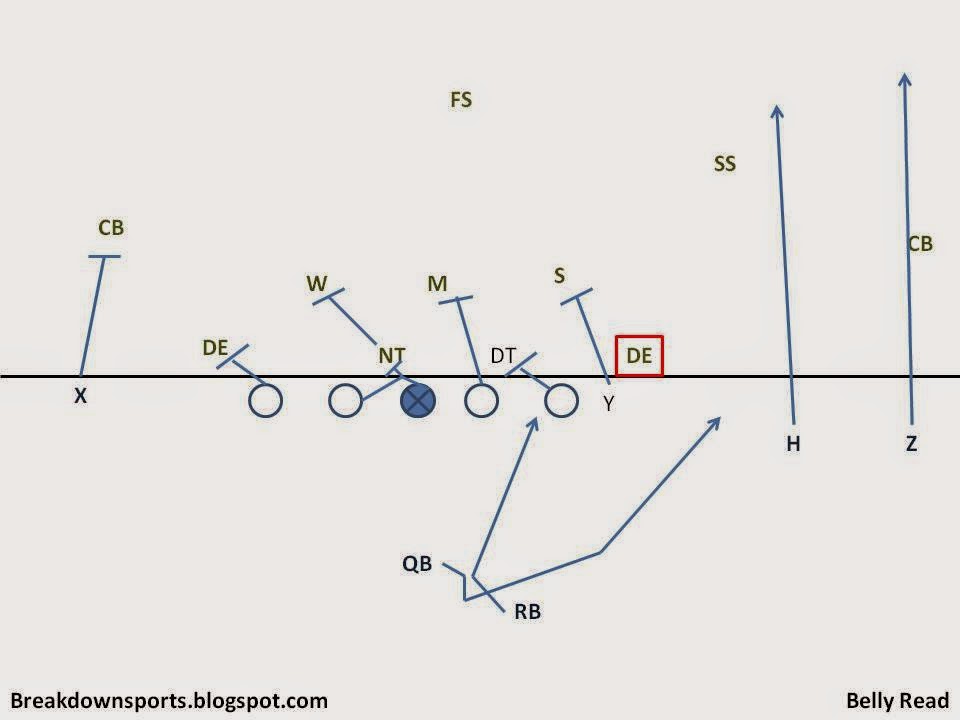
History has a tendency to repeat itself. In football, that means something gets invented, iterations are formed, it gets tucked away for a while, and then it reemerges in a new form but with the same constructs. In this way, we can also predict how defenses will attempt to adjust, and how offenses will likely adjust to their adjustment. And this piece we are going to look at the history and evolution of the veer and belly run plays.