Posts

Showing posts with the label Run-pass option

Football Fundamentals - RPO Run Concepts
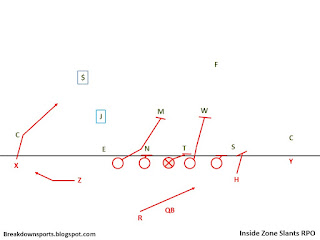
Image
If you've been following along, we've offered up a lot of pass concepts that can be paired with a run play to make an "RPO". We looked at passes behind the LOS , quick passes , and even downfield reads . We've also looked at pass first RPOs, known here as PRO . And if you've been really paying attention, you'll have noticed that those RPOs were attached to pretty much every kind of run scheme. Here we are going to summarize those run schemes and discuss briefly the types of routes to look for given the type of run.

Written in Chalk - RPOs from Pro Personnel - Utilizing FBs/TEs in a Spread World

Image
A lot of talk surrounding Michigan's supposed lean on more RPO schemes has had to do with what is at the base of Jim Harbaugh's scheme: lots of heavy personnel sets and a complex number of run concepts. Some have wondered how the two ideas can converge, despite the fact that Harbaugh himself had previously incorporated RPOs into his offense (albeit with a different type of QB). I've already discussed how Harbaugh can utilize many of his run concepts within an RPO framework , but the question still remains, how do you do that and utilize the bevy of TEs and FBs that are currently on the roster. This post is going to explore utilizing 12 and 21 personnel (pro personnel for short) within an RPO scheme.

Football Fundamentals - Pass First RPOs - PRO and PPO

Image
We are now going to turn our attention to something similar to an RPO , but instead of the first option being run (i.e. there is always a mesh point in the backfield), the first option is to pass. This is going to not only include plays where both a run and pass option exist, but also plays where there are separate pass options in a single play, that we've labeled Pass-Pass Options .

Football Fundamentals: RPO Pass Concepts - Quick Hitters

Image
Now that we've covered the "read" offense and concepts that occur behind the LOS , let's now turn our focus down field a bit. This is where the RPO scheme is currently most dangerous, both at the lower levels, as well as at the college and NFL level. This is the quick passing concepts that are tied to the run threat. Let's take a look.

Football Fundamentals: The Offensive "Read" Concepts

Image
Alright, fine, let's talk the concept du jour. What's the concept du jour? It's the play of the day. But really it's about RPO - Run-Pass Option. Ever since the 2018 Super Bowl football has been all about the RPO. I've talked about it a little bit in the past, first with Illinois , and then tagged onto an OSU post recently . But I want to provide a little more depth because there still seems to be some confusion and misconceptions. And to do that, I want to first lay the ground work for the basics. This first post is going to try to set a foundation with explaining "the read game".

Inside the Playbook: Ohio State's Book and Run Scheme and Arrow/Slide RPO

Image
Everybody knows the basic zone read scheme. Block inside zone  (or one of many types of zone ) while leaving the backside DE unblocked for the QB to read. If the DE crashes the mesh point, the QB pulls and runs off the backside. If the DE stays home, the QB gives to the RB who runs basic inside zone. But as defenses get more athletic and more nuanced in their defense of zone read, making this "read" becomes more challenging for the QB. You now have games like scrape exchange, where the DE crashes and the LB fills behind. You have more athletic edge players that can force a give but get back into the play from the backside. One option is to change the read defender , another option is to utilize additional backs to modify the blocking scheme . In this post, I'll talk about an option that utilizes a little of both which dates back to Meyer's time at Florida, in the Book and Rifle schemes.

Inside the Playbook: Illinois RPO vs Ohio State "Solo" Adjustment

Image
Illinois didn’t have a lot of success against the Ohio State defense, but they did have a really nice run-pass option (RPO, aka package play) that they went to in order to take advantage of the Buckeye’s base Cover 4 defense.