Posts

Showing posts with the label Mesh Concept

Jay Johnson: Coaching Primer

Image
With an incredible defense, Mark Dantonio ushered in one of the most successful coaching tenures in Michigan State football history. While the highs of his tenure will almost certainly be remembered by those quarters-heavy, no-fly zone defenses, his downfall will at least be partially linked to the ineptness of the offense overall. While I don’t believe scheme was the primary issue for the 2019 Michigan State offense, fans will be interested in understanding what Mel Tucker brings in with his new staff. Due to the timing of the coaching change, Tucker heavy relied on bringing his old staff from Colorado with him to East Lansing. With Tucker comes his former Colorado offensive coordinator Jay Johnson. I’ve taken the task of watching the 2019 Buffaloes in an effort to highlight what to expect from the Spartans offense in Tucker’s first year. MSU Athletics

Coaching Points: Michigan vs OSU, 2018

Image
I used to do more of these back in the day. Admittedly, this is more about Michigan and a response to some of the criticisms of Michigan from this game. So sorry it's light on the OSU POV. Kirthmon F. Dozier, Detroit Free Press

Film Review: The OSU Drag and Go Concept

Image
Ohio State has been feasting through in the pass game with one of the core tenets of the Air Raid offense: drag routes. Go into any Air Raid passing playbook from Kevin Wilson (or Mike Leach), or looking back at Chip Kelly's Oregon offenses (the current OSU QB coach is Kelly's former QB coach) and you'll notice that probably 50% of the pass plays contain some sort of drag route. Go to your basic pass game concepts  and you'll see that these playbooks are littered with Over, Cab, Crash, Crease, Mesh , and NCAA concepts . Air Raid coaches love these concepts, and so they rep these concepts constantly, because in man coverage their better athletes can run away from LBs or safeties or get beneficial rubs to allow them to run away from CBs. Against zone you can find a void and settle there and wait for the QB to throw you open. In theory, it works against everything. Yet, it still has it's detractors, because if you don't practice it enough, if you don't put in t...

Inside the Playbook: OSU Follow Pivot Concept

Image
Perhaps one of the greatest strengths of Urban Meyer's passing attack is how simplified he makes it for his QBs. Meyer understands the capabilities of his players and the capabilities of the defenses he is facing, and because of that, he is able to limit the amount of decisions his players have to make to allow them to play fast and make the correct decisions repeatedly. In his mind, there is no reason to complicate what doesn't need to be complicated; and that not only makes perfect sense, it also shows a lot of restraint that many coaches don't have. On this play, what we see is a very simple play for the offense to run, but also a play design that gives the defense a lot to think about. Simplifying the game for your team while complicating it for the opponent allows your team to execute at a higher level, and that's a constant theme throughout Meyer's playbook. Today we're going to look at how Meyer dials up what he calls a "Follow Pivot" as a fur...

Football Fundamentals: The Mesh Concept

Image
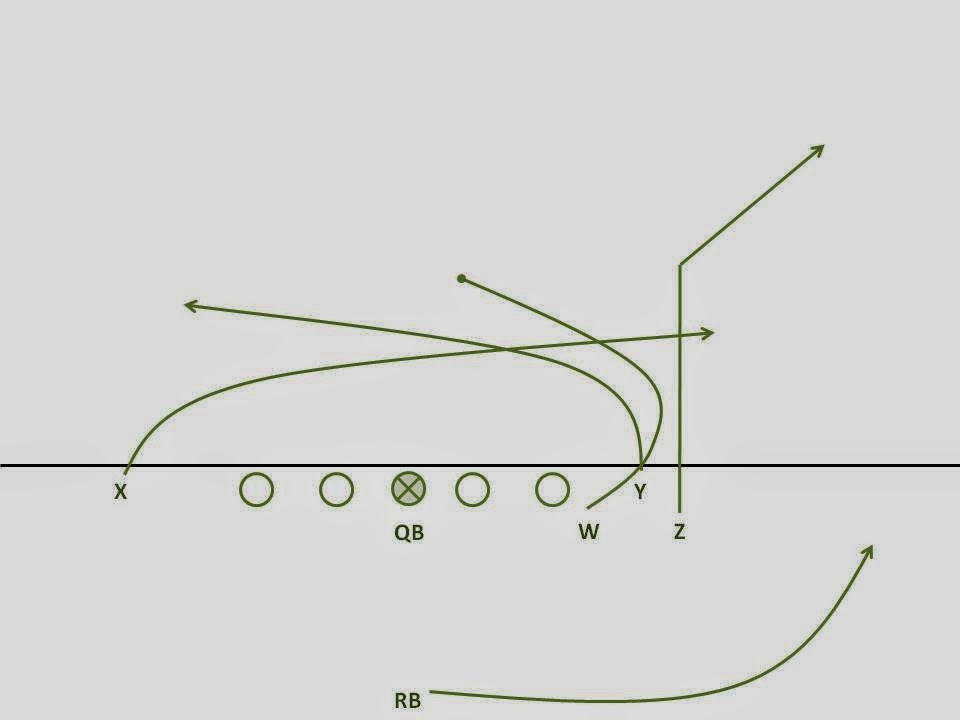
The next combination we'll look at - along with its derivatives - is the Mesh Concept. The Mesh concept is an Air Raid staple that is so successful that it's found its way into almost every offense. It includes the threat of the two drag routes in combination with a natural rub in the center of the field. This makes it very difficult to defend in man coverage, as the defender (often a LB) has to cover the width of the field and run with a receiver in space while not only avoiding the natural wash of other defenders, but the "rub" that comes from the receiver running a drag route from the opposite side of the field. Likewise, it's difficult for zone defenses to cover it as well. Once the receivers pass the mesh point, they can sit down in any open void of the defense. This not only essentially overloads an area generally close to the QB (allowing him to make quick, accurate throws, so the windows can be generally smaller), but forces the zone defender to quickly id...

Inside the Playbook - Meshing the Zone Run with Simplified Pass Concepts

Image
Originally published at Maize n Brew Note This information is applied to the Bill O'Brien PSU teams, but the concepts are familiar throughout the Big Ten. Many teams, such as Iowa, Wisconsins, etc, will utilize zone running schemes. And the mesh concept described below will apply to many teams with young QBs, and will be utilized by coordinators throughout the Big Ten. Introduction This piece will be a bit shorter today, but hopefully it will still be informative. Penn State has given me absolutely no full game footage, making it very difficult to grasp a whole lot about scheme and patterns. But they do have some pretty good game highlights, and for whatever reason some guy from Nebraska has some all 11 footage from when they played Penn State, so I got some nice stuff coming your way (thanks Alonzo Whaley ). Anyway, Bill O'Brien has done a great job in a short time taking many of the offensive philosophies from the Patriots, very much simplifying them, and then teachin...

Inside the Playbook - Michigan State Triangulates the Open Receiver

Image
Previously we looked at how MSU began adjusting their routes and advancing their pass game with the “Switch Concept” . This time, we’ll look more closely at Cook’s progression as a QB, and his ability to read safeties in order to determine where he decides to take the ball. In this case we’ll look at a play that incorporates two triangles, one based off of a Mesh concept, and the other off of a China concept. The Play What’s interesting about this play is that it incorporates two common pass concepts in an effort to defeat either both single-high and two-high defenses. While either concept within itself can be adjusted to beat either coverage, here, the concepts will only be used for their optimal coverage beater. It just so happens that by combining the two concepts, two triangles are formed, giving Cook three options in each of his progressions. More after the jump

Inside the Playbook: Meshing the Zone Run with Simplified Pass Concept

Image
This is a link to a preview that I did over the summer. After several teams ran quite a bit of the mesh concept to start the year, I figured it was a good time to link it here. *     *     *     *     *     *     *     *     * Preview: Running the Mesh Concept In short, the first inside receiver has an aiming point just in front of the MIKE's drop. He must cross in front of the MIKE so that the MIKE is not in a position to defend him and is also unable to reroute the underneath crossing route. The second crossing receiver will aim for the short side shoulder of the other crossing receiver, making sure he doesn't get rerouted by a LB. The receivers will then continue across the formation working to gain distance horizontally, stretching the LBs, and looking for voids in zones for the QB to see. It's typically an easy read because... There will also usually be a flat receiver to stretch the defense...