Posts

Showing posts from 2022

Jim Knowles - Coaching Primer - Part 1

Image
 I've put together some tweets, but didn't get as in-depth as I originally wanted to. That said, I believe I have enough for at least an initial primer of the Jim Knowles defense. Jim Knowles has a pretty diverse background, starting as a primarily 4-3 coach, growing into a 4-2-5 coach at Duke, and finally transitioning to the 3-high safety coach at Oklahoma State which he is known for today. Still, he didn't lose all the tricks in the bag that he developed over the years, so let's take a look. Ohiostatebuckeyes.com
Inside the Playbook - Michigan's Counter Game - Part 3: Execution and Technique

Image
 We've now had an opportunity to look at the general scheme and various run tags Michigan deploys , as well as how they can modify things post-snap . But as any football coach will tell you, all the scheme in the world can't make up for poor execution. Michigan, in their run game, was a well oiled machine. It was clear on film that they were well coached and I want to take a look at some of that now.

Inside the Playbook - Michigan's Counter Game Part 4 - Sequencing and Protecting Tendencies

We've now looked at the basic scheme, the run tags , and the post-snap modifiers . We've also spent some time digesting how Michigan executes their Counter techniques. Now we're going to look at how the scheme is protected from defenses over-playing it. This protection is both built into the scheme itself, and is also done elsewhere in the playbook. Let's take a look. Protection via Alignment and Defensive Tendencies Alignment and motion can also help protect the scheme. Against Nebraska, Michigan attacked the wide side of the field because they were confident in how Nebraska wanted to utilize the safety as part of the fit from their Cover 4 base. (short motion) Many times you saw Michigan attack how teams defended Nub formations as well. Or how they check for unbalanced . Or eliminating pulling OL to avoid provided the defense keys . They also have built in rules they can include, based on defense or as a standard principle. This includes pulling the Center instead of...

Inside the Playbook - Michigan's Counter Game - Part 2 - Post Snap Modifiers

Image
In Part 1 of this series, we looked at the basics of the Michigan Counter package, including the five basic schemes (Counter OH, Counter OF, Counter OT, Counter HF, and Counter O). We also looked at run game tags that can be applied pre-snap to modify blocking assignments, and when to incorporate them. In this part, we are going to look at Post-Snap Modifiers (i.e. reads), and how Counter serves as protection of other schemes, and how Michigan protected Counter within their scheme.

Quick Hit Film Review - Michigan Sequencing Short Motion Counter RPO

 Michigan only ran Counter to the wide side of the field approximately 25% of the time. But against Nebraska and their 2-high heavy, sky force favored defense, Michigan decided to aim their attack to the field more often than usual. This led to some sequencing in their Counter/RPO scheme. Counter + Short Motion In running Counter to the field, Michigan would bring the outside WR in short motion into the formation, giving him a better path to the safety and force the CB into run support. Michigan Strong Counter OH pic.twitter.com/ix4tuaKROv — TalkingDogBDS (@TalkingDogBDS) May 30, 2022 Notice how hard the safety tries to buzz down, and how delayed the CB is in their coverage scheme to commit to the run. This allows Michigan to maintain a numbers advantage at the point of attack and force secondary run defenders to clean up. They did this twice, though the second time Nebraska had on a unique coverage call. Michigan Strong Counter OH pic.twitter.com/pjIO2p1iVj — TalkingDogBDS (@Talk...

Inside the Playbook - Michigan's Counter Game - Part 1 - Scheme and Run Tags

Image
 While the most utilized run scheme for Michigan throughout the duration of 2021 may have been Inside Zone  (specifically, split zone ), it was Counter that ended up as their most effective play . This post is going to look at how Michigan utilized a few counter schemes and a number of tags in order to execute the play at a high level. We’re also going to look at a few variations that they included to break tendencies, and a few other plays that serves as protection for the rest of the playbook.  

Inside the Playbook - A-Gap Power

Image
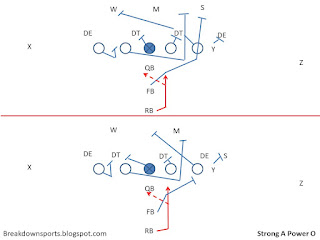
 In this post, we're going to look at A-Gap Power. A-Gap Power itself is not new. As I detailed in "History and Evolution: Power O" , what we know today as standard power was really the B/C gap constraint to the more traditionally Power Sweep. But by the late 70s and early 80s, you started to see variants of A-Gap Power schemes appear as teams wanted to protect their off tackle runs by showing a puller, but hitting inside. Teams like NDSU and Wyoming made a lot of hay off a specific type of A-gap Power, and as they've had success and their former coaches and disciples and knowledge have branched out all across football, you see this specific type of A-Gap Power arise elsewhere. This post is going to go over a few of the basics of A-Gap Power.

Inside the Playbook - Unbalanced Counter CH/OH

Image
 A quick look at Michigan running Unbalanced Counter CH/OH to the weakside of the formation.

Inside the Playbook - Michigan's Counter HF

Image
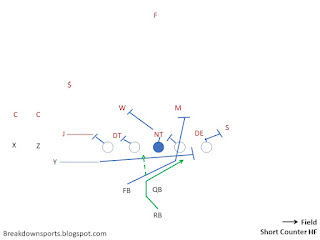
Despite heavily featuring gap run schemes throughout the year, Michigan's plan when facing the vaunted Wisconsin run defense included almost the total elimination of pulling offensive line. In an effort to maintain part of their core playbook, they leaned on a 3-back style offense and "Pull Replace" (replacing a traditional offensive line pull with a back executing the assignment) to retain part of their Counter playbook. In this post, we are going to look at how the Wolverines executed Counter HF from an unbalanced look, how the Badgers responded, and how this scheme can be sequenced off of and run against a variety of formations.

Quick Hit Film Review - Wisconsin Defending Gap Scheme Runs

Quickly, I wanted to talk about how Wisconsin is so good at defending gap run schemes. In the video below, I talk about what makes the Badgers defense so good in that regard. Have gotten some love from Wisconsin, so here’s some love back. Watch how well the whole front plays this gap scheme. Box player keeps it inside. 4T holds up to down block. NT fights back on combo. PSLB scrapes right off 4T butt into hole. BSLB ball hits all the way outside PSLB pic.twitter.com/wO4wkAniak — Space Coyote (@SpaceCoyoteBDS) June 15, 2022

Let's Speak Technique - North/South Combo Block

This post features a series of tweets discussing OL technique on a north/south (veritical) double team. PSU Watch the C. Watch his 2nd step (left foot) His eyes are on LB. He knows he needs to check him. But as he opens with his right foot, he lunges forward with his left, and now is off balance. If he moves his left foot laterally or with depth, he can stay square and redirect pic.twitter.com/1MZ901ULQK — Space Coyote (@SpaceCoyoteBDS) February 10, 2022

Let's Speak Technique - Club Block

Image
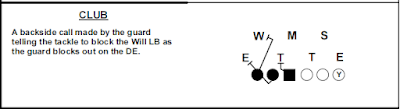
Along the offensive line, it is important to have various techniques and calls that can optimize player strengths, match ups, and angles, and give the opponent different looks. A "Club Block" is a backside combination block in which the backside end man on the LOS (EMOL) will work immediately to the second level, and the blocker inside of him will work out to the end. Club Block 2014 49ers Playbook In our case, we'll use it as an exchange block between the Back Side Guard (BSG) and Back Side Tackle (BST) as well as between a Back Side TE (BSTE) and BST, with the caveat that it is always the EMOL that is releasing directly to the 2nd level.

Inside the Playbook - Michigan State Insert Zone Play Action, Sail Concept from 2x2

Image
 An interesting twist on a fairly simple sail concept from Michigan State. Let's take a look.

Inside the Playbook - Michigan State 3x1 Counter OT vs 2-High Coverage

Image
Against Northwestern's primarily two-high defense, Michigan State found a wrinkle that was effective for their run scheme out of a 3x1 formations (three receivers to one side of the formation, one receiver to the other side). Primarily a zone team, MSU attacked the Wildcats with a mix of Zone Windback and Counter OT . Let's take a quick look at their use of Counter.

Film Review: Northwestern Sequencing Down G

Image
 Down G is a play that once featured heavily in a lot of prostyle offenses, only to go out of vogue in the modern spread era. But as teams have begun incorporating more TEs back into the formation, and have felt the need to implement more gap schemes back into the zone dominant offenses, Down G has been a play that has allowed them to get there. I've previously written about Down G , and how it acts as zone on the backside, and guard kick out on the front side. It is essentially a frontside version of pin and pull, and many will even run it that way if the Center is also uncovered and free to pull. Against Michigan State in the opening game of the season, Northwestern to get outside the Spartan defensive ends setting the edge. With a mismatch also on the interior of the OL, Northwestern started dabbling in Down G to utilize the DE's momentum upfield and out, and pin the defensive front inside. From their TE-Wing look, they were also able to sequence the play with a vertical pla...

Inside the Playbook - Minnesota Mug Green Cover 2

Image
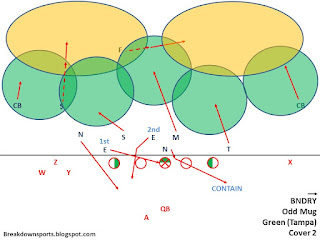
 Against Ohio State, the Golden Gophers got two critical 3rd down stops going to their Cover 2 from their 3-Down, mugged up look. Let's take a look at how it works.

Inside the Playbook - Throw Back Play Designs

Image
Previously, we looked at why throw back plays work. Next, we looked at OSU taking advantage of the throw back in their play against Minnesota This post will look at different version of the throw back that can be added to your playbook. Elsewhere - Leak Everyone has talked about leak, but at least on my blog, I've never explicitly wrote about it. So let's say this is the chance. Here is a diagram of leak: 2016 Falcons Playbook There are lots of iterations of Leak now, but I want to point out a few things that I like better than others.

Inside the Playbook - Ohio State Sequencing with Throwback

Image
I talked previously about how teams sequence the throw back into their run and boot gam e. By threatening run, boot, and throwback, you maintain a threat over the full field. In the Buckeye's opening game against Minnesota in 2021, they actually started attacking Minnesota with the throwback plays before even really delving into the boot action. Seeing how Minnesota reacted to the stretch action and boot action, Ohio State felt that they could win their matchups with their WRs in a space. Let's take a look at how OSU attacked three of the four levels in their throw back game. RB Rail, TE Delay An inversion of the standard "Leak" concept . What I like about this is that the initial alert is the RB running the rail. I've often talked about how the most forgotten person on the field is the player that just received the fake handoff. Defenses naturally eliminate that player as an eligible receiver, and as such, he often becomes the most dangerous person on the field.

Inside the Playbook: Sequencing to the Throw Back

Image
 In offensive football, we often talk about the act of "sequencing plays". What this means is that we initially build a base play. Once a defense does something unsound to stop that base play, we "sequence" a "constraint" play designed to take advantage of that unsoundness. Once the defense responds to that "constraint", we further the iteration to take advantage of that response. In this post, we are going to look at the sequence of events that leads to running throw back plays. 2014 Falcons Playbook -  Sequencing